THE Supreme Courts of the Philippines and Brunei Darussalam have signed a new partnership to strengthen judicial education and cooperation.
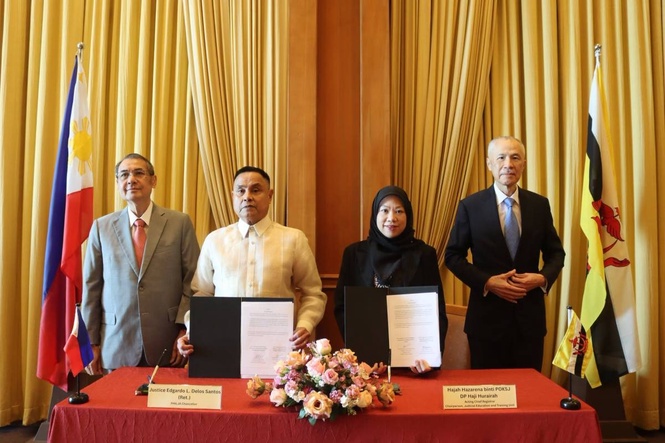
Chief Justice Alexander Gesmundo and Brunei Chief Justice Dato Seri Paduka Steven Chong signed the memorandum of understanding (MOU) during a ceremony in Brunei Darussalam on Aug. 30.
Gesmundo was joined by Philippine Judicial Academy (Philja) Chancellor and retired Associate Justice Edgardo Delos Santos, Philja Vice Chancellor Sedfrey Candelaria and Philja Academic Affairs Office Chief Emerito Enginco.
The agreement designates Philja and Brunei’s Judicial Education and Training Unit as the implementing institutions.
Under the MOU, the two judiciaries will exchange expertise, knowledge and best practices in curriculum development, teaching methodologies and evaluation systems.
They will also organize workshops, seminars, conferences, study visits, and other capacity-building activities for judges, judicial officers and court personnel.
The partnership further provides for the development and sharing of publications, research, bench books, training modules and other judicial learning materials, as well as joint initiatives on issues affecting judicial administration and adjudication.
Gesmundo said the agreement reflects the Philippine Supreme Court’s belief that the administration of justice is strengthened when judiciaries learn from one another.
He described the pact as “an affirmation of the enduring friendship between our two nations” and their shared commitment to judicial excellence, the rule of law and effective justice delivery.
Gesmundo said the fast-changing legal landscape makes continuous learning and cross-border cooperation increasingly important.
Courts, he noted, now confront disputes and criminal activities that transcend national boundaries, while technology is transforming how evidence is generated, preserved and presented.
He cited artificial intelligence, cybercrime, electronic evidence, environmental and climate concerns, and other emerging issues as areas where judicial cooperation could be particularly valuable.
Among the potential areas of collaboration are Shari’ah, trafficking in persons, cybercrime and electronic evidence, climate justice and environmental adjudication.
Gesmundo said the MOU’s deeper value goes beyond institutional cooperation since it would allow judges, judicial educators and court personnel from both countries to build stronger professional relationships and gain a better understanding of different legal traditions.
“Judicial education becomes a bridge, not merely between institutions, but between people and legal traditions, as well,” he said.
Chong described the MOU as recognition that judicial education should not be confined within individual courts but should benefit from cooperation and the exchange of experiences among judiciaries.
He also cited the Philippines’ role as co-chair of the Working Group on Judicial Education and Training under the Council of Asean Chief Justices (CACJ), saying it demonstrates Manila’s commitment to strengthening judicial education as a regional priority.
Chong said the new agreement complements existing cooperation under the CACJ framework and provides another avenue for both judiciaries to address common challenges.
Despite differences in their legal and institutional systems, Chong said the two courts have much to learn from each other.
The agreement traces its roots to discussions during the Advanced Courses on the Role of International Law in Advancing Asean Judiciaries, hosted by the Philippines last February.
The program drew more than 100 delegates from the regional bloc’s member-states, including Brunei Darussalam.