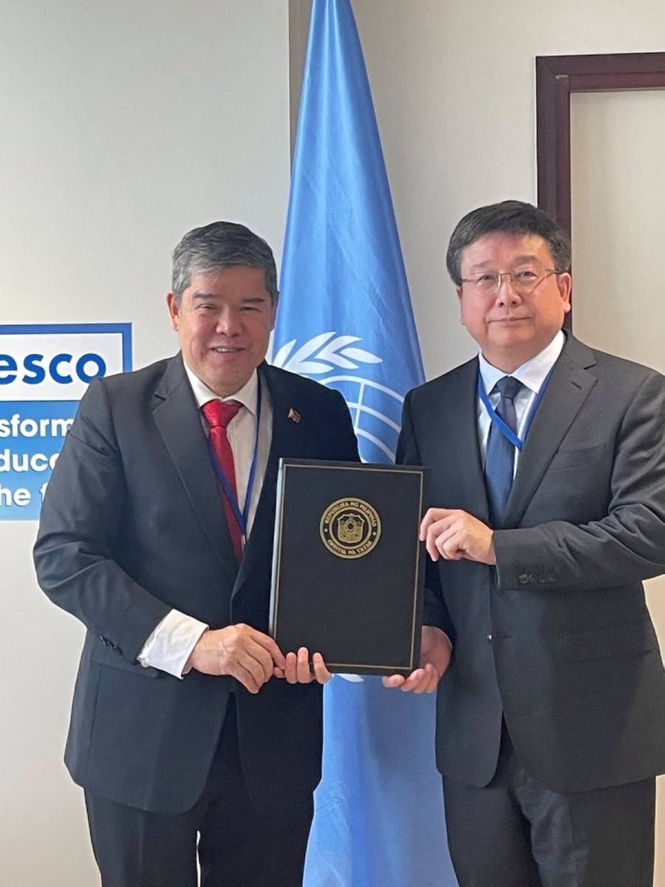
MANILA, Philippines — The Philippines has acceded to the Asia-Pacific Regional Convention on the Recognition of Qualifications in Higher Education, the first member of the Association of Southeast Asian Nations (Asean) to do so.
In a statement on Tuesday, the Commission on Higher Education (CHEd) said the Instrument of Accession was deposited on Nov. 16, 2026 at the United Nations Educational, Scientific and Cultural Organization Headquarters in Paris, France. Professor Qun Chen, Unesco assistant director general for education received the Instrument from the Philippine permanent delegate to the Unesco.
"For CHED Chairperson Shirley C. Agrupis, the Convention represents an important step toward ensuring that international mobility translates into meaningful opportunities for Filipino learners and professionals," the CHEd said.
"When people cross borders in pursuit of opportunity, their qualifications should not become barriers at the border," Agrupis said.
Nov. 26 will mark 15 years since the adoption of the convention in Tokyo, Japan.
CHEd said the convention "establishes a regional framework for the fair, transparent, and efficient recognition of higher education qualifications."
The Philippine accession "reflects the country's commitment to strengthening academic cooperation, facilitating educational mobility, and ensuring that the knowledge and qualifications earned by Filipinos are better understood and assessed beyond national borders," the CHEd said.
President Ferdinand Marcos Jr. signed the Instrument on Oct. 10, 2025.
In Sept. 7, 2026, the Senate concurred in the accession.
"For Filipino students and professionals, the Convention promotes more transparent and predictable procedures for evaluating higher education qualifications across participating countries. It can facilitate access to further studies, academic exchanges, research collaborations, and other cross-border educational opportunities, including the consideration of partial studies and diverse learning pathways, subject to applicable national requirements," the CHEd said.
"As the first ASEAN Member State to accede to the Convention, the Philippines is also positioned to contribute to regional dialogue and cooperation on qualifications recognition," the CHEd said.
"This milestone complements CHED's ACHIEVE Agenda, particularly its commitment to Inclusive and Impact-Driven Internationalization, which seeks to translate international engagement into meaningful opportunities for Filipino learners, faculty, researchers, and higher education institutions," it said.
The CHEd said that the accession was not only diplomatic milestone.
The accession, it said, represented "a commitment to expanding possibilities for Filipinos."
The accession "advances the country's aspiration for Philippine qualifications to be better understood internationally, for Filipino learners to pursue opportunities across borders, and for Filipino talent to thrive in an increasingly interconnected world," the CHEd said.