GLOBAL warming is on course to exceed 1.5 degrees Celsius above preindustrial levels, according to the United Nations Environment Program (UNEP). The threshold is not a single point beyond which climate action becomes meaningless, but crossing it would increase the risks of irreversible damage, extreme weather and ecosystem loss. For a country exposed to stronger typhoons, sea-level rise, droughts and extreme heat, the warning carries particular weight.
Against this backdrop, the Philippines has approved a new Nationally Determined Contribution (NDC) covering 2025–2035. The commitment sets a target of reducing or avoiding greenhouse gas emissions by 75 percent.
The target is divided into two components. Seven percent is unconditional, meaning the Philippines commits to pursuing it using domestic resources and policies. The remaining 68 percent is conditional on access to international finance, technology, capacity-building and other forms of support.
The distinction is important. It does not necessarily indicate limited ambition. Instead, it reflects the unequal circumstances of countries confronting the climate crisis. The Philippines contributes relatively little to historical global emissions yet remains among the countries most exposed to climate-related hazards. Its ability to achieve its pledge’s highest level will depend partly on whether wealthier, higher-emitting countries deliver the support promised under international climate agreements.
The NDC signals a broader shift in how climate action is understood. It is not limited to reducing emissions from energy, transport, industry or land use. It links mitigation with adaptation, recognizing that the Philippines must cut emissions while preparing communities for impacts that are already occurring.
This integrated approach is essential. A stronger electricity system, for example, can reduce emissions while making communities less vulnerable to power interruptions during storms. Climate-resilient agriculture can help farmers cope with heat, drought and changing rainfall while supporting food security.
The NDC places significant importance on forests, mangroves, seagrass areas and other natural ecosystems that can absorb and store carbon. Their value extends beyond accounting for emissions, protecting shorelines, supporting fisheries, and providing livelihoods for coastal and rural communities.
The possibility of the Philippines becoming a net carbon sink offers an important long-term vision. But it should not be treated as a substitute for rapid emissions reductions. Natural carbon sinks can be weakened by deforestation, fires, land-use change and climate impacts. Protecting and restoring them must be accompanied by deep cuts in fossil-fuel emissions and strong safeguards for affected communities.
In case of an overshoot
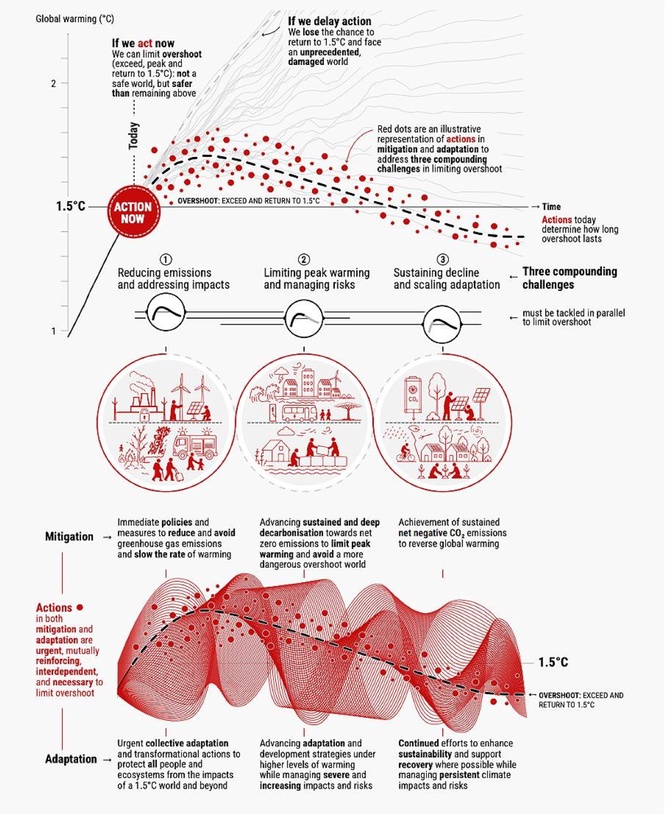
The UNEP report provides a useful framework for understanding the global situation. Even if warming temporarily exceeds 1.5 C, the objective must limit the overshoot, reach a global emissions peak and then drive temperatures downward through sustained emissions reductions and responsible carbon removal.
That possibility does not make exceeding 1.5 C harmless. A temporary overshoot could still cause severe and permanent damage. Some ecosystems may not recover, communities may be forced to relocate and livelihoods may be fundamentally altered. Returning to lower temperatures later would not automatically reverse these losses.
The Philippines’ new NDC is both a climate pledge and a test of governance. Its success will depend on implementation: whether national agencies coordinate effectively, local governments receive adequate resources, vulnerable communities participate in decision-making and social safeguards are enforced.
A whole-of-society approach will be necessary. Businesses, local governments, civil-society groups, Indigenous communities, workers, farmers and youth have roles in translating the national target into practical action. Climate policy must address questions of fairness. The transition to cleaner energy and more resilient development should not impose disproportionate costs on low-income households, workers or communities whose livelihoods depend on vulnerable ecosystems.
The NDC’s approval is a significant step, but a target alone will not reduce emissions or protect communities. Its credibility will be measured through budgets, regulations, infrastructure decisions and the protection of ecosystems on the ground.
Implementation will require the Philippines to improve how it measures progress. Emissions reductions, ecosystem restoration and adaptation outcomes must be tracked through transparent and publicly accessible data. Clear indicators can help determine whether projects are delivering real benefits or merely meeting administrative targets. Monitoring is important for the NDC’s conditional portion, since international partners will need confidence that financial and technical assistance is producing measurable results. Communities should be involved in evaluating projects that affect their land, livelihoods and resources.
The Philippines’ entry into the new decade is a turning point. The world’s crossing of 1.5 C does not eliminate the value of ambition. It makes rapid, fair and sustained action more urgent. The country’s climate pledge is a promise to protect people, ecosystems and future choices in a warming world.
The author is the founder and chief strategic advisor of the Young Environmental Forum and a nonresident fellow of Stratbase Institute. He completed a climate change and development course at the University of East Anglia (UK) and an executive program on sustainability leadership at Yale University (USA). Email him at ludwig.federigan@gmail.com.