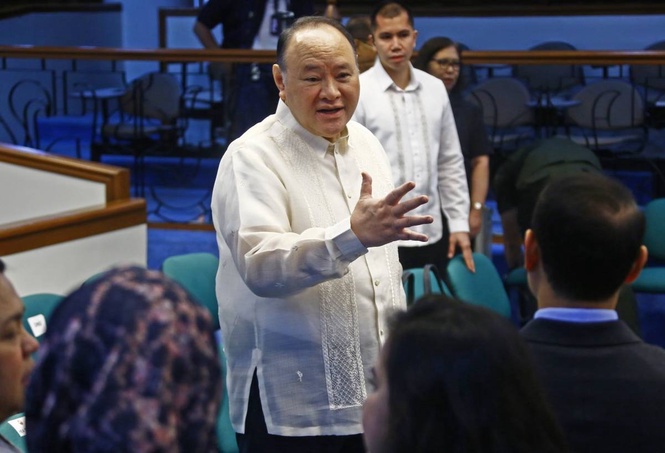
DEFENSE Secretary Gilberto Teodoro Jr.’s forceful response to China’s rejection of the 2016 South China Sea arbitral ruling should set the standard for how Philippine officials defend the country’s sovereignty and national interests, an independent think tank said Friday.
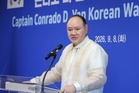
Stratbase Institute President Victor Andres Manhit said Teodoro’s decision to directly challenge China’s position at the Seoul Defense Dialogue in South Korea demonstrated the resolve expected from government officials tasked with protecting Philippine territory and sovereign rights.
“Secretary Teodoro demonstrated the steadfast resolve required to counter coercion, intimidation and attempts to erode established international norms,” Manhit said.
“He showed that defending Philippine sovereignty is not simply a matter of issuing statements. It requires public officials to stand their ground when our rights and the rules-based order are challenged,” he added.
Manhit was commenting on an incident at the Seoul forum in which a Chinese military attaché from the Chinese Embassy in Seoul had a handwritten note passed to Teodoro through a forum staff member while the Defense secretary was answering questions from the floor.
The note reiterated Beijing’s rejection of the 2016 arbitral ruling, describing it as illegal, null and void, and saying it had no binding force.
Teodoro read portions of the note aloud and challenged China’s assertions. He also criticized the manner in which the message was delivered, describing it as “actual coercion, bullying and aggression.”
Manhit said the incident should reinforce the need for a unified government position in protecting Philippine maritime claims.
“The whole government must rally behind one uncompromising mandate: defend every square inch of our national territory and protect every sovereign right of the Filipino people,” he said.
But former Philippine press attaché in Washington Adolfo Quizon Paglinawan said the Philippines could defend its legal position just as firmly without turning its disagreement with Beijing into a personal confrontation.
Paglinawan, vice president for internal affairs of the Manila-based Asian Century Philippines Institute, said Manila should remain uncompromising on its legal position while exercising greater restraint in dealing with China in international forums.
He said Teodoro could have acknowledged that the note reflected Beijing’s official position before calmly restating Manila’s position that it participated in the arbitration under the United Nations Convention on the Law of the Sea (Unclos) and considers the 2016 award legally binding.
“We disagree with you profoundly, but we are confident enough in our legal position,” Paglinawan said, describing this as a stronger diplomatic posture than responding in similarly confrontational terms.
“There’s a great divide between acting aggressive and being authoritative,” he added.
Paglinawan questioned Teodoro’s use of the phrase “China lost,” saying the Philippines’ objective should be to advance Chinese compliance with international law through sustained diplomatic engagement rather than force Beijing to publicly acknowledge defeat.
He said the Philippine position should be “firm on law, calm in language, strong in confidence, open to dialogue” while protecting Philippine interests.
Paglinawan also questioned Teodoro’s reference to the legal principle res ipsa loquitur, saying the doctrine is principally associated with evidentiary inferences in negligence cases and does not establish the validity of the Philippine position on the South China Sea arbitration.
He cautioned against allowing criticism of the Chinese government to spill over into hostility toward Chinese people or Filipino-Chinese communities.
“The Philippine government can be uncompromising about China’s conduct without allowing legitimate criticism of the People’s Republic of China to spill over into hostility toward Chinese people or Filipino-Chinese communities,” Paglinawan said.
Meanwhile, Teodoro said Friday he was not yet ready to decide whether to seek the presidency in 2028 despite growing calls for him to run.
In a radio interview, Teodoro acknowledged that calls for “Gibo for 2028” had intensified following his confrontation with China, but described them as an “offshoot” of his work as Defense secretary.
“For now, I don't think I'm ready to make that decision,” Teodoro said, adding that he still had many things to accomplish at the Department of National Defense.
Teodoro ran for president in the 2010 elections under the Lakas-Kampi-CMD party but lost to then-senator Benigno Aquino III.