
THE Philippines, along with other Southeast Asian nations, might have to evaluate its relationship with Japan’s POWERR Asia (Partnership on Wide Energy and Resources Resilience Asia) initiative, a 1.5-trillion-yen or $10-billion financial cooperation framework for the region, to stop its dependence on the stockpiling of fossil fuel oil. This was stressed during the nonprofit energy research group Ember’s webinar on Oct. 15 and a later report released on Nov. 11, as well as The Manila Times’ email interviews with analysts.
“Stockpiling has a clear short-term role, but it buys time rather than reducing the vulnerability itself,” said Noriaki Oba, energy analyst and president of the Post-oil Strategy Institute (PSI).
Protests against fossil fuel dependence continued throughout the 49th Asean Summit which started on Nov. 16 in Metro Manila, where civil society groups like the Philippine Movement for Climate Justice, Sanlakas, and the Asian People’s Movement on Debt and Development highlighted concerns over trade and investment deals, economic inequalities and continued fossil fuel developments.
Fossil Free Japan, in particular, stated its solidarity with activists arrested for “standing up against Japan’s dirty, dangerous and expensive fossil fuel deals with Association of Southeast Asian Nations (Asean) governments and corporations ... Locking the region into energy-hungry data centers and unwanted fossil fuel deals leaves Southeast Asia, already on the frontlines of the supercharged climate impacts, at the mercy of foreign interests.”
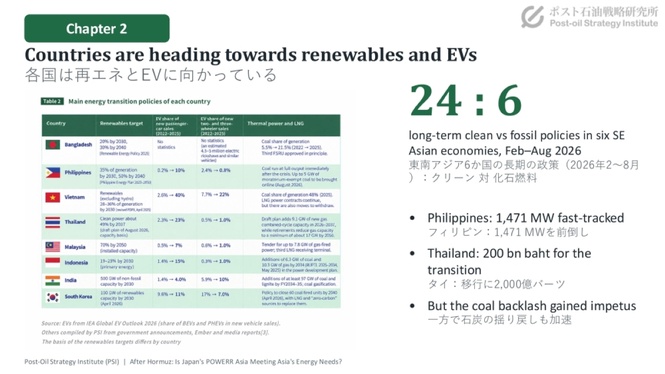
Before the summit, Oba presented a study showing how POWERR Asia “prioritizes fossil fuel security, oil stockpiling and cooperation with the Middle East.” He observed a “misalignment” between POWERR Asia and the energy transition needs of Asean countries as they shift toward electrification and renewable energy.
Oba’s study from February to August 2026 noted that six Southeast Asian countries, including the Philippines, drew up 24 long-term renewable and electric vehicle (EV)-related policies, outnumbering six fossil fuel policies set during the period. Out of 329 projects under the Asia Zero Emission Community, a cooperative platform launched by Japan in 2023 to promote decarbonization and clean energy, Oba found only 2 percent are in EVs; 2-5 percent in grids and storage, with 13-20 percent extending the life of thermal power plants.
Misalignment
While Asean countries are clearly on the road toward renewables, POWERR Asia “keeps imported fuel flowing,” Oba said. He added that the Philippines, one of the countries hit hardest by the energy crisis, is “one of the most active partners in the POWERR Asia framework” as it seeks to reduce its reliance on imported fuel. However, “what exists for the Philippines so far is cooperation on stockpiling rather than financing,” he noted.
In May this year, Japan and the Philippines issued a statement to advance cooperation on a strategic petroleum reserve program and Asean-wide joint stockpiling under POWERR Asia. Oba said that no figure has been disclosed for POWERR Asia financing allocated or disbursed to the Philippines, while other countries such as Bangladesh, India and Cambodia have signed loans under the initiative. Instead, multilateral development banks “did the heavy lifting” by providing financing for projects aimed at reducing fossil fuel dependence and expanding renewable energy, he said.
However, stockpiling and cooperation with the Middle East remain necessary to manage the immediate supply risks, according to Ember energy analyst Alnie Demoral. “The Philippines’ strong push for oil stockpiling during the recent Asean Ministers on Energy Meeting reflects its vulnerability to disruptions in the Strait of Hormuz.”
To address this need, Demoral said the government has proposed the Strategic Petroleum Reserve, amendments to the Oil Deregulation Law, and cooperation with Japan on storage infrastructure and regional stockpiling. Its target is to build a 60-day government reserve, alongside 30 days of mandatory industry stocks. “The challenge is not just building storage capacity, but also securing and financing the oil needed to fill it.”
But Japan’s role could go beyond short-term fossil fuel security, Demoral said. “It can also help the Philippines mobilize the financing, technology and expertise needed to accelerate renewable energy development, strengthen grid infrastructure and energy storage, and reduce long-term dependence on imported fossil fuels.”
More specifically, Oba identified actions Japan can undertake to help the Philippines accelerate its energy transition: Put grids, storage and system operation at the center of POWERR Asia’s “structural response”; electrify transport together with renewable power; and direct finance toward removing conditions that necessitate new thermal plants rather than to technologies that prolong the life of existing ones.
Like the Philippines, Oba said Japan is an oil importer with the same vulnerabilities. Japan’s support measures for energy transition in Asia must be further strengthened, Oba urged. “We need to work together to find the way out of fossil fuel dependence.” He said joining Asia’s electrification efforts “could open new business opportunities for Japan while strengthening its own energy security and its industrial competitiveness.”