
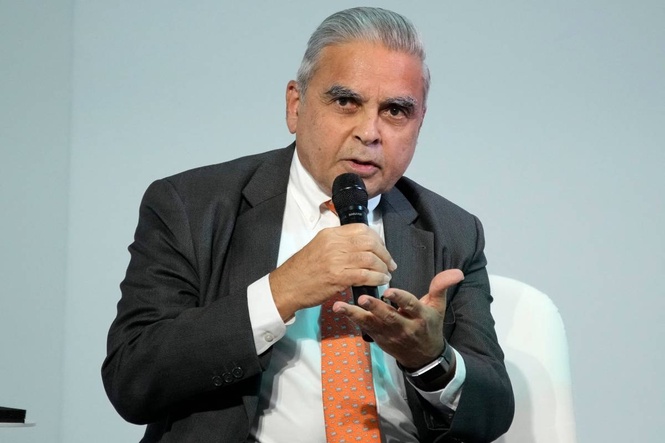
MANILA, Philippines — The Philippines must avoid becoming a proxy battlefield in the continuing rivalry between the United States and China and build enough strategic autonomy to protect its interests, according to a former Singaporean diplomat and academic.
Kishore Mahbubani, who served twice as Singapore’s ambassador to the United Nations and was president of the UN Security Council in 2001 and 2002, issued the warning during a recent lecture on the China-US rivalry at the Ateneo de Manila University.
“The most obvious and most disturbing possibility is the Philippines becoming a proxy arena,” Mahbubani said, warning that countries located along geopolitical fault lines could bear enormous human and economic costs while major powers remain largely insulated from the consequences.
He described the US-China rivalry as the defining geopolitical contest confronting Southeast Asia and cautioned countries in the region against assuming that temporary periods of calm meant the competition had disappeared.
For the Philippines, the challenge is particularly difficult because of its security relationship with the United States and its extensive economic relationship with China. Mahbubani said many Asian countries maintain security or political ties with Washington while simultaneously depending heavily on economic relations with Beijing. Southeast Asian states generally prefer maintaining productive relations with both powers rather than being forced into a binary choice, he said.
He also cautioned the Philippines against simply “piggybacking” on a stronger power, raising the question of whether relying on a major power for security could leave the country vulnerable to the consequences of great-power competition.
Mahbubani stressed that strategic autonomy does not necessarily mean neutrality. Rather, it requires a country to manage several relationships simultaneously while retaining enough room to make independent decisions. He also argued that international law remains important but cannot by itself overcome power politics. Major powers have historically applied international law selectively, Mahbubani said.
For smaller countries, legal victories need to be complemented by diplomacy, deterrence, economic resilience and strategic judgment. He cited Russia’s invasion of Ukraine as a warning about great-power competition and proxy dynamics. While describing the invasion as illegal, Mahbubani also raised the separate strategic question of whether the escalation toward war could have been prevented.
The broader lesson, he said, was that smaller countries need to understand how major powers use partnerships, military assistance and regional conflicts to pursue their strategic objectives. He pointed to the Association of Southeast Asian Nations (Asean) as a possible model for the Philippines. Mahbubani said Asean has maintained dialogue and regional diplomacy among countries with widely different political systems and strategic relationships while keeping competing major powers engaged. This ability to maintain relationships with rival powers is one of the region’s strategic strengths, he said.
The approach could also apply to South China Sea disputes, particularly in areas where countries share practical interests despite unresolved sovereignty issues. Fisheries, for example, could provide an avenue for cooperation on sustainability, scientific research, information sharing, livelihood protection and conflict prevention rather than treating disputes solely as questions of sovereignty, enforcement or maritime power.
The Philippines, he said, faces an asymmetry of power at sea, while its alliances, defense arrangements, economic relationships and even academic and educational exchanges are increasingly being viewed through the lens of the US-China rivalry.
“The alternative to choosing sides is not weakness or surrender,” he said, but the harder task of building the capacity to make independent choices. For the Philippines, Mahbubani said, Asean’s experience of keeping competing powers engaged while preserving regional diplomatic space could offer a model as the country navigates an increasingly intense US-China rivalry.