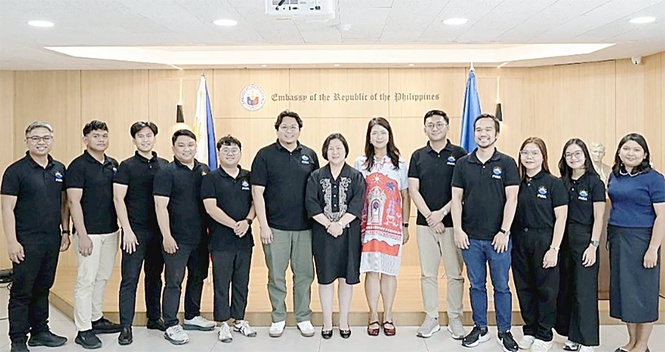
TEN Philippine Space Agency engineers are in South Korea for advanced training as the Philippines prepares for its first planned liquid-fueled sounding rocket demonstration in Cagayan in 2027.
The training is part of PhilSA’s SIKLAB: Building Industrial Space Launch Systems Project and focuses on the Blue Whale-class sounding rocket platform developed by South Korean company Perigee Aerospace.
Reina Reyes, PhilSA Space Mission Director, said the program is intended to give Filipino engineers practical expertise that can be applied to future rocket development and launch activities in the Philippines.
“The training is intended to develop personnel who can support rocket development and launch operations in the country,” Reyes said. “Apart from the training, PhilSA engineers are expected to share the knowledge gained with researchers and academic institutions.”
The current training is the second phase of the program. The engineers completed their first phase in South Korea from October to November 2025, covering rocket theory, launch-vehicle systems and hands-on assembly of rocket subsystems.
Reyes also said that the PhilSA, the Department of Information and Communications Technology, (DICT) the Cagayan Economic Zone Authority (CEZA), Ascend International Gateway and Perigee Aerospace signed a memorandum of understanding in March covering rocket-development training and experimental launches in the Philippines.
The program is building toward a 2027 demonstration in Cagayan involving a liquid-fueled sounding rocket carrying a locally developed payload of up to 2 kilograms to an altitude of at least 5 kilometers.
The flight will be suborbital rather than an attempt to place a spacecraft in orbit. Its immediate purpose is to give Philippine personnel experience with the practical demands of assembling, testing and operating a liquid-fueled launch vehicle.
“This is not the first rocket launch though,” Reyes said. “There has been several in the past especially by student and universities but the Cagayan launch will be the first one using liquid propellant not solid fuel.”
The country has developed capabilities in satellites, remote sensing and space science, but has yet to establish a domestic rocket-launch capability. The Cagayan flight will provide an early test of the Philippines’ ability to carry out the engineering and operational work required to conduct rocket launches from its own territory.
For PhilSA, the longer-term objective is to develop the technical workforce and industrial experience needed to support a domestic space sector, including future launch infrastructure and more capable launch systems.
Under the agreement, knowledge gained through the program is also expected to reach Philippine researchers and academic institutions, helping build expertise beyond PhilSA itself.