LIFE on Earth may offer lessons for surviving in outer space, but Filipina space biologist and biomedical scientist Florence Pauline “Pauli” Basubas is also exploring how research beyond Earth could improve life on the planet.
At 28, Basubas investigates how organisms respond to conditions different from those on Earth, including changes in gravity, radiation, atmosphere and nutrient availability.
Growing up surrounded by nature in Cebu and Mindanao nurtured her curiosity about living organisms. She pursued biology and later worked as a biomedical scientist involved in drug discovery research.
Space research was not part of her original career plan.
“Then when I encountered an opportunity to work in a space biology laboratory, I thought, ‘Oh, it's so interesting,’” Basubas recalled. “Why don't I try it out? And I did.”
One of her most memorable experiences was participating in a parabolic flight, in which an aircraft follows a steep upward and downward arc to create brief periods of microgravity, or near-weightlessness.
The experience allowed her to conduct experiments under conditions that help researchers understand how living cells, tissues and biological systems respond to environments unlike those on Earth.
“I think it is still kind of the number one experience in my life. But it's also really quite remarkable because it is not easy, actually,” she said. “Being in microgravity where our bodies are not used to it, where we don't know the orientation, and then you have to do an experiment, it is quite an experience.”
Beyond space exploration, her research could contribute to advances in terrestrial life science, including a better understanding of how DNA breaks and repairs itself and how genes and cells can be engineered for specific applications.
“We will be able to better engineer organisms that we can even utilize for applications in daily life here on Earth,” she said.
Basubas has worked with international and national organizations to expand access to analog space missions and microgravity research, particularly for developing countries such as the Philippines.
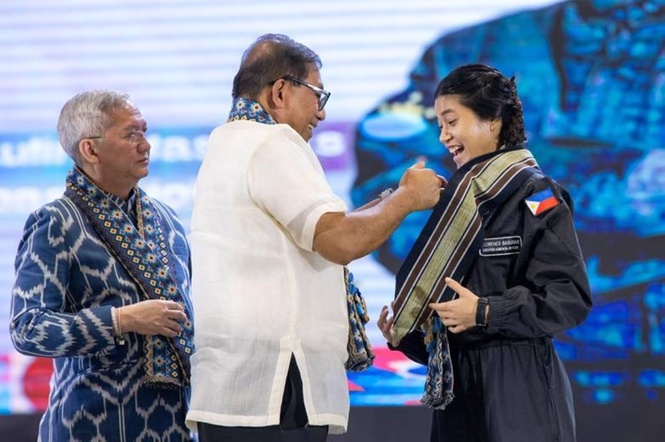
She also advocates gender equality and stronger institutional support for science, technology, engineering and mathematics. Her work earned her recognition as one of the science ambassadors of the Department of Science and Technology-Davao Region during its Regional Science, Technology and Innovation Week in Davao City.
Basubas encourages young Filipinos interested in the field to recognize their existing skills and pursue opportunities, even in areas of science that may seem beyond their reach.
“As Filipinos, we have a lot of skills, and I think we should just try because we don't have anything to lose. And if we give them a chance to give us a chance, who knows where the opportunities might take us,” she said.
Her experience has reinforced her belief that scientific research should address practical challenges, particularly in a country with pressing development needs.
“There are a lot of challenges and issues in the Philippines that we can address and help contribute to with science and technology. So, it really pushed me to be meaningful and purposeful in this endeavor,” Pauli said. - Karl Jerome A. del Mundo, DOST-STII