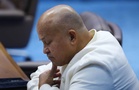
THE Philippine National Police (PNP) reiterated their unwavering vow to implement the arrest warrant against Sen. Ronald dela Rosa regardless of his ties with the law enforcement agency he once led and served almost all his life.
“Our chief PNP made it abundantly clear that we will not allow any hindrance, regardless of the person’s position or previous public position, we will do our duty, we will implement the warrant of arrest,” Col. Allen Rae Co, PNP spokesman, said in a press briefing.
The PNP’s answer came following the challenge issued by Palace Press Secretary Claire Castro to PNP chief Jose Melencio Nartatez Jr. to pursue the arrest of dela Rosa despite his historical connections.
Dela Rosa is wanted by the International Criminal Court (ICC) for crimes against humanity for his role in the bloody war on drugs, when he was then-president Rodrigo Duterte’s PNP chief.
Castro made the challenge following Local Government Secretary Jonvic Remulla’s pronouncement that dela Rosa’s connection as former PNP chief and a graduate of the Philippine Military Academy are making his arrest more difficult.
“We understand that this is not a matter of personal discretion or political consideration. The PNP does not play politics. We remain true to our oath of fulfilling our duty within the law,” Co said.
Remulla repeatedly said that dela Rosa is being coddled by a powerful armed group whom the government would rather negotiate with than risk 10,000 just for the arrest of one man.
While not divulging the results of the negotiations, the government has issued a P50-million bounty for information leading to the arrest of dela Rosa, tagged him as “armed and dangerous,” and gave him a week to surrender.
The week has passed with no surrender or feelers from the fugitive senator. His camp, through his lawyer, even renewed their petition before the Supreme Court to block the ICC arrest citing recent developments such as the bounty and the armed and dangerous tag as dangers to his life.
Sen. Panfilo Lacson, a former PNP chief himself, said the PNP and the Department of the Interior and Local Government should refrain from divulging information on manhunts.
The PNP expressed agreement with Lacson’s statement and maintained that indeed, they are keeping the integrity of operational details.
Lacson on Wednesday said that Philippine courts must be respected and local legal procedures observed if dela Rosa is arrested.
Lacson said dela Rosa should be placed under the custody of a Philippine court, even in a ministerial capacity, if authorities apprehend him so he can avail himself of all legal remedies available under Philippine law, including recourse to the Supreme Court.
“That’s part of due process — if he is arrested, he may be placed under the custody of a local court where he can avail of all legal remedies up to the Supreme Court. The Supreme Court will be the final arbiter of the law,” Lacson said in an interview on radio DZMM.
He cited Section 17 of Republic Act 9851, or the Philippine Act on Crimes Against International Humanitarian Law, Genocide and Other Crimes Against Humanity, which establishes the country’s jurisdiction over persons suspected or accused of crimes covered by the law under specified circumstances.
These include cases in which the accused is a Filipino citizen, is present in the Philippines regardless of citizenship or residence, or has committed the alleged crime against a Filipino citizen.
However, the law also allows Philippine authorities, in the interest of justice, to defer investigation or prosecution when another court or international tribunal is already investigating or prosecuting the same crime. Authorities may instead surrender or extradite the accused to the appropriate international court or another state, subject to applicable laws and treaties.
Lacson also cited Article 17 of the Rome Statute of the ICC, which provides that a case may be deemed inadmissible before the ICC if it is being investigated or prosecuted by a state with jurisdiction over it, unless that state is unwilling or unable genuinely to carry out the proceedings.
The same provision covers cases in which a state has investigated an alleged crime but decided not to prosecute, unless the decision resulted from its unwillingness or inability to genuinely pursue the case.