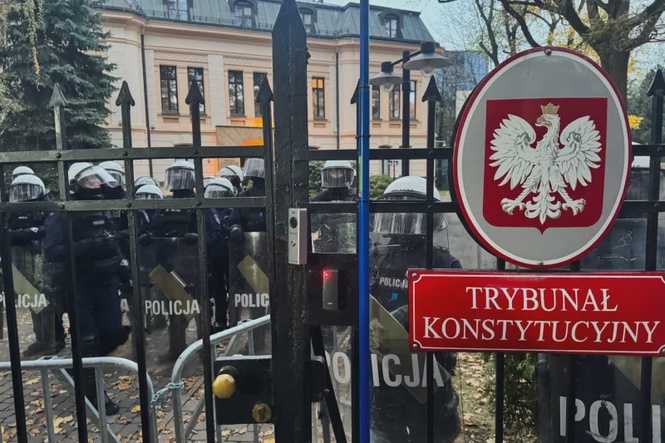
The president of Poland's Constitutional Tribunal was suspended on the evening of October 30 by a judge who was elected by parliament but never sworn in by the country's president. President Karol Nawrocki, an ally of the right wing opposition Law and Justice party, cut short a trip to Senegal and pushed his way into the court building late at night. Prime Minister Donald Tusk insists his government is restoring the rule of law, while the opposition calls it a "coup." Protesters have gathered outside the court for two nights.
Who Suspended The Court's President?
The Constitutional Tribunal's website announced at around 6 p.m. Warsaw time on October 30 that its president, Bogdan Święczkowski, had been suspended. The site then went down, and the Associated Press said it could not verify the official reason given. Reuters reported that the suspension was ordered by the court's most senior judge, Anna Korwin-Piotrowska, who took over the tribunal.
According to The Guardian, Korwin-Piotrowska is one of five judges whom Nawrocki has refused to accept. She assumed the role of court president on the grounds that she is the longest serving judge, and also suspended Vice President Bartłomiej Sochański. Deutsche Welle reported that both suspensions are for one month.
The two sides give very different accounts of why. The AP cited the government as saying Święczkowski had repeatedly broken the law and endangered the court's functioning. He was appointed under the previous Law and Justice (PiS) government, and Tusk accuses him of blocking judges chosen by the parliamentary majority from taking office. The Guardian reported that Justice Minister Waldemar Żurek has asked for the immunity of the court's president and vice president to be lifted so they can be prosecuted for obstructing the court's work.
The court has rejected all of this. Deutsche Welle reported that the tribunal posted on X denying the suspension notice on its website, insisting that Święczkowski remains in office and that Korwin-Piotrowska, never sworn in by the president, has no authority to act. The Guardian said opposition leaders and the court's social media accounts accused the government of staging a "coup."
Why The President Turned His Plane Around
Nawrocki was flying to Senegal for a state visit on October 30 when he ordered his plane to turn back. "At a time like this, the president must remain in Poland. I am interrupting my flight to Senegal and returning," he wrote on X.
According to The Guardian, Nawrocki arrived at the court shortly before 1 a.m. on October 31 and walked through the police cordon. Video showed him jostling with guards and other judges as he forced his way into the building, where he was still present at 4 a.m. Deutsche Welle reported that in another video he could be heard telling Korwin-Piotrowska and others, "You are not Constitutional Tribunal judges at all!" The AP said the president claimed he had helped the suspended court president get into the building.
Maciej Berek, a judge nominated by Tusk's government who joined the court only in September, posted a video on X accusing Nawrocki of physically assaulting Korwin-Piotrowska, Deutsche Welle reported.
Early on October 31, an aide read a statement from the president outside the court. "Tonight, there was a breach of public order in the Republic of Poland and a forcible takeover of a constitutional body," it said, according to Reuters. The Guardian said he also demanded that security forces withdraw from the court.
Reports differ on the size of the protests outside the court. The AP said dozens gathered on the evening of October 30, while Reuters and The Guardian put the number in the hundreds, including opposition lawmakers, according to The Guardian. Police said some protesters broke through the court's fence and threw objects at officers, and three people were detained. The AP reported that PiS leader Jarosław Kaczyński and far right politicians joined the protests, and that hundreds gathered again on the night of October 31.
Former Justice Minister Zbigniew Ziobro wrote on X: "This is a blatant, criminal attack on the constitutional order. That is why I call for loud, firm, united and fearless resistance."
Two Polish ambassadors have resigned over the crisis, Deutsche Welle reported. Paweł Soloch, ambassador to Romania, cited an attempt to illegally take over the Constitutional Tribunal, and Jakub Kumoch, ambassador to China, said he could not continue in his post. Both had served as aides to former President Andrzej Duda.
A Coup Or A Restoration Of The Rule Of Law?
"Restoring the rule of law is our duty," Tusk wrote on X on the evening of October 30. "After years of PiS lawlessness, this process is difficult, at times even painful, and requires decisive action. There is no other way."
In a prime time televised address on the evening of October 31, Tusk said "there can be no compromise on certain things" and that "there was never any doubt that the court in the form PiS imposed is not a real court," The Guardian reported. He compared the opposition's anger to a thief who snatches an elderly woman's handbag and then cries that he is the victim of violence when caught. He also criticized Nawrocki: "In a democracy, no politician can walk into a court to give orders or intimidate judges, not even the president." Tusk noted that former Russian President Dmitry Medvedev had joined the opposition chorus in accusing Warsaw of a "constitutional coup."
"I am certain that the Constitutional Tribunal will function as it should. Also, independently of me and in line with the constitution," Tusk added, according to Reuters, as reported by The Jerusalem Post.
Foreign Minister Radosław Sikorski admitted the scenes outside the court were "not very dignified," but insisted, according to The Guardian: "The alternative is to accept Poland being unconstitutionally turned into a presidential republic."
The president's camp says it is the government that is breaking the law. "Since last night, we have been facing a major constitutional crisis in Poland, caused by an attempt at an illegal, forcible takeover of a key institution," senior presidential adviser Marcin Przydacz told the AP. Another senior aide, Zbigniew Bogucki, responded to Tusk's speech by calling him "a pathological liar who is setting Poland on fire," The Guardian reported.
Polish legal experts are also divided over whether the suspension is lawful. According to The Guardian, the Helsinki Foundation for Human Rights in Poland said on October 31 that the legal basis for the temporary suspension was "questionable" and "does not help" rebuild the court. Legal scholar Marcin Matczak, a longtime critic of PiS, said he never expected to defend Święczkowski, but that the legal basis for his suspension "simply does not exist."
Why The Court Has Been Paralyzed For A Decade
Reuters noted that the dispute dates back to 2015, when PiS sought to appoint judges to seats already filled by the previous government. Its nominees went on to form a majority on the court, and critics at home and abroad say it no longer meets the standard of an independent and impartial tribunal established by law. The Guardian pointed out that in 2015 both the outgoing centrist government and the incoming right wing government used legally questionable methods to install their own appointees. The AP reported that the European Union's top court, the Court of Justice of the EU, has said the tribunal is no longer an impartial court after the PiS appointments, and related judicial reforms led the EU to fine Poland.
After Tusk returned to power in 2023, he promised to restore judicial independence, but the AP noted that his government's efforts have been vetoed by two successive presidents allied with PiS. Reports differ on how many judges remain unsworn in 2026: Reuters said Nawrocki refused to swear in three of the six judges elected by parliament, while The Guardian and Deutsche Welle put the number at five. Święczkowski has also refused to let judges chosen by the current parliamentary majority take their seats.
According to The Guardian, the Council of Europe's Venice Commission, its advisory body on the rule of law, said earlier in October that a president's refusal to swear in judges should not prevent them from taking office. The European Commission on October 31 urged Nawrocki to accept the new judges nominated by parliament so the court can operate in line with the constitution and EU law. Deutsche Welle reported that the European Court of Human Rights ruled in May that these judges should be allowed to take up their duties. Reuters also noted that parliament appointed Tusk's ally Berek as a judge in September, which critics say contradicts the government's pledge to restore checks and balances.
What Happens Next
Nawrocki invited parliamentary parties to consultations on October 31 to try to defuse the crisis. The AP reported that representatives of coalition members Poland 2050 and the Polish People's Party, along with several opposition parties, met the president, but Tusk did not attend. The Guardian said the talks produced no obvious breakthrough. Przydacz told the AP that the president's camp hopes the crisis will weaken Tusk's parliamentary majority. "Everything depends on the parties that have supported Tusk so far," he said.
Washington has also weighed in. US Ambassador to Poland Tom Rose wrote on X: "The last thing Poland needs is a confrontation that spirals into something far worse," Al Jazeera reported.
Korwin-Piotrowska, as the most senior judge, has called a meeting of all Constitutional Tribunal judges for November 3, Deutsche Welle reported. Święczkowski has said the judges he recognizes will boycott it, Euro Weekly News reported.
The AP noted that the dispute comes a year before Poland's next parliamentary elections and could deepen political polarization, while The Guardian cited polls showing Tusk's broad coalition running neck and neck with the nationalist right.