
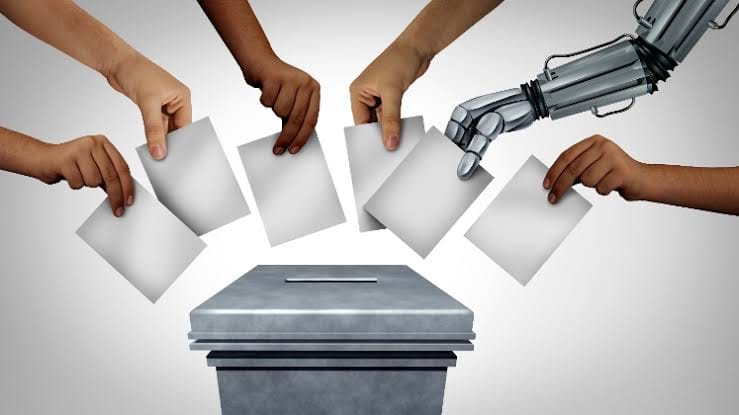
Imagine a politician seeking public feedback on a policy. Traditionally, this involved focus groups—a process as slow as molasses and as costly as a diamond ring, often delaying decisions by weeks.
Today, AI-driven “voters” can deliver responses in minutes. In the United Kingdom, companies like Electric Twin, Artificial Societies, GWI, and Toluna are cashing in by using real research data to craft AI personas that evaluate political messaging.
Providers such as Synthetic Respondents charge around USD16 (approximately RM 75) per project—a fraction of the cost of traditional focus groups.
Kanishka Narayan, the UK’s AI Minister, is among the pioneers of this technology. He remarked that his first move upon taking office was to test an AI focus group, noting that Members of Parliament can now gauge public sentiment more affordably than ever before.
As with any newfangled idea, there are pros and cons. Jason Mander from GWI pointed out that it’s unlikely to replace real human interactions because humans are as unpredictable as the weather, complex, ever-changing, and full of contradictions.
Ben Warner of Electric Twin said, “This agentic AI is very useful, particularly for getting instant responses.” The Finance Minister could easily find out whether people are tickled pink or not with the government’s plan.
A study by the Pew Research Center highlighted the darker side of this technology. They discovered a 12 percent difference between AI and human responses. AI often gets flummoxed by new issues and tends to repeat the same answer.
AI “voters” struggle to accurately reflect minority viewpoints or emerging issues. Concerns are growing that Members of Parliament might reduce their engagement with human constituents due to the convenience of AI interactions—especially since these systems don’t express dissatisfaction or frustration.
There was one amusing and embarrassing incident. Earlier this year, Axios had to correct an article that reported an AI’s perspective. Another viral outlook involving the Los Angeles mayor turned out to be just a social experiment.
Despite the many drawbacks, many believe this technology can help the government make better decisions. Sometimes a good policy goes down the drain because it wasn’t properly tested.
But remember, to predict what people think isn’t the same as understanding why they think that way.
In any case, technology will truly change the way a politician does their job. So, if you’re a politician, would you rather ‘meet’ AI before making any decision?
Because at the end of the day, it’s humans who cast the votes, not the AI.
Amir Al Fateh (malaydigest@gmail.com) is a content creator under the Newswav Creator programme, where you get to express yourself, be a citizen journalist, and at the same time monetize your content & reach millions of users on Newswav. Log in to creator.newswav.com and become a Newswav Creator now!
The User Content (as defined on Newswav Terms of Use) above including the views expressed and media (pictures, videos, citations etc) were submitted & posted by the author. Newswav is solely an aggregation platform that hosts the User Content. If you have any questions about the content, copyright or other issues of the work, please contact creator@newswav.com.