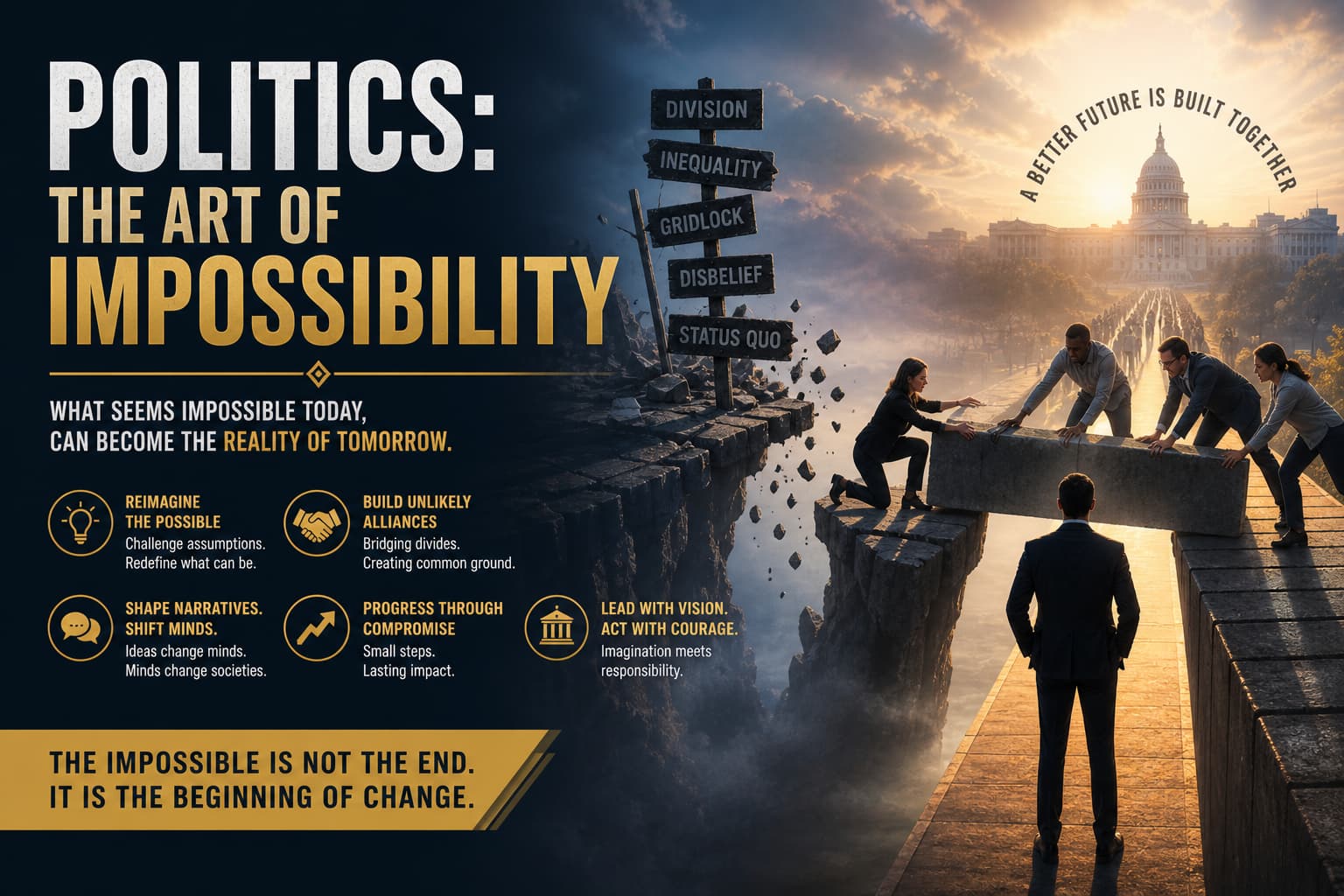
Politics is often described as the art of the possible, the patient negotiation of interests within the limits of reality. Yet, history suggests a more demanding truth: politics is also the art of impossibility. It is the discipline of taking what seems unworkable, unacceptable, or unthinkable and, through imagination and persistence, turning it into a lived reality.
At its core, politics operates in a landscape of constraints, conflicting values, scarce resources, entrenched interests, and imperfect information. In such a setting, many goals initially appear impossible. Ending a long-standing conflict, dismantling systemic inequality, or achieving consensus across deeply divided societies can seem beyond reach. However, it is precisely within these constraints that political leadership is tested. The ability to reframe problems, build unlikely coalitions, and shift public perception transforms the boundaries of what is considered possible.
The “impossible” in politics is rarely a fixed barrier. It is often a reflection of current assumptions. When assumptions change, so too does the realm of possibility. Consider how social norms evolve: positions once dismissed as radical can, over time, become mainstream. This transformation does not occur spontaneously; it is driven by sustained advocacy, strategic communication, and incremental victories that gradually reshape public opinion. Politics, in this sense, is not just reactive, it is creative. It constructs new realities by altering the narratives through which societies understand themselves.
Compromise, frequently misunderstood as weakness, is another essential tool in navigating impossibility. Political actors rarely achieve their objectives in pure form. Instead, they must reconcile competing demands, accepting partial gains while keeping long-term goals in view. This process can be frustrating, even disillusioning, but it is often the only path forward in pluralistic societies. The art lies in distinguishing between principled compromise, which advances progress, and concessions that undermine core values.
Crisis moments further reveal politics as the art of impossibility. During periods of upheaval, economic collapse, public health emergencies, or social unrest, governments are forced to act beyond conventional limits. Policies once deemed unfeasible may be implemented rapidly out of necessity. These moments demonstrate that what was previously labeled “impossible” was often a matter of political will rather than practical feasibility.
However, the pursuit of the impossible carries risks. Ambition without grounding can lead to overreach, eroding trust when promises cannot be fulfilled. Effective political leadership requires a balance between vision and pragmatism, an ability to inspire belief in change while remaining attentive to real-world constraints. It is not about ignoring reality, but about stretching it responsibly.
Ultimately, to say that politics is the art of impossibility is to recognize its transformative potential. It is a field where imagination meets negotiation, where persistence challenges inertia, and where the limits of today are continually tested by the aspirations of tomorrow. The impossible, in politics, is not a destination but a starting point, a challenge that invites innovation, courage, and the collective effort of society to redefine what can be achieved.
Laguvendran Sandran (laguvendran96@gmail.com) is a content creator under the Newswav Creator programme, where you get to express yourself, be a citizen journalist, and at the same time monetize your content & reach millions of users on Newswav. Log in to creator.newswav.com and become a Newswav Creator now!
The User Content (as defined on Newswav Terms of Use) above including the views expressed and media (pictures, videos, citations etc) were submitted & posted by the author. Newswav is solely an aggregation platform that hosts the User Content. If you have any questions about the content, copyright or other issues of the work, please contact creator@newswav.com.