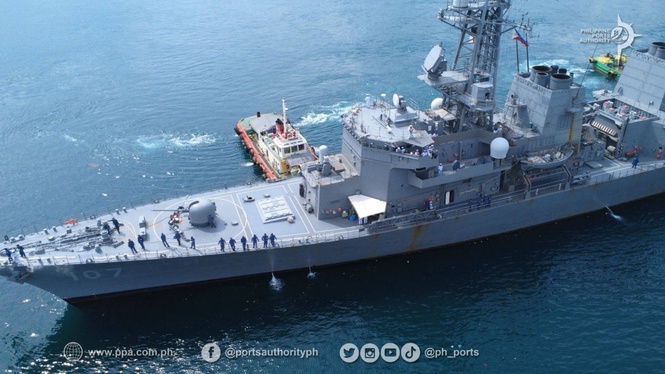
THE Philippine Ports Authority (PPA) now allows Philippine Navy vessels to utilize idle berths while protecting commercial shipping schedules from operational delays.
PPA has issued Operational Memorandum Order (OMO) 006-2026 to regulate how Philippine Navy vessels are accommodated at government-managed ports.
On May 19, 2026, PPA Assistant General Manager Mark Jon Palomar signed the directive, which requires local port authorities to extend berthing courtesies to naval ships without disrupting the schedules of commercial cargo and passenger vessels.
The policy instructs Port Management Offices (PMOs) to utilize idle or unoccupied berths for naval assets. This formalizes a protocol for government maritime operations, allowing military vessels to dock during routine deployments when space is available.
However, the PPA explicitly states that accommodating Navy ships must not compromise pre-arranged commercial berthing windows. In times of port congestion, commercial vessels with fixed schedules and high turnaround efficiency retain their priority to prevent delays in supply chain logistics.
To manage high-traffic situations, the memorandum introduces a specific movement protocol. If a port becomes crowded and a berth must be cleared, Philippine Navy vessels will be the last to be moved. Port managers must exhaust all other practical adjustments with alternative vessels before relocating a naval ship.
The policy includes an override mechanism for urgent national matters. PMOs retain the authority to grant immediate accommodation to Navy vessels involved in emergencies, humanitarian missions, or national security operations. In these instances, port managers must report the override to the Office of the Assistant General Manager for Operations within 24 hours.
Implementation relies on logistical coordination between civilian port operators and naval commanders. PMOs must maintain communication with the Philippine Navy, providing advance notice of port traffic, and aligning estimated arrival and departure times to maintain orderly port operations.