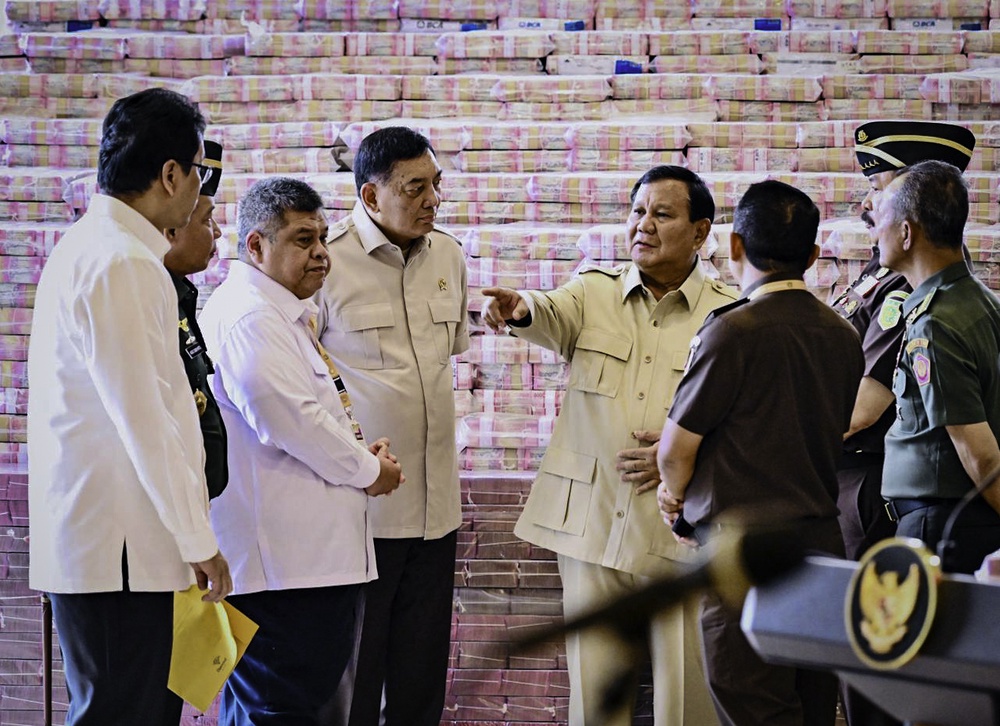
When his steps stomped in the magnificent hall of the Attorney General's Office of the Republic of Indonesia in Jakarta, the public's eyes fell on the wooden pillars of the podium that held piles of money not just a piece of Rp 50 thousand, but tens of trillions of rupiah that had returned to the hands of the state. It is there that President Prabowo Subianto stands, not as a figure who usually appears in campaigns or state speeches, but as a symbolic witness to the return of state losses worth Rp 13,255,244,538,149.00 from the corruption case of CPO exports and its derivatives. (Cabinet Secretariat)
Such moments echoed photos scattered, the public stunned: how it seemed that massive corruption was paid back, how a country burdened with sustainable development could see its money "taken away". There was relief, there was confusion: Was this a victory for law enforcement, or was it just a moment of imagery? During the frenzy, his story is worthy of being a mirror not just about numbers, but about justice, integrity, and the social consequences that surround it.
This case originated from the crude palm oil (CPO) export sector and its derivatives, an industry that for many years has been an economic motor as well as a spotlight on the potential abuse of export permits and fiscal facilities. (https://story.kejaksaan.go.id)
In the official report, it was stated that the country's economic losses in this case reached around Rp 17,708,848,926,661.00 or more than Rp 17.7 trillion. Meanwhile, what was successfully returned until the time of submission was Rp 13.255 trillion, which was symbolically handed over by Attorney General ST Burhanuddin to Finance Minister Purbaya Yudhi Sadewa, with President Prabowo witnessing. (https://story.kejaksaan.go.id)
The three corporations referred to as returnees are:
- Wilmar Group – around IDR 11.88 trillion (https://story.kejaksaan.go.id)
- Musim Mas Group – around IDR 1.18 trillion (detikfinance)
- Permata Hijau Group – around IDR 186.43 billion (detikfinance)
This means that there is still a difference of around Rp 4.4 trillion that has not been realized, according to the Prosecutor's Office. (Cabinet Secretariat)
Photos that were spread showed President Prabowo standing in front of a pile of neatly framed money in the Prosecutor's Office Hall. Media such as Detik wrote with the title "When Prabowo Stands in Front of the 'Mountain' of State Compensation Money". After all, this is not just theater: there is a strong moral and symbolic impact. That when the money that is "lost" from the people's money returns to the state, there is hope that justice can be upheld even at the level of large corporations.
The figure of Rp 13.2 trillion certainly extends to the public memory how many schools can be built with that number? This republic needs a lot. President Prabowo himself calculated: Rp 13 trillion can be used to renovate more than 8,000 schools or build around 600 fishing villages with a budget of Rp 22 billion per village. (Cabinet Secretariat)
But if we take a step back and see that the state loss in this case reached Rp 17.7 trillion, then we see that only about 75% have been successfully returned there is still a significant gap. In the introduction to the event, the Attorney General emphasized that the remaining around Rp 4.4 trillion will be redeemed through the postponement mechanism and asset guarantee. (https://story.kejaksaan.go.id)
What does all this mean? That law enforcement is not just about punishing, it's about restoration. About narrowing down the number of "unreturned". In Indonesia, where development budgets are often burdened by routine spending and debt, recouping state losses is an important component of keeping fiscal space healthy.
When President Prabowo in his speech said that "illegal activities ... we can imagine the loss of Rp 30 trillion or Rp 40 trillion a year" (Cabinet Secretariat) he is bringing attention in a broader direction: that the natural resources sector (illegal mining, smuggling, undervaluation) is a field of corruption that has not been fully addressed.
In a sociological perspective, this has two major implications:
- Social justice – When corruption harms the state, citizens who should enjoy public facilities (schools, infrastructure, health services) are indirectly harmed. The return of state losses is not merely symbolic but can be a remedy for social wounds, though not a single healer.
- Public trust – Law enforcement that successfully returns the people's money is a form of "concrete symbol" that the system can work. But if it's just a symbol, and the rest of the losses remain floating around without billing, then trust can be lost. In research on public trust in government, momentum like this can be a positive signal if it is followed by transparency and real results.
A corruption expert quoted in the media said that "recovering state losses is just as important as punishing the perpetrators” because if only punished without recovery, then the public's sense of justice is still incomplete.
While the news of the return seems heroic, the reality on the ground is much more complicated. First, billing to large corporations often intersects with the asset negotiation process, civil and criminal prosecutions, and time-consuming legal frameworks. In this case, the remaining Rp 4.4 trillion has not been settled at the time of handover. (Cabinet Secretariat)
Second, there is pressure that even if the money is returned, the effect on reducing corruption in the same sector cannot be immediately measured. The CPO industry has a complex network export commodity, licenses, permits, fiscal, government facilities all of which can be potential gateways for abuse. President Prabowo also said that this is only one small sector of the bigger picture. (Cabinet Secretariat)
Third, the post-return transparency aspect is often a criticism from the public and civil society organizations: Is this money really being used for public programs? What is the management mechanism, and is there independent supervision so that there are no more leaks at the use stage? Without a clear mechanism, returns can be a story that stops there.
For an elementary school teacher in a remote area, or a fisherman who has been craving access to modern facilities, the figure of Rp 13 trillion is not just jargon it can mean classrooms with leaky roofs replaced, adequate electricity networks, a slightly brighter picture of the future. President Prabowo himself emphasized that the funds can be allocated for the development of fishing villages, targeting 1,100 villages by the end of 2026. (Cabinet Secretariat)
However, for citizens who have felt that the system is "unfair", and where corruption feels like an inevitability, this moment can be a bright spot if it is then maintained. If this refund becomes just one big event in the media, without any real follow-up, then the potential for disappointment becomes great.
From an economic perspective, the return of state losses means the addition of fiscal space that can be used for development, such as basic infrastructure, health, and education. But the effect is not just on the state budget figures: what matters most is the public's confidence that the system can work for them.
When the glare of the camera lights shines on the pile of money in the Prosecutor's Office, and President Prabowo raises the microphone to express his appreciation, we can see a picture of a nation that is trying to uphold the principle: if the people's money is misappropriated, then the money must be returned. However, that's not all at stake. What is deeper is the trust of the people, the justice felt in daily life, and the sustainability of the system that avoids future re-leaks.
So, the question is not just "how many trillions are returned?", but "what to do next?". Will the funds really be used to build rickety schools, to strengthen marginalized fishing villages? Will there be an open report so that the people know and can judge? And more than that, will similar practices occur in other sectors, mining, commodity exports, strategic permits or is this just a one-point reality in the vast sea of corruption?
As a reader, as a citizen who today still pays taxes, who still awaits decent public service, this moment can be a hope. The hope is that the system can be reversed, that no one is immune from the law, and that the people's money can go home. But that hope will become real only if there are sustainability, commitment, and transparency.
Behind the cheers and camera shots, there is real life awaiting: schoolchildren who need new tables, fishermen who need a strong dock, villagers who need clean access to electricity and water. The money returned today is a promise, but a promise is worthless if it is not followed by action. May this moment be the beginning of a new chapter: not just a symbolic victory, but a real transition towards justice felt by those who have been quietly speaking.
AM World (tameer.work88@gmail.com) is a content creator under the Newswav Creator programme, where you get to express yourself, be a citizen journalist, and at the same time monetize your content & reach millions of users on Newswav. Log in to creator.newswav.com and become a Newswav Creator now!
The User Content (as defined on Newswav Terms of Use) above including the views expressed and media (pictures, videos, citations etc) were submitted & posted by the author. Newswav is solely an aggregation platform that hosts the User Content. If you have any questions about the content, copyright or other issues of the work, please contact creator@newswav.com.