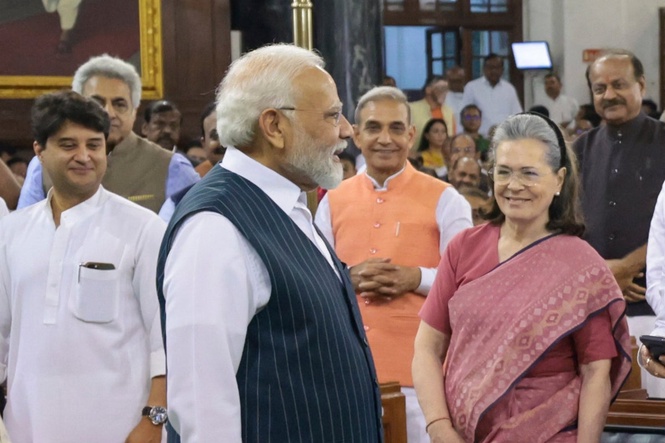
Sonia Gandhi, one of the most influential figures in Indian politics, has claimed that prime minister Narendra Modi “tends to look away” and avoid eye contact when they meet.
In her newly released memoir Belonging: A Journey of Love, Gandhi says she has had “practically no real contact” with Modi during his more than 12 years as prime minister. Their encounters, she writes, are largely limited to formal greetings at parliamentary gatherings, with the prime minister looking away when they meet.
Born in Italy, Gandhi moved to India in 1968 after marrying Rajiv Gandhi, the son of then prime minister Indira Gandhi and grandson of India’s first prime minister Jawaharlal Nehru.
She initially stayed away from electoral politics, but entered public life after her husband's assassination in 1991.
She went on to become president of the Congress party in 1998, eventually leading it for a total of 19 years. For 10 of these years, between 2004 and 2014, the Congress ruled the country.
Her son Rahul Gandhi is now the leader of opposition and Modi’s chief political rival, while her daughter Priyanka Gandhi Vadra is a parliamentarian and a general secretary of the Congress party.

Gandhi, 79, writes that her encounters with Modi are largely confined to formal gatherings, including meetings in the Lok Sabha Speaker’s chamber at the end of parliamentary sessions, where leaders of major political parties traditionally assemble.
“It’s a very small room, and usually many people are present, but when he comes face-to-face with me, we greet each other with a formal namaste. This is different from the past, when leaders across party divides would treat one another with cordiality. He tends to look away, avoiding eye contact,” she says.
Gandhi adds that Modi has occasionally asked about her health after she returned from hospital, greeting her with “Are you all right?”. Gandhi has had several hospital visits this year, including admissions in January and March for respiratory discomfort and a systemic infection. She also underwent a routine check-up in May.
Gandhi argued that their differences were ideological rather than personal, writing that she learned about India from “the members of my family, their lives of service, and their faith in a nation that encompassed a host of races and cultures, languages and faiths, based on principles of liberty and equality for all”.
She traces Modi’s worldview to the RSS, a Hindu nationalist organisation he joined as a young man and which is the ideological parent of his ruling BJP party. “Narendra Modi's idea of India was constructed by the ideologues of the RSS and the experience of his own growing up. It affirmed a fundamentalism in which his faith and culture superseded all others,” she writes.
Gandhi questions the image of Modi's humble origins, writing that “his origins may not have been as humble as his PR team has made out in marketing his image”.
She acknowledges that he worked his way to power within the RSS ecosystem, rising from what she describes as “an underprivileged world”.
Born into a modest family in Gujarat, Modi has often spoken about helping his father sell tea at a railway station as a child, a story that became a defining part of his political identity.
Gandhi also criticises his conduct in the parliament, writing that Modi sometimes uses the “same coarse language” as does did at public rallies.
“Much of the time he derides the opposition in what can only be termed a tirade,” she writes.
The book’s journey to publication hasn’t been straightforward. Penguin Random House India, which was initially due to publish the memoir, pulled out of the deal in August after disagreements over the manuscript.
Gandhi later told the Guardian that the publisher was “uneasy in general with the criticism of the government” and dropped the book after she refused to make certain changes.
Penguin disputed this, saying the suggestion it had walked away because Gandhi rejected its edits “does not accurately reflect the circumstances”.
HarperCollins India eventually took on the book, which was released on Tuesday.
Read MorePakistan says pollution from Diwali firecrackers in India worsened Lahore’s smog
Elon Musk’s X says takedown notices targeting Indian free-speech groups were fake
Delhi turns into fortress as Modi’s rivals stage new protests against election chief
Three workers die of suffocation at iPhone parts factory in India
Delhi wakes up to post-Diwali smog amid reports of air quality index crossing 2,000
Ten-year-old boy dies in India after Diwali fireworks explode in his hand