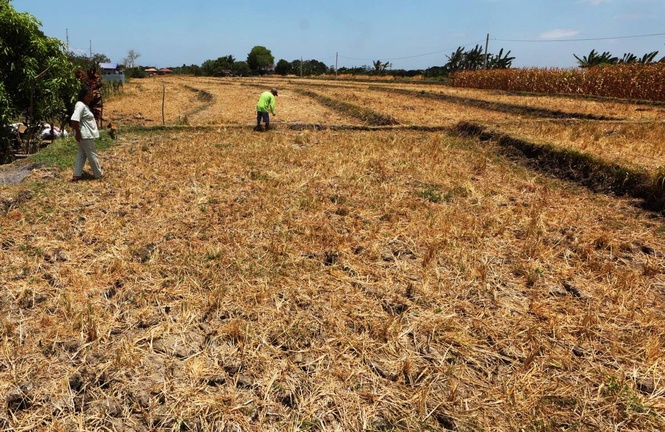
SEN. Francis Pangilinan urged the government to pre-position relief supplies and mobilize emergency response teams ahead of a strong El Niño, warning that delayed action could leave vulnerable families, farmers and fisherfolk facing water shortages, rising food prices and mounting agricultural losses.
In a statement, Pangilinan said authorities must act before the effects of prolonged dry spells worsen, stressing that early intervention is critical to protecting livelihoods and ensuring food security.
“Prevention is better than cure, right? Instead of pointing fingers and blaming one another when the problem hits, why don’t we prepare now? We know that super El Niño is coming, and farmers, fisherfolk and low-income households will certainly be among the first to be affected,” he said.
El Niño has already caused billions of pesos in agricultural damage, with the Department of Agriculture (DA) reporting losses of P6.87 billion as of Sept. 26, affecting 223,214 farmers and 249,028 hectares of agricultural land.
The DA raised its estimate to P8.57 billion during a Senate budget hearing on Oct. 21, with 288,058 farmers affected across 14 regions.
Pangilinan has also warned that palay (unmilled rice) production could decline by about 700,000 metric tons in the second half of 2027 because of El Niño and other weather-related shocks. He said the potential shortfall could affect the annual rice requirements of about 3.6 million Filipinos.
He called on the executive department to consider declaring a national state of calamity to mobilize additional resources and strengthen assistance for affected farming and fishing communities.
The Philippine Atmospheric, Geophysical and Astronomical Services Administration (Pagasa) has warned that El Niño could peak before the end of 2026, with its effects potentially continuing through the first half of 2027.
El Niño, a climate phenomenon associated with warmer-than-normal sea surface temperatures in the central and eastern Pacific, increases the likelihood of below-normal rainfall in the Philippines. This can lead to dry spells, drought and water shortages, threatening crops, livestock, fisheries and agricultural livelihoods.
As chairman of the Senate Committee on Agriculture, Food and Agrarian Reform, Pangilinan proposed an eight-point action plan to mitigate the weather phenomenon’s impact on vulnerable communities, agricultural production and the country’s food supply.
He cited Section 9 of Republic Act 12287, or the Declaration of State of Imminent Disaster Act, which allows national, regional and local disaster risk reduction and management councils to undertake preventive actions when a disaster is highly probable and its projected impacts are severe.
Pangilinan’s eight-point action plan also calls for appropriate disaster declarations, identification of available funds, protection of farms and water systems, enforcement of applicable price controls, measures against profiteering and hoarding, livelihood assistance and a public accountability system to monitor government interventions.
Another senator, Bam Aquino, on Thursday renewed his call for sweeping tax reform measures to shield Filipino families from a weakening peso, high interest rates and the devastation of a “super El Niño.”
Aquino, who chairs the Senate Committee on Trade, Commerce and Entrepreneurship, cautioned that the peso’s continued slide, paired with slow economic growth, threatens to drive up the cost of food, electricity and petroleum products.
“Families feel that they are bringing home less food for the same budget. Their earnings need to keep pace with the rising prices of goods,” Aquino said. “A larger portion of their salary should remain so that they have enough to buy food, rice and other basic necessities.”
At the center of his legislative push is Senate Bill 267, which seeks to raise the annual personal income tax exemption cap from the current P250,000 to P480,000.
Aquino noted that the current exemption levels under Republic Act 10963, or the Tax Reform for Acceleration and Inclusion Law, have been heavily eroded by persistent inflation. The proposed P480,000 baseline translates to a monthly tax-free income of P40,000, which he described as an ideal monthly living wage for a family of four or five.
The Department of Finance said it was open to Aquino’s proposal, signaling it would back the higher tax exemption cap provided that equivalent, alternative revenue sources are identified to offset the resulting fiscal impact on government coffers.