THE Senate impeachment court will determine on Monday how to proceed with the prosecution’s reported decision to drop Article III of the impeachment complaint against Vice President Sara Duterte, with the move potentially affecting the trial calendar and the sequence of presenting evidence.
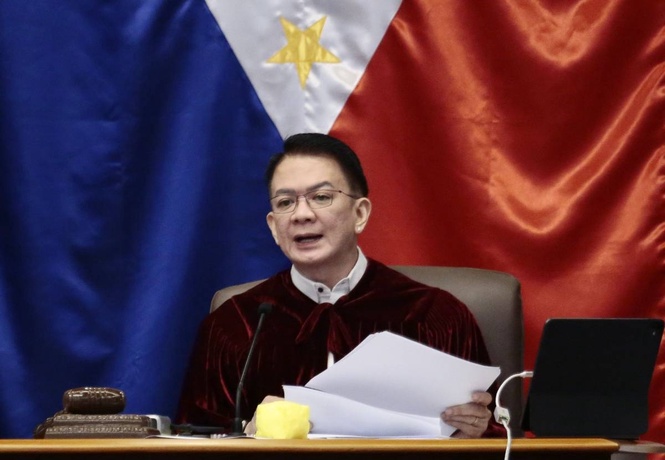
Senate impeachment court spokesman Regie Tongol said the court had received a formal manifestation seeking to drop Article III, but the matter remains subject to action by the presiding officer, Sen. Francis Escudero.
“The manifestation filed with the impeachment court will suffice,” Tongol told reporters during his press briefing following the 37th day of the trial on Oct. 10, adding that the court would await the presiding officer’s action or any questions he might raise on the matter.
House prosecutor Chel Diokno earlier announced that the prosecution would rest its case on Article II after presenting financial forensic expert Alexander Cabrera.
Prosecutors said that dropping Article III, concerning bribery allegations against the vice president, would speed up the trial and noted that the evidence in the other articles was strong enough to win conviction.
Tongol said the prosecution’s next move would depend on the court’s action on the manifestation concerning Article III.
The prosecution has yet to rest its case on Article I. Tongol recalled that Diokno had been preparing to do so when the presiding officer raised the possibility of presenting additional witnesses, including Col. Lachica and Maj. Gen. Nolasco.
The court must therefore await the House prosecution panel’s decision on how to proceed with the remaining article, he said.
Tongol declined to predict whether dropping Article III would alter the trial calendar or when Duterte’s defense could begin presenting evidence.
He said the court would have to determine whether to allow a period for the formal offer of prosecution evidence and the defense’s comments, as is customary in ordinary court proceedings.
While expediting the trial remains a priority, Tongol said speed must not come at the expense of due process.
“The impeachment court will have to consider everything to balance the interests of everyone,” he said, adding that procedural pauses should not automatically be considered unreasonable delays.
The court is also expected to clarify whether the defense must present its evidence in the same sequence as the prosecution’s articles or may choose its preferred order.
Tongol said either approach was possible but emphasized that the presiding officer would have to rule on the question.
On attendance, Tongol said the Senate had maintained a quorum of 13 senator-judges at the start of the proceedings.
Under the continuing-quorum rule, senators may monitor the trial from the Senate lounge after a quorum has been established, he said.
Tongol also said the Senate Secretariat’s advisory indicated that the chamber’s recess would end on Nov. 8, with plenary sessions resuming on Nov. 9.
He said the presiding officer would clarify the trial schedule on Monday.
Incontrovertible
House prosecutors on Friday described their evidence against Vice President Duterte as “incontrovertible” and declared that the prosecution’s final witness could deliver the decisive blow in the impeachment case.
“I believe, and I’m sure that my colleagues here share my opinion in saying that this will be the final nail in the coffin,” House prosecution spokesperson and adviser Ace Barbers said at a post-trial press briefing.
“I must say that our final witness ended with a bang,” he added.