Budget wishlists aren't usually the most exciting reading.
But Proton's latest one could eventually affect what powers your next car, how much of its technology is developed locally, and even what happens to the ageing car currently sitting in your driveway.
Ahead of Budget 2027, Proton has laid out several priorities for Malaysia's automotive industry. Strip away the policy language, though, and they can essentially be grouped into three big requests: a long-term strategy for electrified vehicles, deeper localisation, and a proper framework for renewing Malaysia's ageing vehicle fleet.
Those all sound very industry.
They're actually quite relevant to ordinary drivers.
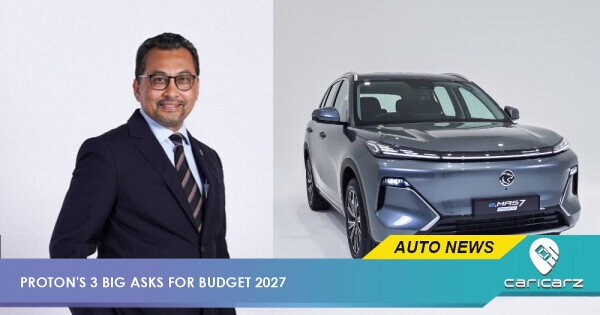
First up is electrification. Proton wants a long-term and technology-inclusive automotive policy as Malaysia transitions towards electrified vehicles, or xEVs, according to Proton deputy CEO Datuk Ir Abdul Rashid Musa's comments reported by Bernama.
 Deputy Chief Executive Officer of Proton, Datuk Ir. Abdul Rashid Musa
And xEV doesn't simply mean fully electric cars. The umbrella can include hybrids (HEVs), plug-in hybrids (PHEVs), battery EVs (BEVs) and fuel-cell vehicles (FCEVs).
Why should buyers care?
Long-term policy certainty matters when carmakers and suppliers are deciding whether to invest in new technologies, production lines and locally assembled models.
Proton argues Malaysia needs a managed transition that allows the industry to progressively prepare for electrification rather than treating it as a switch that happens overnight.
And Proton isn't alone in asking Putrajaya to make xEVs easier for consumers to adopt. The Malaysian Automotive Association (MAA) has separately proposed a RM7,000 to RM10,000 personal income tax rebate for Malaysians buying xEVs under Budget 2027.
That's an MAA proposal, not Proton's, and neither is confirmed government policy.
Still, both point towards the same underlying issue: how does Malaysia make the transition to electrified cars affordable enough for ordinary buyers?
2. Proton Wants Malaysia To Do More Than Just Assemble CarsThis is probably the least exciting-sounding part of Proton's wishlist. It may also be one of the most important in the long run.
Proton wants stronger government support for Malaysia's vendor ecosystem, upstream automotive activities, technology investment and local sourcing.
Its argument is relatively straightforward: bring more suppliers and technology into Malaysia, source more locally, and the industry could reduce development and component costs, potentially making electrification more affordable.
But Proton is talking about much more than stamping body panels and bolting cars together.
Think Beyond CKDProton Wants More Of The Technology Behind The Car Developed Here TooThat includes automotive research, software development, artificial intelligence, battery technology, advanced electronics, testing facilities and vehicle homologation.In simple terms:
Don't just build more future cars in Malaysia. Build more of the knowledge and technology behind them here too.
We're already seeing a version of that localisation push within Proton itself. Its e.MAS 7 PHEV entered local production at Tanjong Malim with 30% locally sourced components, including a locally assembled engine and motors.
For drivers, deeper localisation doesn't automatically mean cheaper cars tomorrow.
But Proton's argument is that a stronger domestic supply chain, more local expertise and reduced development and component costs could eventually help make electrified vehicles more affordable.
3. And Then There's Malaysia's Really Old CarsThis is probably the part most motorists will immediately understand. Proton wants Malaysia to establish a comprehensive national vehicle renewal and recycling framework to deal with ageing and unsafe vehicles.
And before anyone with an old Wira starts hiding the keys...
No, Proton Isn't Asking To Force Your Old Car Off The RoadThe Proposed Approach Is VoluntaryAbdul Rashid stressed that the intention isn't to force Malaysians to replace their vehicles or create another financial burden for households. Proton wants practical and affordable ways for owners to retire vehicles that are no longer safe, efficient or economical to maintain.And Malaysia has already experimented with exactly this sort of incentive.
Under Budget 2026, the government allocated RM10 million for matching grants of up to RM2,000 for around 5,000 owners replacing vehicles aged over 20 years, with national carmakers providing matching incentives.
Proton subsequently rolled out its own programme, and Carz previously explained how eligible owners could receive combined incentives of up to RM4,000 when replacing and scrapping an old vehicle for a new Proton.
That's probably the most eye-catching number in Proton's entire Budget 2027 wishlist.
Proton believes expanding the programme into a longer-term framework could help get ageing vehicles that are no longer economical or safe to maintain off the road.
There's another argument too: fuel subsidies.
Abdul Rashid argues that replacing ageing vehicles with newer, more fuel-efficient models could help reduce the government's fuel-subsidy bill while giving more Malaysians access to safer vehicles and newer technology.
The logic is straightforward, but it's worth keeping the claim in perspective. Proton hasn't provided a figure for how much the government could actually save, so this remains Proton's policy argument rather than a quantified government projection.
Interestingly, MAA Wants To Go Even FurtherProton isn't the only automotive industry player talking about old cars ahead of Budget 2027.
MAA has separately proposed a RM5,000 personal income tax rebate for voluntarily retiring and scrapping vehicles aged 20 years or older, alongside its proposed RM7,000 to RM10,000 xEV purchase rebate.
Again, these are MAA's proposals. They are not Proton's proposals, and they have not been confirmed for Budget 2027.
The details differ, but the overlap is interesting.
Both Proton and MAA are effectively arguing that electrification, localisation and renewal of Malaysia's ageing vehicle fleet shouldn't be treated as completely separate problems.
They're increasingly being presented as pieces of the same automotive transition.
So, What Actually Changes For You?Right now? Nothing.
And that's probably the most important sentence in this story.
These are requests and proposals being put forward ahead of Budget 2027. They are not confirmed Budget measures.
So don't send your 25-year-old Wira to the scrapyard just yet, and don't postpone buying that hybrid because you're expecting a new tax incentive next week.
Budget 2027 will ultimately determine which, if any, of these ideas Putrajaya actually adopts.
The Bigger PictureMore electrified choices. More Malaysian technology. And a better way to voluntarily retire cars that have reached the end of their useful lives.That's essentially where Proton thinks Malaysia's automotive policy should head next. Whether Budget 2027 agrees is another question.