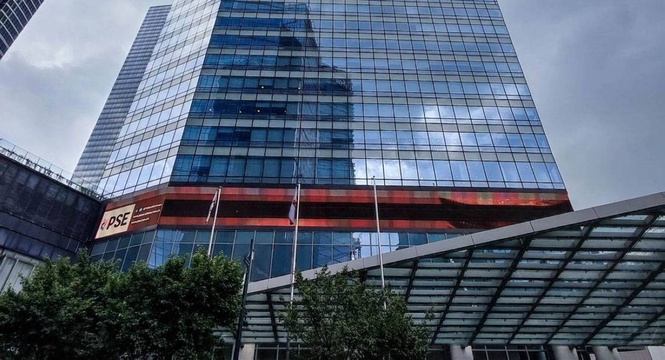
THE Philippine Stock Exchange index (PSEi) plunged to its lowest closing level in more than six years on Monday, while the peso started the week losing against the US dollar.
The stock market’s main index extended its losing streak as concerns over elevated inflation, slowing economic growth, and the possibility of further US interest rate hikes weighed on investor sentiment.
The benchmark index dropped 111.61 points, or 2 percent, to close at 5,481.88, its lowest finish since May 18, 2020, when it settled at 5,479.35 during the height of the Covid-19 pandemic and lockdowns.
The index has now declined for four consecutive trading days and six of the past seven sessions, falling below the 5,600 support level and approaching the 5,400 mark.
Stagflation woes
Japhet Tantiangco, research analyst at Philstocks Financial Inc., said the market’s decline reflected mounting stagflation concerns amid elevated inflation and slowing economic growth.
He added that the possibility of another US Federal Reserve rate hike at its December meeting, following higher-than-expected US inflation in October, further dampened sentiment.
“With the local bourse’s latest decline, it has given up its support at 5,600. New support is at 5,400,” Tantiangco said.
Head of sales at Regina Capital Development Corp. Luis Limlingan said macroeconomic concerns continued to weigh on the market amid the prolonged economic slowdown and mounting inflationary pressures.
He noted that investors were also concerned that the Bangko Sentral ng Pilipinas (BSP) may have limited room for further monetary tightening, as broader price pressures complicate the outlook and additional rate increases could further weigh on economic activity.
Michael Ricafort, chief economist at Rizal Commercial Banking Corp., said the market’s decline reflected a combination of weaker corporate earnings, concerns over stagflation, rising US Treasury yields and a weaker peso.
He also cited higher borrowing costs globally and the peso’s depreciation to 63.94 against the US dollar from 63.72 in the previous trading session as factors that could increase importation costs and inflationary pressures.
Brent crude oil prices also edged higher to around $96 per barrel amid renewed tensions involving the United States and Iran, although Ricafort noted that prices remained below their recent peak of $118 per barrel recorded on Oct. 30.
Dollar strengthens
The local currency weakened by 22 centavos to close at P63.94 from Friday’s P63.72. It opened at P63.8 and traded from P63.745 to P63.95. The volume reached $1.022 billion, markedly down from the previous P2.202 billion.
Ricafort said the peso weakened as the US dollar strengthened against major global currencies.
MUFG economist Lee Hardman also said the renewed upward momentum in the USD has been driven primarily by an abrupt hawkish repricing of Fed rate hike expectations.
“Market participants have moved to price in a more aggressive Fed tightening cycle following the third consecutive upside surprise in US core CPI in October and a hawkish shift in Fed rhetoric,” Hardman said.
“As a result, the US rates market is now assigning a higher probability to three consecutive hikes in December, January and March,” Hardman added.
At the stock market, all sectoral indices ended in negative territory, led by mining and oil, which fell 3.69 percent.
Among the PSEi constituents, only five advanced, with Ayala Corp. posting the biggest gain of 1.70 percent.
Market breadth was negative, with 131 decliners against 51 advancers, while 59 issues were unchanged.
Trading activity remained relatively brisk, with net value turnover reaching P6.49 billion, above the year-to-date average of P6.24 billion. Foreign investors were net sellers, recording outflows of P155.80 million, according to Philstocks data.