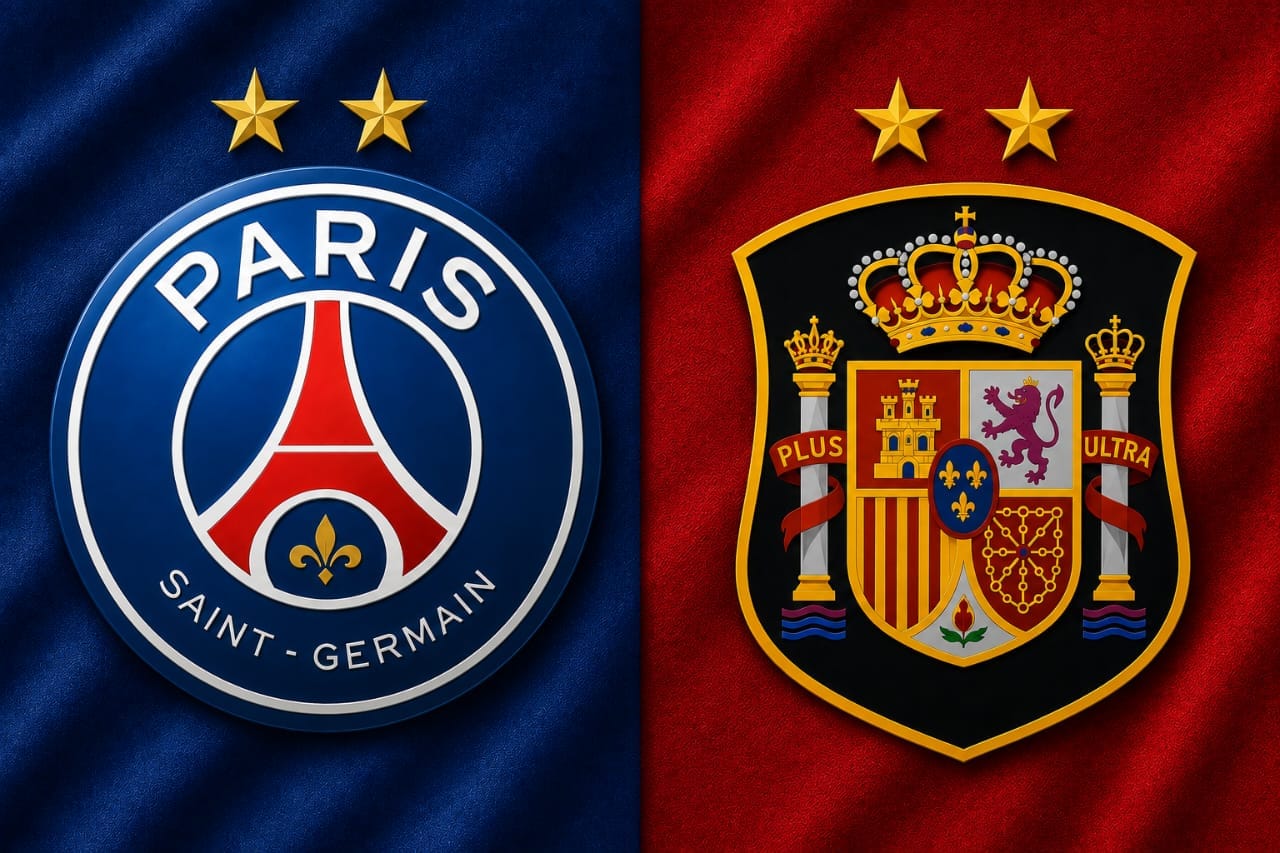
PSG vs Spain: A Dream Matchup Between Club and Country
What would happen if the best version of Paris Saint-Germain faced the Spanish national team in a competitive match?
It is an unusual comparison because PSG are a club built by recruiting players from around the world, while Spain can select only players eligible to represent the country. Yet, in 2026, the hypothetical matchup has become particularly fascinating.
PSG are the back-to-back UEFA Champions League winners, having defeated Arsenal on penalties in the 2025/26 final to retain Europe's biggest club trophy. Spain, meanwhile, are the 2026 FIFA World Cup champions, defeating Argentina 1–0 after extra time in the final.
So if these two teams met at full strength, who would be the favorite?
The answer is not as simple as it might appear.
Two Different Kinds of Football Power
The first thing to understand is that PSG and Spain are constructed in completely different ways.
PSG can recruit almost any player in world football. Their squad is assembled specifically to compete across an entire club season, with players training together virtually every day.
Spain have a completely different limitation. Luis de la Fuente can select only Spanish players, and the national team has relatively little time to train together compared with a club.
That makes PSG's squad-building advantage enormous.
However, Spain compensate for this with something that club teams cannot simply purchase: a deeply established national football identity.
Spain's possession-based football, technical quality and tactical discipline have become the foundation of their success. Their 2026 World Cup victory demonstrated how effective that collective approach can be. FIFA described Spain as controlling the final from start to finish in their 1–0 victory over Argentina.
PSG's Biggest Advantage: Club-Level Chemistry
One of the strongest arguments for PSG is the amount of time their players spend together.
A national team might have only a handful of training sessions before an important tournament match. PSG players, by contrast, train together throughout the club season.
That matters enormously.
Players learn:
- where teammates want the ball;
- when to press;
- when to make overlapping runs;
- how to rotate positions;
- how to defend transitions;
- how to react when possession is lost;
- and how to exploit spaces created by teammates.
Luis Enrique has spent several seasons developing his PSG system, and the results have been extraordinary.
PSG's 2025/26 Champions League campaign ended with another European title. They defeated Chelsea 8–2 on aggregate in the round of 16, Liverpool 4–0 in the quarter-finals and Bayern Munich 6–5 in the semi-finals before overcoming Arsenal in the final.
That experience against elite club opposition would be a major advantage against Spain.
Spain's Biggest Advantage: Tactical Cohesion
But there is another side to the argument.
Spain do not need months of preparation to understand how they want to play.
Their footballing identity has been developed over many years, from youth level through to the senior national team.
The 2026 World Cup provided perhaps the strongest evidence yet.
Spain won the tournament without losing, defeating Argentina 1–0 in the final after extra time. They dominated possession and created 20 attempts in the final, while Argentina failed to register a shot during regular time.
Even more impressive was Spain's defensive record.
They conceded only one goal throughout the entire 2026 World Cup, an extraordinary achievement over eight matches.
That tells us something important: Spain are not simply a possession team.
They can control matches and defend extremely well.
Midfield: Where the Battle Could Be Decided
If PSG and Spain met, midfield would probably be the most fascinating part of the game.
Spain possess tremendous technical quality in the center of the pitch, with players capable of controlling possession and manipulating the opposition's defensive structure.
The biggest individual story from the World Cup was Rodri.
The Spanish midfielder won the Golden Ball as the tournament's best player, while Spain went on to win their second men's World Cup.
Against PSG, however, Spain would face an opponent with enormous midfield quality of its own.
PSG's advantage would be depth.
They can rotate midfielders without dramatically changing their style, while their squad has been built to cope with the demands of Champions League football.
The question would therefore be:
Can Spain's midfield control the ball before PSG's pressing system forces mistakes?
That could determine the entire match.
Attack: PSG Have More Variety
In attack, PSG arguably have the advantage.
Their squad contains multiple types of attacking players: explosive wingers, creative midfielders, technically gifted forwards and players capable of attacking space behind the defense.
Khvicha Kvaratskhelia, Désiré Doué and Ousmane Dembélé give PSG several different ways of attacking.
PSG's attacking strength was on display again in the 2026 UEFA Super Cup.
Just days before the current season began, PSG defeated Aston Villa 2–1, with Kvaratskhelia opening the scoring and Doué scoring the decisive goal.
That victory also made PSG back-to-back Super Cup winners.
For Spain, the answer is collective rather than individual.
Lamine Yamal, Nico Williams, Ferran Torres and Spain's other attacking options provide speed, movement and technical quality.
Ferran Torres, in particular, became a World Cup hero by scoring the winning goal in the 106th minute of the final against Argentina.
The Fascinating Connection: Fabián Ruiz
There is an especially interesting complication in this hypothetical matchup.
That means he would literally have to choose a side in this imaginary PSG-versus-Spain match.
Ruiz had an extraordinary 2025/26 season because he won the Champions League with PSG and then the World Cup with Spain.
His involvement illustrates just how closely connected the two teams actually are.
It would also make the matchup even more interesting tactically because Spain would know exactly what one of PSG's midfielders can contribute—and PSG would know Ruiz's strengths equally well.
Defense: Spain May Have the Edge
If there is one area where Spain might actually have the advantage, it could be defensive organization.
Spain's World Cup campaign was remarkable defensively.
Conceding only one goal in eight matches demonstrates that their defensive structure was extremely difficult to break down.
Their defenders were supported by a midfield that could retain possession and prevent opponents from generating sustained pressure.
PSG, meanwhile, have developed into an excellent defensive team under Luis Enrique, but they would be facing an opponent that is exceptionally comfortable playing without giving the ball away.
That creates an intriguing tactical question.
Would PSG press Spain aggressively?
Or would they allow Spain to have possession and attempt to attack quickly when the opportunity appeared?
The Coaches: Luis Enrique vs Luis de la Fuente
The coaching battle would be almost as interesting as the players.
Luis Enrique has already demonstrated that he can build a team capable of dominating European club football.
He has taken PSG to consecutive Champions League titles and recently added another European Super Cup.
Luis de la Fuente has achieved something different.
He has built Spain into world champions.
Spain's 2026 triumph came after their European success and was achieved through a system that prioritizes collective football rather than simply relying on individual superstars.
There is also a fascinating connection between the coaches.
Luis Enrique previously managed the Spanish national team.
Now he manages PSG.
That means he understands Spanish football extremely well, while de la Fuente would have an excellent understanding of the footballing culture and principles that influenced Luis Enrique.
What Would the Match Look Like?
A realistic match might begin with Spain attempting to establish possession.
They would circulate the ball through midfield, trying to pull PSG's defensive structure apart.
PSG would probably respond with aggressive pressing.
Their objective would be to force Spain into a mistake and immediately attack the space left behind the midfield.
That could produce a fascinating contrast:
Spain want to control the game through possession.
PSG want to control the game through possession, pressing and transitions.
In other words, neither team would necessarily want a chaotic match.
Both would want to dictate the rhythm.
The First 20 Minutes Could Be Crucial
The opening period could tell us a lot.
If Spain successfully bypassed PSG's first line of pressure, they could establish territorial dominance.
But if PSG repeatedly won the ball high up the pitch, Spain could find themselves defending dangerous attacks before their defensive block had time to organize.
This is why the matchup would be so difficult to predict.
Spain's greatest strength—keeping the ball—could also become dangerous if PSG's press were able to turn possession losses into immediate chances.
Would Spain Be Able to Handle PSG's Depth?
Over 90 minutes, PSG's squad depth could become decisive.
A national team has excellent substitutes, but a club like PSG can build a squad specifically around tactical rotation and competition for places.
If the match reached the final 20 minutes at 0–0, PSG could introduce fresh attacking players and change the character of the game.
Spain could do the same to a degree, but PSG's resources would probably give them more tactical alternatives.
This is one of the biggest reasons to favor PSG in a hypothetical one-off match.
But Spain Have Something PSG Cannot Buy
There is also an argument for Spain that should not be underestimated.
They are world champions.
Their players have just experienced the pressure of a World Cup knockout stage, a semi-final and a final—and they succeeded.
Spain defeated Argentina in the final despite needing extra time to find the breakthrough.
That tournament experience creates enormous confidence.
And Spain's current generation is not simply a collection of talented individuals.
It is a highly synchronized group.
Their success is based on a shared footballing philosophy.
So Who Would Win?
If both teams were fully rested and available, I would give PSG a slight advantage.
My prediction:
PSG 2–1 Spain
Estimated chances:
| Team | Win probability |
|---|---|
| PSG | 55% |
| Spain | 45% |
That is intentionally close.
PSG would have the advantage because they are a club side with greater day-to-day tactical preparation, extraordinary squad depth and recent experience against the strongest club teams in Europe.
Spain would have a realistic chance because they are the reigning world champions, possess exceptional technical quality and have demonstrated outstanding defensive organization.
Why PSG Get the Edge
There are four major reasons.
1. More training time
PSG players work together throughout the season.
2. Greater squad depth
PSG can recruit internationally and build a squad specifically for tactical flexibility.
3. Champions League experience
They have just won Europe's premier club competition twice consecutively.
4. Multiple attacking solutions
PSG can attack through the wings, central combinations, pressing turnovers and quick transitions.
Why Spain Could Still Win
Spain's case is equally compelling.
1. They are world champions
They defeated Argentina in the 2026 final.
2. Exceptional defensive record
They conceded only one goal during the tournament.
3. Elite midfield control
Rodri's Golden Ball-winning World Cup performance demonstrated the quality of Spain's midfield leadership.
4. A proven footballing identity
Spain's possession game is not something they invented overnight. It is the product of a long-term footballing system.
The Bigger Question: Club vs Country
Ultimately, PSG versus Spain is not simply a comparison between two teams.
It is a comparison between two different models of football.
PSG represent the modern elite club: international recruitment, daily tactical training, enormous squad depth and constant competition.
Spain represent the national-team model: a limited player pool, relatively little preparation time, but an extraordinary footballing culture and a shared national identity.
That is what makes this hypothetical match so compelling.
Final Verdict
If PSG and Spain played tomorrow, I would expect a very tactical match.
Spain would probably enjoy long spells of possession.
PSG would look for opportunities to press aggressively and attack quickly.
Spain's defensive structure could frustrate PSG for long periods, but PSG's depth and familiarity with elite club-level competition could eventually make the difference.
Final prediction: PSG 2–1 Spain.
But this is not a mismatch.
Spain are the 2026 World Cup champions, while PSG are back-to-back Champions League champions.
In other words, this hypothetical game would bring together two of the most successful teams in world football at the same moment.
And if it ever happened, it could be one of the most tactically fascinating matches football could offer.
William Lee (kokwei67@gmail.com) is a content creator under the Newswav Creator programme, where you get to express yourself, be a citizen journalist, and at the same time monetize your content & reach millions of users on Newswav. Log in to creator.newswav.com and become a Newswav Creator now!
The User Content (as defined on Newswav Terms of Use) above including the views expressed and media (pictures, videos, citations etc) were submitted & posted by the author. Newswav is solely an aggregation platform that hosts the User Content. If you have any questions about the content, copyright or other issues of the work, please contact creator@newswav.com.