
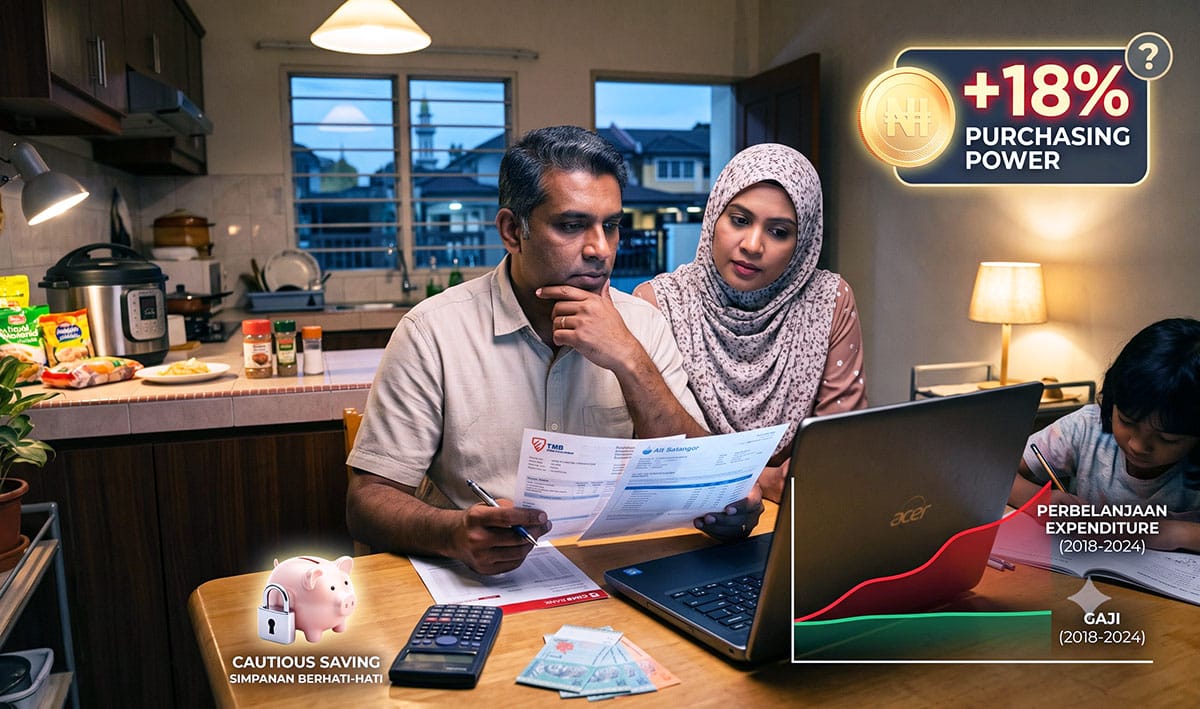
The numbers say we're doing better. My household hasn't gotten that memo. Somewhere between the report and the reality, something isn't adding up, and I don't think I'm the only one feeling that gap.
The Number That Sounds Better Than It Feels
A new consumer outlook report from BMI, a Fitch Solutions company, found that the average Malaysian household now has 18 per cent more purchasing power than it did in 2019. The reasoning behind it is sound on paper. Inflation is expected to sit around 1.9 per cent in 2026, helped by the petrol price cap. Unemployment is holding at a low 3.0 per cent. Bank Negara has paused interest rate hikes at 2.75 per cent. Real household spending is projected to hit RM1.10 trillion this year, comfortably above pre-pandemic levels. Put together, it reads like a genuine recovery story.
My Own Household Doesn't Recognise This Number
Here's where I have to be honest instead of polite about it. For my own household, it doesn't feel better. Grocery prices keep creeping up in ways that never quite make headlines, a few ringgit here, a smaller pack size there, nothing dramatic enough to trend on social media but persistent enough to notice every single week. Wages, meanwhile, have mostly stayed where they were. We're not in crisis, but we're not exactly basking in 18 per cent more purchasing power either. If anything, it feels like standing still while prices quietly walk past us.
Who Is Actually 18% Better Off?
I suspect the reason for that disconnect is who this average is actually describing. A national average can be technically accurate while still hiding who's driving it. My read is that the households genuinely feeling this 18 per cent gain sit mostly in the M40 bracket and above, people with enough income buffer to actually benefit when inflation cools and wages inch upward.
For lower income households, the ones already stretched thin before any of this, stagnant wages against a rising cost of living isn't something a national purchasing power index fixes. They're not spending more comfortably, they're finding ways to survive, which increasingly means taking up new loans or consolidating existing debt into a single account just to make the monthly numbers work.
The Debt Number That Matters More
This is where the more current, more authoritative figures matter. Bank Negara's own data, confirmed by Prime Minister Anwar Ibrahim in a parliamentary reply, puts household debt at RM1.73 trillion as of March 2026, equivalent to 84.4 per cent of GDP, down only marginally from 84.7 per cent the quarter before. The impaired loan ratio remains low at 1 per cent, and the median debt-to-income ratio has held steady at 1.3 times, which the government reads as debt growing in step with income rather than reckless borrowing.
That's the reassuring version. The less reassuring version is that 84.4 per cent of GDP is still a significant load sitting on Malaysian households, and it doesn't take much, an unexpected rate hike, a fresh external shock, to turn a manageable debt service ratio into a genuinely painful one.
What I'm Seeing With My Own Clients
I'm not just going by household anecdotes here. Working with SME clients through my own company, the mood on the ground has shifted toward caution rather than confidence. Businesses I work with are spending less than they used to, tightening budgets, holding off on bigger marketing pushes, being more deliberate about every ringgit committed. That's not the behaviour of a market that feels 18 per cent richer. That's the behaviour of businesses bracing for something, even if nobody can quite name what.
Why Are Malaysians Still Borrowing More?
The honest answer is stagnant wages colliding with a cost of living that never really eased, whatever the inflation index says. When your income doesn't move but your expenses quietly do, month after month, the gap has to be filled by something, and increasingly that something is credit. Loan consolidation, in particular, has become less of a financial planning tool and more of a survival mechanism for households trying to turn several unmanageable repayments into one slightly less unmanageable one. That's not a sign of a population enjoying a purchasing power windfall. That's a population managing decline as carefully as it can.
My Take
I'll be honest, my read on this leans cautious, roughly seventy-thirty against pure optimism. The macro numbers aren't fabricated, purchasing power genuinely has improved on average, and the debt figures aren't in crisis territory yet either. But averages hide struggle just as easily as they reveal progress, and right now I think they're doing more hiding than revealing for a large chunk of Malaysian households.
If you're reading this and wondering whether the "good news" applies to you, my advice is to stay conservative regardless of what the headline says. Keep building whatever buffer you can, avoid taking on new debt you don't need, and don't let a national average talk you into spending like the recovery has already reached your bank account. Your future self will thank you for the caution, especially if the next external shock turns out to be the one that actually reaches us.
Kamarul Azwan (k.azwan@gmail.com) is a content creator under the Newswav Creator programme, where you get to express yourself, be a citizen journalist, and at the same time monetize your content & reach millions of users on Newswav. Log in to creator.newswav.com and become a Newswav Creator now!
The User Content (as defined on Newswav Terms of Use) above including the views expressed and media (pictures, videos, citations etc) were submitted & posted by the author. Newswav is solely an aggregation platform that hosts the User Content. If you have any questions about the content, copyright or other issues of the work, please contact creator@newswav.com.