
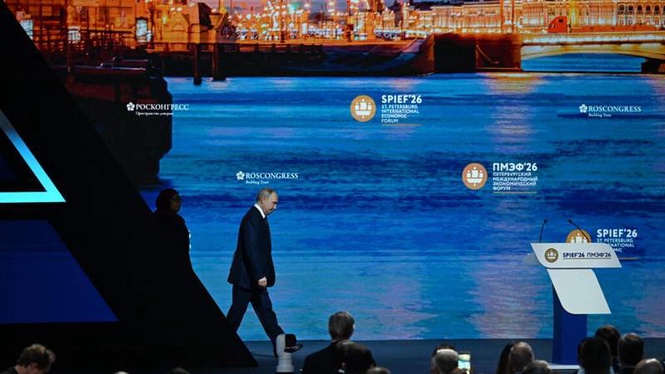
The US-Israeli assassination of Iran’s supreme leader Ayatollah Ali Khamenei in Tehran reportedly unsettled Russian President Vladimir Putin.
In the wake of the killing, Russia’s security services shut down parts of a surveillance system protecting the Russian president and his closest aides to seal it off from the internet, according to the Financial Times (FT).
Hours of video footage harvested from Iran’s traffic cameras by Israeli intelligence allowed them to pinpoint the exact time and location of the supreme leader's meeting with an aide on February 28, the day the US and Israel killed Khamenei and launched their war on the Islamic Republic.
The assassination showed how artificial intelligence (AI) can process millions of hours of videos from thousands of cameras “to extract patterns and secrets at an industrial scale”, the FT wrote.
The internet has been a source of concern for Putin for years. Since Russia’s full-scale invasion of Ukraine in 2022, the regime has regularly resorted to internet blackouts to reinforce its control over the population.
Read moreUkrainian drones hit Saint Petersburg as 'Russian Davos' opens
“Depending on political events, big celebrations, events like the St. Petersburg International Economic Forum, or in border regions with Ukraine where there are military operations, internet shutdowns can be activated without any reason – for one week, two weeks or more,” said Ksenia Ermoshina, a senior researcher at the Center for Internet and Society of the CNRS.
FRANCE 24 spoke with Ermoshina for more on Putin’s increasing paranoia over the internet and AI-enabled surveillance systems.
FRANCE 24: What does the landscape in Moscow and Russia look like when it comes to surveillance cameras?
Russia began developing a “smart” camera system in 2015. Before 2015, videos could be saved on memory cards, which could be extracted and viewed in case of a crime or particular event. The system was centralised on servers and above all, there was no AI – these videos were not being analysed by AI.
In 2015, a company called NTech Lab, which was founded by Rostech, a company piloted by the state for the “sovereignisation” of technologies in Russia, became responsible for installing “smart” cameras which could analyse images and not only save them but send them to a server.
The Russian Minister of Digital Development, Communications, and Mass Media, Maksut Shadayev, said in 2025 that every Russian city was not yet equipped with this camera.
In 2023, there were 508,000 cameras in Russia equipped with artificial intelligence. This is not a lot. Moscow of course had the most AI-equipped cameras in Russia with 216,000 devices.
Moscow was also the pilot city for this project, with NTech lab already deploying these AI-equipped cameras in 2017 in the capital. Seventy-four percent of public spaces are equipped with these “smart” cameras: bus stations, metro stations, museums, government sites of course. Ninety percent of the buildings where citizens live have these cameras.
Interestingly, a tandem has begun developing in Russia between Internet providers like Rostelecom and surveillance cameras. This is how almost 90 percent of buildings in Moscow came to be monitored by AI-equipped cameras.
This is a way of combining the internet – which is a service that [offers] something that citizens want – and surveillance for reinforcing security. There is a discourse about how daily life will be improved thanks to these cameras. Russians never asked questions about the legality of this, or their rights to privacy.
Moscow remains the most monitored city in Russia. The Minister of Communication has promised to install 5 million AI-equipped cameras in Russia for 2030. There are currently 1.2 million cameras.
FRANCE 24: Could this system of surveillance turn against the Kremlin? How vulnerable is this surveillance system to infiltration by foreign and national enemies?
Surveillance cameras are often hacked in Russia, and not just by Russia’s enemies but also by Russians themselves. Groups of citizen hackers break into the system for fun, just to see what the cameras “see”.
The system is vulnerable: the Russian artist Helena Nikonole even hacked into the cameras of Russian voting stations. Certain cameras not only have a microphone but speakers that allow them to project sound.
The artist used the camera’s speakers to make them play the national Ukrainian [anthem]. Other activists have carried out similar actions to criticise the regime.
We don’t know to what extent the cameras around the Kremlin are different. I imagine they are more expensive and better protected, but it’s possible to access these cameras via the internet. As soon as an electronic digital device is connected to a central network, vulnerabilities can be detected.
The only way to completely secure cameras is to disconnect them from the internet. Yet then they lose their utility. It’s essential to have live images, like of who enters and exits the Kremlin or who uses the bridges in the area.
FRANCE 24: Are there other signs that Putin is becoming increasingly paranoid about security linked to the internet?
It’s very interesting when Putin moves around – anthropologically speaking. There is a kind of digital shadow and silence which follows him. When he travels from one city to another, there are always internet blackouts. It’s almost like in a story by J.R.R. Tolkien.
In observing the connectivity cuts in Russia, my colleagues and I noticed that Putin moves around by protecting himself through the absence of [internet] connection. So, he considers the internet a threat.
As soon as there is internet connection, he thinks he is vulnerable, so he orders the mobile network to be disconnected.