.jpeg)
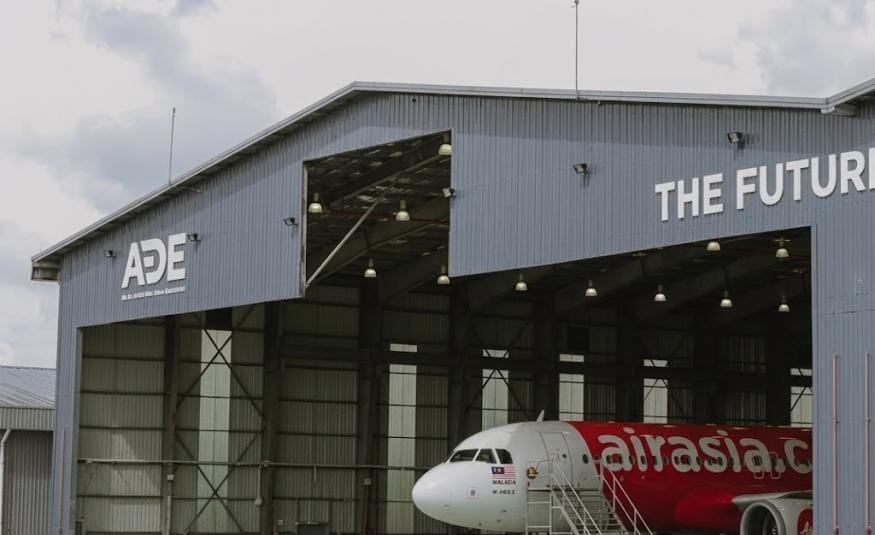
Qatar’s latest move in Malaysia is not taking place in an airport terminal, but inside the less visible world that keeps aircraft flying: maintenance hangars, engineering teams, safety inspections and spare-parts systems. The US$100 million financing secured by Asia Digital Engineering, or ADE, from Qatar National Bank (Q.P.S.C.) — QNB Group is therefore more than a corporate loan. It is a signal that Gulf capital is beginning to look at Southeast Asia’s aviation economy through its technical backbone, not only through routes and passenger traffic.
The deal was announced in Kuala Lumpur on May 22, 2026. ADE is the maintenance, repair and overhaul, or MRO, subsidiary of Capital A, the Malaysian group behind AirAsia. The company said the financing facility from QNB Group would support its expansion and increase its operational capacity. Local reports said ADE has completed more than 300 C-checks in five years, operates line maintenance across 20 airports in ASEAN, and has base maintenance capacity of 16 lines. QNB Group, officially Qatar National Bank (Q.P.S.C.), was established in 1964 as Qatar’s first Qatari-owned commercial bank, with ownership split between the Qatar Investment Authority and members of the public.
MRO means maintenance, repair and overhaul. In plain language, it is the workshop economy behind aviation: inspecting aircraft, repairing faults, replacing parts, carrying out scheduled checks and returning planes safely to service. A C-check, for example, is a deeper scheduled inspection that takes an aircraft out of normal service for detailed technical work. Without MRO, new routes remain promises on paper; with strong MRO, airlines can keep aircraft available, control costs and protect safety standards.
Malaysia is not new to this field. The country has spent years trying to build itself as an aerospace and MRO hub, not merely as a base for low-cost travel. Official investment materials have stated Malaysia’s ambition to capture 50% of Southeast Asia’s MRO business and 5% of the global market by 2030. The National Industrial Master Plan 2030 also frames aerospace as a sector where Malaysia can deepen local capability and move higher in the regional value chain.
This is why the ADE financing matters. AirAsia made Malaysia visible in affordable regional travel, but ADE points to the next layer of value: what happens after the aircraft lands. If Malaysia can strengthen aircraft engineering, technical services, component support and line maintenance, it can create skilled jobs that last longer than a tourism upswing and reduce dependence on foreign maintenance centres.
The timing also strengthens the message. After the Covid-19 pandemic years, airlines across Asia have been rebuilding fleets, restoring routes and managing higher operating costs. In that environment, maintenance capacity becomes a strategic asset. A plane kept on the ground for too long is not only an engineering problem; it means lost revenue, disrupted schedules and weaker customer confidence. ADE’s expansion suggests that Capital A is trying to move beyond the old low-cost airline model and build a broader aviation platform in which engineering is part of the business, not just a support function.
This wider strategy becomes clearer when placed next to AirAsia X’s planned Kuala Lumpur–Bahrain–London Gatwick route, scheduled to begin on June 26, 2026. The new service positions Bahrain as AirAsia X’s first global hub outside Asia, giving the airline a western link between Southeast Asia, the Gulf and Europe. For ADE, this matters because route expansion eventually depends on reliable aircraft availability, maintenance capacity and cost control. The loan and the Bahrain route are separate developments, but together they show Capital A moving toward a wider aviation model built around routes, MRO, finance and regional reach.
Still, the loan should not be read as a guarantee of success. Money can open a hangar door, but it cannot by itself produce engineers, discipline, safety culture or customer trust. ADE will have to prove that it can turn financing into real capacity, attract more third-party airline customers and compete with established regional aviation service centres, including Singapore and Thailand.
What makes this deal interesting is its quiet realism. It does not promise a new airport city or a dramatic aviation revolution. It points instead to a practical future: Gulf finance, Malaysian engineering, ASEAN demand and a growing need for reliable MRO services. If ADE uses this financing well, Malaysia’s aviation workshop may become more than the backroom of AirAsia’s success. It may become one of the small but important places where Southeast Asia and the Gulf build a new economic relationship, one aircraft check at a time.
Abdullah Bugis (kualalumpur.abdullah@gmail.com) is a content creator under the Newswav Creator programme, where you get to express yourself, be a citizen journalist, and at the same time monetize your content & reach millions of users on Newswav. Log in to creator.newswav.com and become a Newswav Creator now!
The User Content (as defined on Newswav Terms of Use) above including the views expressed and media (pictures, videos, citations etc) were submitted & posted by the author. Newswav is solely an aggregation platform that hosts the User Content. If you have any questions about the content, copyright or other issues of the work, please contact creator@newswav.com.