
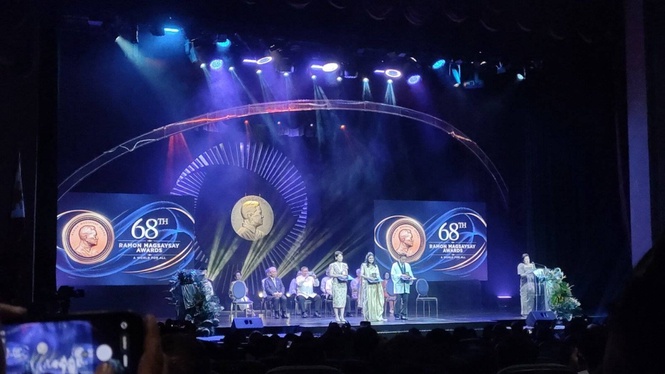
MANILA, Philippines — The Ramon Magsaysay Award Foundation (RMAF) on Sunday presented the 2026 Ramon Magsaysay Awards to Myanmar human rights advocate Bo Kyi, Friendship Bangladesh founder Runa Khan, and Singaporean diplomat Tommy Koh.
The RMAF Board of Trustees recognized Bo Kyi for "his life's work as a steadfast pursuit of truth, accountability, and justice," according to the presentation ceremony booklet.
"His enduring commitment reflects extraordinary moral courage, personal sacrifice, and an unwavering belief that democracy and human dignity are always worth defending," the booklet read.
In 2000, Bo Kyi co-founded the Assistance Association for Political Prisoners (AAPP), through which he "has helped restore" people's personhood and "reclaim their future," the board noted.
In his acceptance speech, Bo Kyi thanked the foundation and said he was deeply honored to receive an award carrying the name, vision, and legacy of the late Philippine president Ramon Magsaysay.
Meanwhile, the board recognized Khan for her "profound empathy for the poorest of the poor in her country, and her courage, vision, and tenacity in building and leading Friendship to accomplish her mission."
Coming from a privileged background, Khan "was deeply moved by what she saw" during a 1997 visit to a char—described in the booklet as "temporary islands and sandbars formed by river silt." She launched a hospital ship for char residents in 2002 before founding Friendship later that year "after realizing that she needed help if she wanted to do more."
According to the RMAF, the organization has saved lives and helped char communities adapt to climate change, educate their children, empower women, create livelihood opportunities, and secure social justice.
"We need conscience, we need integrity, humility in leadership to make changes happen and understand deeply and humbly that no leader can walk alone," Khan said in her speech. "Thus, this great honor given to me tonight, in reality, belongs to the communities who trusted us and let us walk with them for 25 years in peace and harmony."
She also thanked the foundation "for recognizing the power of humanity and giving me this honor in the memory of the kind of leader we all hope to have in our midst."
For Koh, the board cited his "exemplary leadership in international diplomacy and in the formation of a new generation of advocates devoted to the advancement of justice and human dignity the world over."
"Through his steadfast faith in dialogue, the rule of law, and international cooperation, he has helped make peaceful coexistence possible in a world of unequal power," the citation read.
As president of the Third United Nations Conference on the Law of the Sea in 1982, Koh "led more than 150 nations to adopt the United Nations Convention on the Law of the Sea (UNCLOS)." The booklet noted that this "constitution for the oceans" defined territorial waters and coastal economic rights while establishing dispute-settlement mechanisms—a milestone of "enormous significance to maritime countries."
The board also highlighted Koh's work mentoring generations of leaders in Singapore and advocating for "a more equitable international order."
"His greatness of spirit lies in his unwavering commitment to the common good, his deep sense of duty to his country, his moral consistency in choosing law over power, dialogue over coercion, consensus over confrontation, institutions over personalities, and mentorship over self-promotion," the booklet stated. "In the end, his greatest achievement is not simply what he built, but how he built it. Character was always his most enduring instrument of leadership."
Singaporean Ambassador to the Philippines Constance See accepted the award on Koh’s behalf during the ceremony.
In a video response, Koh thanked the board for selecting him as one of the awardees and congratulated his fellow awardees.