
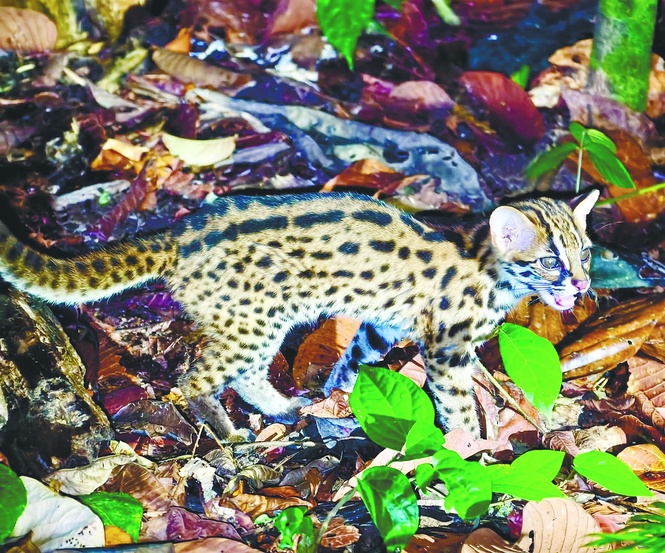
The leopard cat is one of five wild cat species found on Borneo, alongside the Sunda clouded leopard, marbled cat, flat-headed cat and the bay cat, the last of which is endemic to the island and rarely photographed even by camera traps.
STAFF at the Rainforest Discovery Centre (RDC) in Sepilok, Sandakan, have recently recorded a rare nighttime sighting of a juvenile leopard cat (Prionailurus bengalensis), giving conservationists a fresh reminder of the biodiversity still thriving within the reserve.
The animal was photographed by RDC staff member Mohd Sazalee Roslee during nocturnal monitoring.
Sabah Forestry deputy director (Research and Development) Dr Arthur Chung said the image captured the cat during its nighttime activity, and described it as a welcome addition to the centre’s records.
Small cat with big adaptations
The leopard cat is one of five wild cat species found on Borneo, alongside the Sunda clouded leopard, marbled cat, flat-headed cat and the bay cat, the last of which is endemic to the island and rarely photographed even by camera traps.
Despite its name, the leopard cat is not closely related to true leopards. The name refers only to its spotted coat, which typically bears solid black markings that blend into streaks running along the neck and back, an effective camouflage pattern for the dappled light of the forest floor.
Chung said while the leopard cat is roughly the size of a domestic cat, it has comparatively longer legs, an adaptation suited to moving quickly through dense undergrowth.
Adults typically weigh between 3kg and 5kg and measure 40cm to 55cm in head-to-body length, with a tail adding another 23cm to 29cm.
It is also a competent swimmer and climber, and unlike some of its more arboreal relatives, hunts both on the ground as well as in the trees.
As a nocturnal and naturally seclusive animal, the leopard cat is not often seen even where it is known to live, making documented encounters like this one useful to researchers monitoring the health of the forest.
An opportunistic hunter
According to Chung, the leopard cat’s diet is varied and opportunistic, comprising mostly small rodents, shrews and birds, and extending to lizards, amphibians and insects, depending on what is available.
That adaptability is part of why the species is classified as “Least Concern” on the IUCN Red List and remains the most widely distributed wild cat in Asia, found from Pakistan and India through Southeast Asia to China, Korea and the Indonesian islands.
In Borneo, it is recognised as its own subspecies, The Rainforest Discovery Centre (RDC) in Sepilok, Sandakan.
Researchers who study the species elsewhere on the island, including in Sabah’s Deramakot Forest Reserve, have noted that leopard cats tend to tolerate disturbed and secondary forest better than many of Borneo’s other wild cats, which is one reason sightings turn up periodically in accessible, well-managed reserves such as RDC.
Sign of a breeding population
Leopard cats are typically solitary animals outside of breeding and rearing periods, so the appearance of a juvenile is a notable detail.
Arthur said it points to a reproducing population living within or near the reserve, rather than a single transient animal passing through.
Since opening in 1996, RDC has built a reputation as one of Sabah’s more accessible environmental education sites, known for its 620m canopy skywalk and status as an “Important Bird Area”, drawing both casual visitors and birders hoping to spot species such as the Bornean bristlehead.
Sightings of rarer mammals like the leopard cat add another dimension to that reputation, giving the centre material to highlight Borneo’s less-known wild cats alongside its more famous residents, such as orangutans and hornbills, in its ongoing conservation and education work.
Chung said the sighting reaffirms the ecological value of the Kabili-Sepilok Forest Reserve and reinforces the importance of protecting the forest habitat that species like the leopard cat depend on.
FOR SALE: Thousands of hectares of “rare beauty” owned by an English lord, which could become one of Britain’s biggest sanctuaries of biodiversity.
A leading UK conservation charity is in a crowdfunding race against time in an ambitious bid to buy a swathe of rolling moorlands and woodlands, in the largest land sale in England in three decades.
The Wildlife Trusts organisation needs to raise £30 million (RM166 million) to acquire the whole 3,800ha Rothbury Estate in northern Northumberland.
It has launched a major donations campaign and so far collected £20.6 million in just under two years. But that leaves a little less than £10 million to find by the end of September.
“This is a once-in-a-lifetime opportunity and we can’t let this go,” Peter Batchelor, who is managing the acquisition plan for the Wildlife Trusts, told AFP. More than 20,000 people have contributed to date, “some giving £5 and others £5 million”, he said.
The Wildlife Trusts bought part of the estate – including the famous Simonside Hills – in late 2024. Its sale has surprised many given the Percy family – the Dukes of Northumberland – have owned it for almost eight centuries, using the land until 2022 for grouse shooting.
The current duke’s son Max Percy has said it is too difficult to manage from his home in southern England.
He has agreed to give the charity two years to raise the funds to buy the remainder.
‘Nature-depleted’
Carpeted with purple heather and green ferns, conservation specialist Duncan Hutt can already imagine what the entire estate – an area as big as central London – might look like if acquired.
It could feature “new scrub, trees, woodland”, restored peatlands and cattle pastures, he said, gazing out over the site some 50km north of Newcastle.
If the fundraising effort falls short, the charities fear the estate will be carved up and sold to different owners, who could exploit the lands for commercial purposes.
“We were very concerned about who would buy it and what they would do with it,” said Katy Nickolls, Rothbury’s Women Institute secretary who has lived locally for 30 years.
Famed UK naturalist David Attenborough has even voiced his support in a video, triggering a surge in donations – £1 million in a single week.
Bordered by several nature reserves and restoration project areas, the Wildlife Trusts and owners of those sites dream of one day creating a 65km-long biodiversity corridor stretching inland from the estate by the North Sea.
It would provide a much-needed sanctuary for wildlife in the denselypopulated, nature-ravaged UK.
According to the State of Nature 2023 report – compiled by dozens of conservation organisations and research institutes – it is “now one of the most nature-depleted countries on Earth”.
The report blamed “intensive management of agricultural land” as “the most significant factor driving species’ population change”.
‘Big’ patch
Katy Barke, nature recovery head at Northumberland Wildlife Trust, which is a Wildlife Trusts network member, watched through binoculars as skylarks flew over a flower-filled meadow.
Other species include red squirrels, cuckoos, hares and butterflies. Pine martens and golden eagles, which already inhabit the region, could potentially return.
The potential introduction of beavers would create pools teeming with insects and invertebrates, and strengthen resilience to floods, which have become more frequent due to the impacts of climate change.
Meanwhile, the lands also harbour archaeological treasures, including prized Neolithic rock carvings.
Barke noted the size and “integrity” of the Rothbury Estate set it apart. “In terms of England, it’s about as big a patch of land that you (can) get… so that’s really special,” she said.
The sale has caused “some nervousness” among local people about the change of ownership, admitted Sophie Bulgin, estate project manager.
There have been rumours of the possible reintroduction of wild animals such as bison. But the coalition has said any such move would be put to public consultation.
The Wildlife Trusts wants to encourage the dozen farmers, mainly keeping sheep, to adopt more environmentally friendly practices, using fewer pesticides and chemical fertilisers.
The charity insists it wants to involve local communities in its efforts to promote nature and biodiversity.
For recreation, the Trusts also plans to turn an old railway line running through the estate into a cycle path and hiking trail.