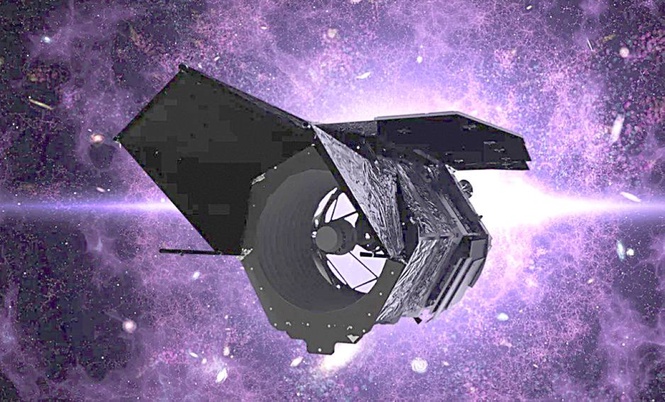
NASA launched its latest deep-space flagship observatory, the Nancy Grace Roman Space Telescope, embarking on a wide-angle mission to map the large-scale structure of the cosmos and analyze the fundamental physics of dark energy. The 18,000-pound spacecraft lifted off at 7:26 a.m. EDT aboard a SpaceX Falcon Heavy rocket from Launch Complex 39A at NASA’s Kennedy Space Center in Florida.
Flight controllers at NASA’s Goddard Space Flight Center in Greenbelt, Maryland, established telemetry communications with the spacecraft within seven minutes of liftoff. The telescope separated from the rocket's second stage roughly 31 minutes into flight. Ground teams confirmed the deployment of its solar arrays and lower instrument sunshade approximately 83 minutes after launch, according to NASA.
Tracked by NASA’s Near Space Network and Deep Space Network, the observatory is navigating a 100-day journey toward the second Sun-Earth Lagrange point, known as L2. Located approximately one million miles (1.5 million kilometers) from Earth in the direction opposite the sun, the region offers a stable thermal environment for high-precision infrared astronomy. Upon arrival at its destination, the $4.3-billion telescope will undergo a three-month commissioning phase. Engineers will test and calibrate its systems, with NASA targeting the release of initial public test images in early 2027.
The telescope features a 2.4-meter primary mirror — the same physical scale as the Hubble Space Telescope — coupled with a 300-megapixel Wide Field Instrument. This system provides a field of view 100 times larger than Hubble’s infrared capability while maintaining comparable image resolution. The hardware enables the observatory to map the sky nearly 1,000 times faster than its predecessor, according to NASA.
The mission is also testing advanced technological systems, including a Coronagraph Instrument designed to filter out direct starlight to image surrounding gas giant planets. NASA officials noted the coronagraph serves as a operational proof of concept for future observatories aimed at searching for potentially habitable, Earth-like worlds. Over its primary five-year mission, Roman is expected to beam down roughly 1.4 terabytes of data daily, marking the highest transmission rate of any astrophysics mission in NASA history.
Scientists plan to use the data to map more than two billion galaxies, catalog tens of thousands of distant exoplanets through gravitational microlensing, and chart the repulsive expansion force of dark energy across cosmic time. The observatory is named in honor of Nancy Grace Roman, NASA’s first chief astronomer, who was instrumental in establishing the agency's space astronomy program. NASA/SPACE.COM