
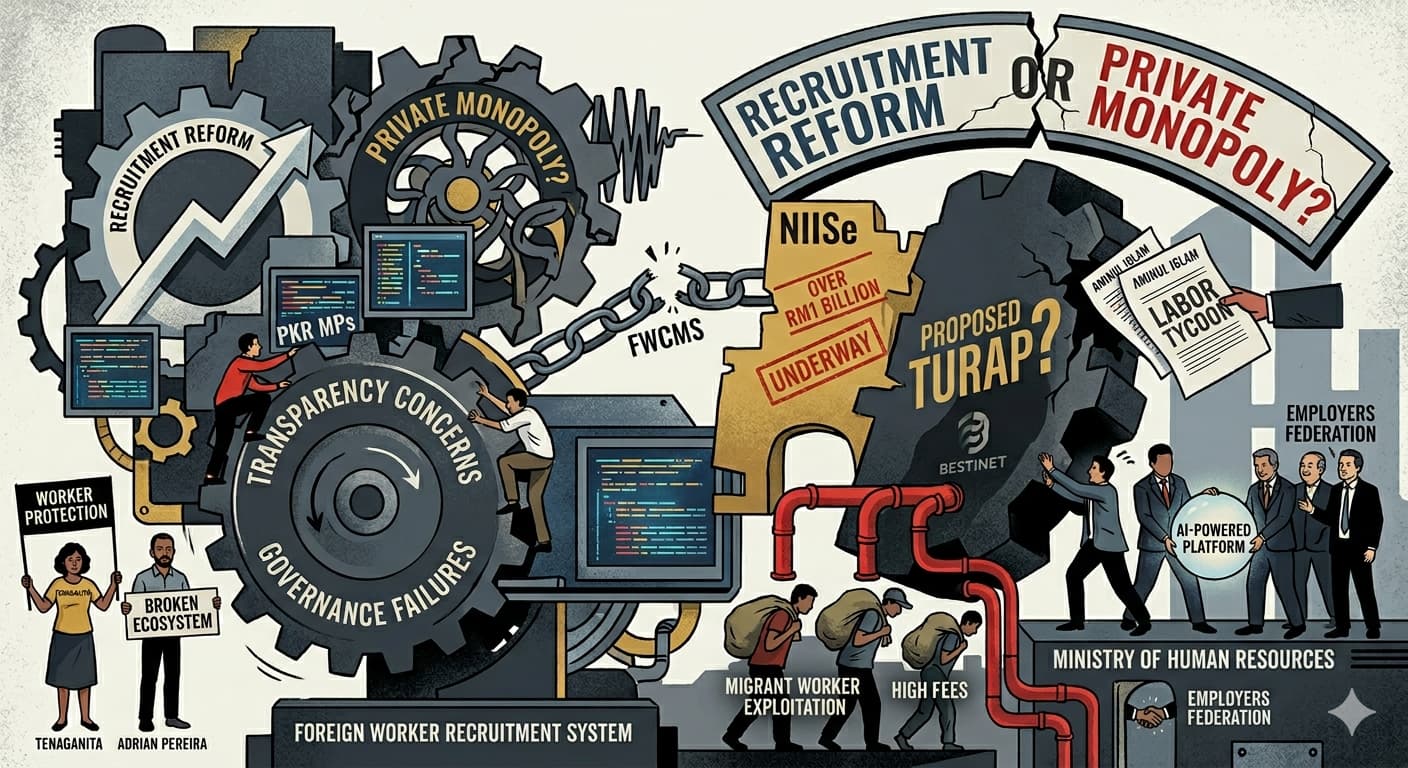
A growing policy rift within the government has cast fresh light on Malaysia’s long-standing struggle to reform its foreign worker recruitment system.
Ten PKR Members of Parliament, including Dato' Seri Rafizi Ramli (Pandan), Nik Nazmi Nik Ahmad (Setiawangsa), Wong Chen (Subang) and Lee Chean Chung (Petaling Jaya), have openly opposed the proposed Universal Recruitment Advanced Platform (Turap), arguing that Malaysia risks repeating past mistakes under the guise of labour recruitment digital reform.
The remaining six MPs are Rodziah Ismail (Ampang), Zahir Hassan (Wangsa Maju), Bakhtiar Wan Chik (Balik Pulau), Hassan Karim (Pasir Gudang), Onn Abu Bakar (Batu Pahat), and S. Kesavan (Sungai Siput).
At the heart of their objection lies a simple but critical question: why build a new system when an expensive one is already underway? The MPs point to the upcoming National Integrated Immigration System (NIISe), reportedly costing over RM1 billion and expected to be operational by 2028, as a sufficient and more appropriate platform to streamline immigration and labour processes.
Their concern is not merely about duplication, but governance. Malaysia is already contractually tied to the Foreign Workers Centralised Management System (FWCMS), operated by Bestinet Sdn Bhd, until 2031. Introducing Turap - reportedly linked to the same company - could effectively extend private sector dominance over a system that critics argue should remain firmly under government control.
The MPs did not mince words, warning that multiple overlapping systems would not only create inefficiencies but also entrench monopolistic practices. They highlighted troubling findings: FWCMS allegedly operated for years without a formal contract and suffered from weak controls that allowed unauthorised approvals. For them, these are not isolated glitches but symptoms of deeper governance failures.
Echoing these concerns, Charles Santiago has previously questioned the government’s continued reliance on Bestinet, citing irregularities in existing systems. The issue, therefore, is no longer just about technology - it is about trust, accountability, and institutional integrity.
However, the human resources ministry has pushed back against what it describes as premature criticism. Led by Minister Dato' Seri R. Ramanan, the ministry insists that Turap remains a proposal under evaluation, not a confirmed policy. It emphasised that no agreements or appointments have been finalised and that ongoing consultations with source countries such as Bangladesh, Indonesia, and India are still in early stages.
The ministry argues that an AI-powered platform could enhance transparency and efficiency, receiving support from major industry groups like the Malaysian Employers Federation and chambers of commerce. Yet, critics remain cautious, wary that “digitalisation” may simply mask structural flaws rather than resolve them.
Civil society voices have added further pressure. Labour rights group Tenaganita has called for full transparency, warning against yet another cycle of opaque systems that burden migrant workers with high fees and debt. Its message is unmistakable: reform must prioritise worker protection, not corporate profit.
Similarly, activist Adrian Pereira painted a grim picture, suggesting that exploitation remains widespread regardless of the system in place. His blunt assessment highlights a sobering reality - technology alone cannot fix a broken ecosystem.
Even more concerning are ongoing legal allegations surrounding Bestinet’s founder, Dato' Seri Aminul Islam, who faces scrutiny abroad over claims of money laundering and trafficking-related activities - allegations he has denied. While unrelated to current policy decisions, such issues inevitably cast a long shadow over public confidence.
As Malaysia stands at a crossroads, the debate over Turap reveals a deeper dilemma: is the country genuinely reforming its migrant labour system, or merely repackaging it? Without transparency, accountability, and meaningful stakeholder engagement, any new platform - no matter how advanced - risks becoming another costly chapter in a familiar story.
In the end, the real test is not whether Malaysia can build a better system, but whether it can build one that is fair, transparent, and truly free from the shadows of its past.
By: Kpost
Information Source:
Kpost (ckhorsk@gmail.com) is a content creator under the Newswav Creator programme, where you get to express yourself, be a citizen journalist, and at the same time monetize your content & reach millions of users on Newswav. Log in to creator.newswav.com and become a Newswav Creator now!
The User Content (as defined on Newswav Terms of Use) above including the views expressed and media (pictures, videos, citations etc) were submitted & posted by the author. Newswav is solely an aggregation platform that hosts the User Content. If you have any questions about the content, copyright or other issues of the work, please contact creator@newswav.com.
