
In Malaysia, the longstanding income classification system ~ Bottom 40% (B40), Middle 40% (M40), and Top 20% (T20) ~ has long shaped public policies and economic debates.
The chart below illustrates the income thresholds for the B40, M40, and T20 categories:
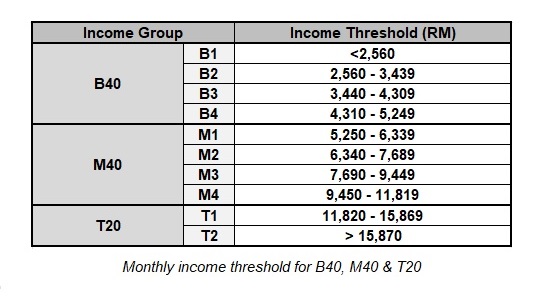
However, as Malaysia's economy evolves, the relevance and accuracy of these categories have come under scrutiny. Recent insights from the Khazanah Research Institute (KRI) suggest that these classifications may no longer reflect the realities of the country's socioeconomic landscape.
Misconceptions About Income and Wealth
KRI researchers Gregory Ho and Dr. Suraya Ismail argue that the B40-M40-T20 framework is misleading because it focuses solely on income, often conflating it with wealth. Wealth, which encompasses assets, investments, properties, and even social capital, paints a far more nuanced picture of financial well-being. According to KRI, while poverty can be measured objectively through thresholds like the national poverty line, affluence is a relative and context-dependent concept.
For instance, in developed nations, being "rich" might entail owning luxury cars or extensive financial portfolios. In Malaysia, however, "richness" might simply mean owning a home and achieving financial security. This disparity underscores the limitations of income-based classifications in assessing true affluence.
A New Framework: B20-M50-T30
KRI proposes a new model that divides households into Bottom 20% (B20), Middle 50% (M50), and Top 30% (T30), based on equivalised income ~ a method that adjusts household income by considering the size and composition of households. This approach provides a more accurate comparison of financial well-being across diverse household structures.
For example, a family of four earning RM4,000 a month faces different financial pressures than a single-person household earning the same amount. Equivalised income accounts for these differences, ensuring a fairer assessment of household resources.
Key Insights
1. B20: Households primarily focused on basic necessities like food, housing, and clothing.
2. M50: Economically unstable households navigating trade-offs between essential and aspirational goods.
3. T30: Households exhibiting aspirational spending patterns but not necessarily wealthy by global standards.
Implications for Policy
The proposed framework challenges the assumption that the T20 represents unequivocal affluence. It also highlights the financial vulnerability of the M50 group, which often finds itself excluded from both government assistance and opportunities for upward mobility.
KRI emphasizes that addressing the needs of the M50 is crucial for fostering social mobility and reducing inequality.
Suggested interventions include:
• Targeted subsidies for education and healthcare.
• Job creation initiatives.
• Improved social safety nets for the B20 to alleviate poverty.
Moving Beyond Outdated Classifications
The introduction of the T15 classification in the 2025 Budget signals the government’s recognition of the need for more precise income categorization. KRI's insights urge policymakers to adopt a more integrated expenditure-based approach, ensuring that resources are directed where they are most needed.
In a rapidly changing economic environment, rethinking how we define and measure wealth is not just an academic exercise but it is essential for creating policies that address the vulnerabilities and aspirations of all Malaysians.
By: Kpost
Information Source:
Nst , DailyExpress , KrinstituteOrg
Kpost is a content creator under the Newswav Creator programme, where you get to express yourself, be a citizen journalist, and at the same time monetize your content & reach millions of users on Newswav. Log in to creator.newswav.com and become a Newswav Creator now!
The User Content (as defined on Newswav Terms of Use) above including the views expressed and media (pictures, videos, citations etc) were submitted & posted by the author. Newswav is solely an aggregation platform that hosts the User Content. If you have any questions about the content, copyright or other issues of the work, please contact Newswav.

