
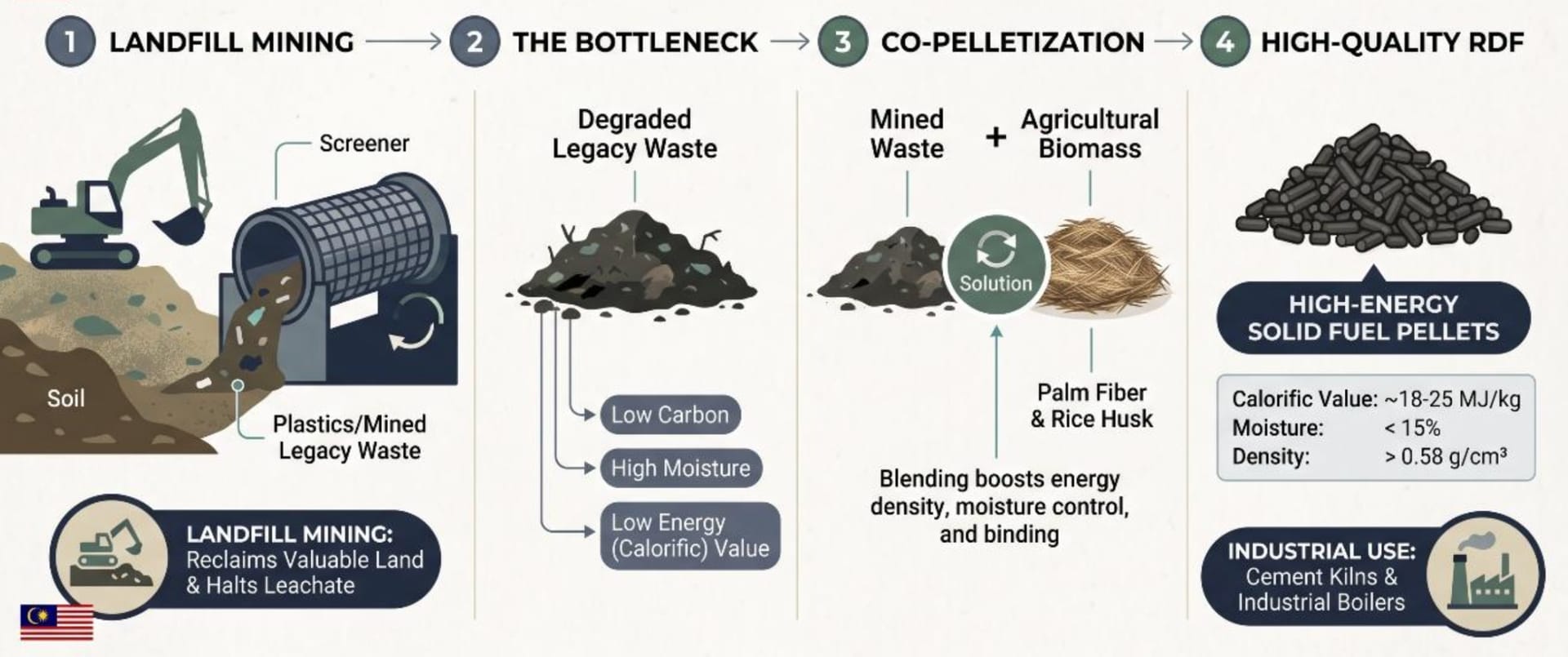
Every single day, Malaysia generates nearly 39,000 tonnes of municipal solid waste (MSW), an enormous volume equivalent to filling almost 3,000 garbage trucks daily (Zaikariah, 2026). For decades, the nation has depended heavily on open dumping and unmanaged landfilling. Today, Malaysia operates 135 active landfills, but only 22 are engineered sanitary facilities, leaving over 110 sites operating as open dumpsites (Zaikariah, 2026; Priyambada et al., 2026). Official projections from SWCorp warn that these facilities will reach maximum capacity by 2041 as waste generation continues to grow by 1.3% to 1.7% annually (Zaikariah, 2026).
Beyond severe land scarcity, unmanaged legacy waste poses critical environmental and financial hazards. Trapped organic food scraps decompose anaerobically, releasing untrapped methane emissions that accelerate climate disruption. Simultaneously, untreated toxic leachate threatens freshwater river systems. A striking example occurred in 2019 when a landfill bund breach at the Ladang CEP (CEP Estate) sanitary landfill in Renggam, Johor, released heavy metals and high concentrations of ammonia into Sungai Benut, forcing the closure of a major water treatment plant serving over 75,000 residents. Moreover, maintaining 174 closed landfill sites imposes an ongoing fiscal burden of RM1.9 billion annually on Malaysian taxpayers (Zaikariah, 2026).
To decarbonize its power grid, Malaysia set a national target of a 31% renewable energy (RE) share of installed capacity by 2025, which was reported as achieved in December 2025 (Bernama, 2026), and has longer-term targets of 40% by 2035 and 70% by 2050 under the National Energy Transition Roadmap (NETR) (Ministry of Economy, 2023). Progress has been supported mainly by Large-Scale Solar (LSS) schemes alongside hydropower (Najmin, 2026, Nordin et al. 2024). However, this rapid solar deployment introduces a distinct clean energy paradox, end-of-life photovoltaic (PV) modules will eventually generate a significant e-waste management issue (Nordin et al., 2024). One recent projection indicates that Malaysia will generate over 191,380 tonnes of solar panel waste by 2051 (Mohamed Sultan et al., 2025). While solar technology addresses atmospheric carbon during power generation, it cannot eliminate the physical municipal waste accumulating in local landfills today. A resilient clean energy transition requires a balanced generation mix (Nordin et al., 2024; Priyambada et al., 2026). In the authors’ view, Waste-to-Energy (WTE) solutions, specifically Refuse-Derived Fuel (RDF), can complement solar PV by transforming daily physical waste streams into clean, dispatchable energy. This is the authors’ recommendation rather than an established national policy position.
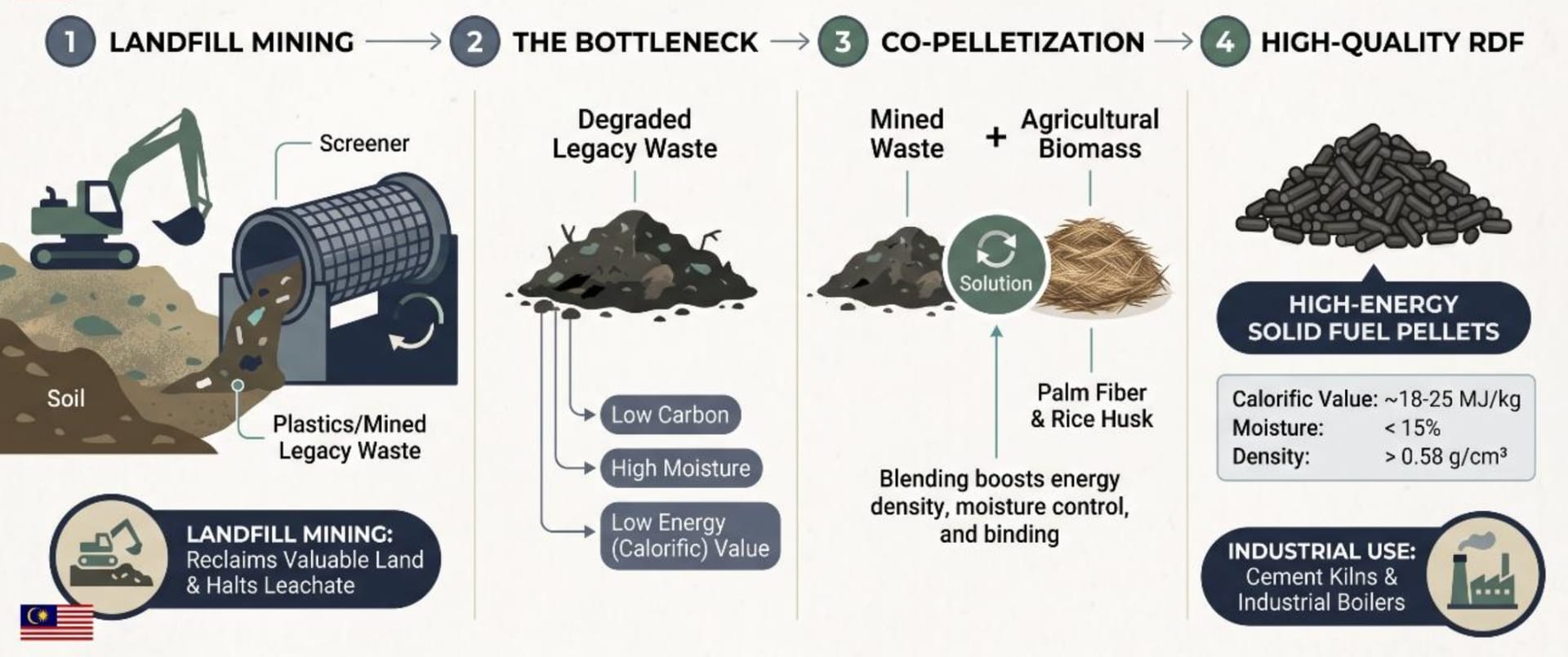
Refuse-Derived Fuel (RDF) is an engineered solid fuel produced by processing non-recyclable, high-calorific waste materials (Figure 1). Through mechanical and biological treatment including sorting, drying, shredding, and densification combustible fractions such as plastics, paper, cardboard, and textiles are converted into uniform, high-energy solid fuel pellets (García et al., 2021; Salaripoor et al., 2025; Priyambada et al., 2026). Commercial adoption of RDF is accelerating as energy-intensive industries seek low-carbon alternatives to fossil fuels. Cement kilns and industrial boilers utilize high-grade RDF as a direct substitute for fossil coal and petroleum coke (Salaripoor et al., 2025; Priyambada et al., 2026). Co-firing RDF in high-temperature kilns offers substantial economic and ecological advantages. It lowers industrial carbon dioxide emissions, reduces fuel procurement costs, and diverts non-recyclable materials from finite landfills into a productive circular economy (Salaripoor et al., 2025).
To supply feedstock for RDF production while tackling historical waste liabilities, environmental planners are turning to landfill mining. Landfill mining involves excavating, screening, and recovering buried legacy waste from aged dumpsites (Han et al., 2026). This approach delivers a compelling dual victory for national sustainability (Han et al., 2026; Priyambada et al., 2026). It enables land reclamation and environmental remediation by freeing valuable urban space, halting leachate infiltration into groundwater, and eliminating public health hazards, while simultaneously recovering vast quantities of buried combustible materials that can be valorised into secondary industrial fuel. By systematically mining these aged dumpsites, Malaysia can shrink its historic waste footprint and secure a stable, domestic energy supply. Despite its immense promise, excavating legacy waste reveals a major technical hurdle in which aged landfill waste undergoes extensive biological degradation over time. Consequently, mined legacy waste suffers from low carbonaceous content, high moisture levels, elevated ash content, poor binding ability, and low calorific value. When densified alone, degraded waste exhibits poor particle density (as low as 0.43 g/cm³), high elastic expansion during storage, and unstable combustion profiles (Han et al., 2026).
To overcome this bottleneck, recent scientific literature highlights co-pelletization of landfill waste with carbon-rich agricultural biomass or dewatered sewage sludge (García et al., 2021; Han et al., 2026; Wu et al., 2026). Blending mined waste with agricultural residues (such as palm oil empty fruit bunches, rice husks, pine sawdust, straw, or coconut husks) restores the overall carbon framework and calorific value (García et al., 2021; Han et al., 2026). Furthermore, incorporating biomass or sewage sludge introduces natural binding agents including lignin, cellulose, and extracellular polymeric substances (EPS), which significantly improve pellet durability, increase particle density (>0.58 g/cm³), prevent storage degradation, and stabilize high-temperature combustion (Han et al., 2026; Wu et al., 2026). Blending degraded legacy waste with agricultural biomass (such as palm oil empty fruit bunches or rice husks) restores the lost carbon framework, increasing particle density from 0.43 g/cm³ to over 0.58 g/cm³ while delivering stable high-temperature combustion performance.
To achieve widespread industrial adoption, waste-derived pellets must meet international quality standards, such as the solid recovered fuel (SRF) specifications and classes in ISO 21640:2021 (ISO, 2021), of which Class 1 is the highest grade. Market-ready, high-grade RDF requires several balanced chemical and physical characteristics:
- High Heating Value: A net calorific value (NCV) of at least 25 MJ/kg (25,000 kJ/kg) for ISO 21640:2021 Class 1 (≥20 and ≥15 MJ/kg for Classes 2 and 3) to effectively match commercial industrial coal.
- Low Moisture Content: Moisture levels reduced below 10–15% via biological or thermal drying to maximize combustion efficiency and heat output.
- Low Chlorine & Heavy Metal Content: Strictly controlled chlorine levels (≤0.2% dry mass for Class 1; ≤0.6% and ≤1.0% for Classes 2 and 3) and heavy metal concentrations to eliminate boiler slagging, fouling, and high-temperature equipment corrosion.
- High Density & Mechanical Durability: Particle density above 0.58 g/cm³ (up to about 1.0 g/cm³) and mechanical durability exceeding 96% (with an Impact Resistance Index up to 300) to prevent dust generation, crumbling, and structural degradation during transport and handling.
Malaysia stands at a decisive crossroads in its waste management and energy transition journey. The broader policy context includes the Circular Economy Blueprint for Solid Waste (2025–2035) (KPKT, 2024), which sets the direction for solid waste management and includes expanding waste-to-energy facilities, the National Energy Transition Roadmap (NETR), which sets the national RE targets, and the Ministry of Investment, Trade and Industry’s (MITI) Circular Economy Policy Framework. These documents provide general circular economy and energy-transition context and, to the authors’ knowledge, do not set RDF-specific targets or standards. The RDF-specific policy and standards framework is still to be developed. Furthermore, fiscal incentives are available under the Green Technology Tax Incentive. The Green Investment Tax Allowance (GITA) for business purposes is applied for through the Malaysian Investment Development Authority (MIDA), while the Malaysian Green Technology and Climate Change Corporation (MGTC) administers GITA for assets and verifies qualifying capital expenditure. Integrated waste management projects fall under Tier 2, which offers a 100% Investment Tax Allowance on qualifying capital expenditure, offset against 100% of statutory income over five years (MIDA, 2024), and Budget 2027 extended GITA until 31 December 2030 (Yi and Rajan, 2026). Eligibility of individual RDF projects should be confirmed with MIDA. However, policy frameworks and tax incentives alone are not enough. Realizing commercial RDF production requires establishing structured Public-Private Partnerships (PPP), enforcing mandatory municipal waste separation, and building reliable supply chains that connect municipal waste operators with heavy industrial off-takers. With coordinated institutional backing and private sector technology adoption, Malaysia can successfully dig itself out of its landfill crisis transforming legacy environmental liabilities into high-value green wealth.
This article is prepared in collaboration between SEDA Malaysia and Universiti Sains Malaysia
Author:
Ts. Dr. Nik Azimatolakma Binti Awang
School of Civil Engineering,
Tuanku Syed Sirajuddin Engineering Campus,
Universiti Sains Malaysia.