CHINA is reportedly considering 10 possible countermeasures against the Philippines, including sanctions on Filipino politicians, cuts in fuel and fertilizer supplies, and the removal of a Philippine Navy ship grounded at Ayungin Shoal, amid escalating tensions over the South China Sea and recent remarks by Defense Secretary Gilberto Teodoro Jr.
The proposed measures, outlined in a report by the Manila-based Chinese-language newspaper Philippine Shangbao, also known as Chinese Commercial News, have not been officially confirmed by Beijing, and it remains unclear whether they have entered China’s formal decision-making process.
Citing unnamed sources, the newspaper said Beijing was losing patience with recent Philippine actions and statements concerning China. The reported options cover maritime security, trade, tourism, labor, diplomacy and consular relations.
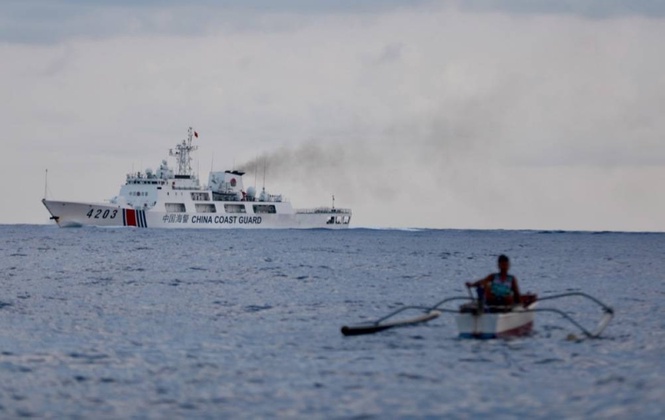
Among the most consequential proposals is towing away the BRP Sierra Madre, which Manila deliberately grounded at Ayungin Shoal, internationally known as Second Thomas Shoal, to maintain a Philippine presence in the disputed waters.
China is also reportedly considering blocking Philippine resupply missions to the ship and taking stronger action against attempts to reach the outpost.
Any attempt to remove the vessel or prevent its resupply could further heighten tensions between Manila and Beijing, whose competing claims in the South China Sea have repeatedly triggered confrontations between their maritime forces.
The Philippines maintains that Ayungin Shoal lies within its exclusive economic zone and continues to supply Filipino personnel aboard the aging vessel despite repeated Chinese efforts to block or disrupt resupply missions.
The reported economic measures include suspending supplies of refined petroleum products and fertilizers to the Philippines, and restricting exports of other goods considered urgently needed by the country.
If implemented, the measures could put additional pressure on Philippine energy supplies, agricultural production and supply chains, while straining bilateral trade.
Beijing is also reportedly weighing sanctions against Philippine politicians considered hostile to China, including entry bans covering them and their immediate family members in mainland China, Hong Kong and Macao.
Other proposed actions include freezing their assets in Chinese territory, prohibiting Chinese companies and individuals from conducting transactions with them, and publicly disclosing their alleged business dealings, personal ties to Chinese entities and assets held in China.
The report also cited a possible travel advisory discouraging Chinese citizens from visiting the Philippines, with alleged online gambling operations, telecommunications fraud, kidnapping and security risks among the concerns that could be invoked.
Another proposed measure involves tighter enforcement of visa and employment regulations affecting Filipino workers in Hong Kong and Macao, including arrests of those found violating immigration rules and the suspension of labor-related dialogue with Manila. China could also intensify arrests of Filipinos working illegally on the mainland.
On the diplomatic front, Beijing could demand the closure of some Philippine consulates in China, including the Philippine Consulate General in Hong Kong, if Manila allows Taiwan authorities to establish an additional office in Cebu.
The report said China could cite what it considers an imbalance in the number of consulates the two countries maintain in each other’s territories.
Beijing steps up criticism of Teodoro
The reported countermeasures come as the Chinese Embassy in Manila intensified its criticism of Teodoro over his remarks on China and his involvement in a May operation at Sanjia Steel Corp., during which 70 Chinese workers were arrested.
In a separate statement, the embassy raised seven questions about the operation, including why the Defense secretary participated in a law enforcement action, why Chinese workers were detained while Filipino workers were released, and why military aircraft were used to transport the Chinese citizens to Manila.
The embassy alleged that the 70 workers were held in overcrowded conditions, claiming that 13 detainees were placed in a cell measuring about 5 square meters. It also accused Philippine authorities of failing to provide consular notification and access as required under bilateral arrangements.
According to the embassy, the workers were released after 32 days in detention.
Citing a May 28 resolution by the Department of Justice, the Chinese Embassy said the allegations lacked sufficient evidence to justify the workers’ continued detention. It questioned Teodoro’s continued accusations against them after the department’s action.
The embassy also challenged Teodoro’s suggestion that the workers’ failure to carry their passports when arrested raised suspicions of human trafficking.
In response to the embassy’s questioning, Teodoro had said the government was not obliged to answer to the Chinese diplomatic mission over lawful operations, describing its intervention as interference and an abuse of Philippine sovereignty.
The embassy separately accused Teodoro of working with external parties to attack and discredit Chinese-language education in the Philippines, claiming that the actions had forced more than 180 Chinese teachers to leave the country.
It also rejected Teodoro’s characterization of China as a regional “troublemaker,” arguing that such remarks would do little to improve bilateral relations.
The reported countermeasures remain unverified as official Chinese policy. The newspaper’s account and the embassy’s statements do not establish that Beijing has decided to implement any of the proposed actions.
Malacañang, the Department of Foreign Affairs (DFA) and the Department of National Defense have yet to comment on the report.
‘Weaponized narrative’
House prosecution panel adviser and spokesman Ace Barbers on Thursday warned that an unconfirmed report on possible Chinese sanctions against the Philippines could be a “weaponized narrative” to intimidate Philippine leaders and weaken public resolve on the West Philippine Sea.
“Unless these hostile measures are officially confirmed by the Chinese government, we must view this as a weaponized narrative and a state-directed ‘propaganda plant’ specifically designed to target our supply chains, intimidate our leaders and fracture public resolve on the West Philippine Sea,” Barbers said.
He said the report lacked identified sources and acknowledged that the proposed measures had not entered Beijing’s formal decision-making process, urging the public not to mistake unverified media reports for official Chinese government policy.
Barbers also drew parallels with claims circulated in September about alleged historical ties between Batanes and Taiwan, which were amplified by China’s state-run Global Times.
“Our national stance on the West Philippine Sea is unshakable, and we will not be bullied by phantom threats from unverified media mouthpieces,” Barbers said, urging Filipinos to reject what he described as psychological warfare and stand firmly behind the country’s sovereign rights.
Akbayan Party-list Rep. Percival Cendaña on Thursday warned that China’s alleged consideration of retaliatory measures against the Philippines could further escalate tensions between the two countries.
“If true, these alleged retaliatory actions are a serious escalation from the Chinese government. Filipinos simply chose to stand up for their rights and sovereignty,” Cendaña told The Manila Times.
“It is very disappointing that the Chinese government would contemplate an inordinately harsh response to Filipinos’ calls for accountability from a Chinese diplomatic official,” he added.
Undiplomatic
The DFA said the latest “undiplomatic” social media statements of the Chinese Embassy in Manila severely undermined the efforts to stabilize and improve bilateral relations between the two countries. The embassy earlier said the lawmakers who wanted to declare Chinese Ambassador Jing Quan persona non grata are not welcome to China and even dared them to also seek the closure of the embassy.
“The escalatory and undiplomatic tone and language used in the latest social media statements of the Chinese Embassy erode mutual trust and confidence,” the DFA said in a statement on Thursday.
The Foreign Affairs department said “all diplomats are expected to conduct and express themselves in a manner befitting diplomatic envoys, especially on social media.” The Philippines values its relations with China, the DFA said. It also reaffirmed the Philippines’ continued adherence to its One-China Policy.
But the embassy’s recent public statements “do not reflect the long-standing spirit of constructive engagement between the two countries and the two foreign ministries,” it stressed.
“Such statements are not conducive to good relations nor to the effective discharge of diplomatic functions,” the DFA said.
The DFA reiterated that it “reserves the right to take further diplomatic action as it deems necessary.”