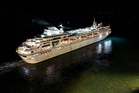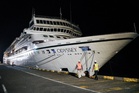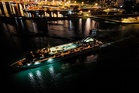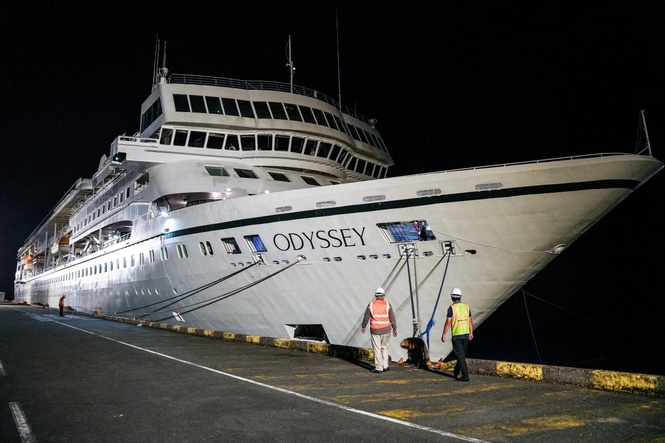
The Villa Vie Odyssey cruise ship has been legally detained in Singapore amid ongoing financial issues.
Odyssey was stranded in Cambodia on 27 October after operator Villa Vie Residences unexpectedly suspended operations, citing an increase in fuel costs.
The residential vessel left Cambodia, sailing out of Sihanoukville with no passengers on board and a crew of around 50, on 8 November.
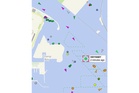
According to court records, Odyssey was listed “under sheriff’s arrest” at 10.34am local time on Sunday morning at Changi General Purpose Anchorage off Singapore’s east coast.
Singaporean law firm Helmsman LLC is listed as the arresting solicitor, likely representing a fuel supplier, according to CBS News.
A ship arrest is a legal procedure where a court detains a marine vessel until a legal claim is settled, such as unpaid fuel or port fees.
Once a ship is arrested, it cannot sail until the owner provides a payment or a judicial sale is made of the vessel.
Ahead of its launch, Villa Vie promised an around-the-world sail starting in October 2024, visiting more than 425 ports in 147 destinations over three and a half years.
Problems plagued this ship from the start, casting a shadow over the pioneering cruise when the new residents endured four months in 2024 stuck in Belfast after a string of last-minute repairs.
The ship had been cruising the world for at least 755 days when its 200 passengers were given just eight hours to disembark.
“The vessel has been placed under arrest pursuant to a court order,” the Maritime and Port Authority of Singapore told Business Insider.
“The crew onboard are reported to be well, and arrangements for their welfare and wellbeing are being managed by the vessel’s creditors.”
The Independent has contacted Villa Vie Residences and the Maritime and Port Authority of Singapore for comment.
Odyssey was supposed to offer guests something more permanent than a holiday. It was meant to be a home from which passengers could travel the world indefinitely.
Villa Vie had marketed cabins for sale at between $120,000 (£89,225) and $440,000 (£327,161), with residents able to buy cabins outright, sign up for five-year stays, or rent rooms for shorter periods.
However, Villa Vie said on 27 October the cost of fuel had risen sharply in the regions where the Odyssey was operating, with monthly expenditure per cabin climbing from an average of $1,800 (£1,338) to an estimated $6,000 (£4,461) to $8,000 (£5,948) in parts of Asia.
“Since the conflict began in late February, we have taken significant steps to reduce fuel consumption, including slowing the itinerary and spending more time in port,” the operator said in a statement, referring to the US-Israeli war against Iran. “Those measures have not been enough to offset the extraordinary increase in fuel costs, and we have been unable to continue carrying the resulting operating losses.”
It added that passing the full increase on to residents was “not a realistic solution”.
“For us, when our monthly expenses go up from $400,000 (£297,419) to $2m (£1.49m) where are we going to get the $1.6m (£1.19m)?” the company’s chief executive, Mikael Petterson, told CBS News in October.
He said the company had tried to keep the vessel running by borrowing money and delaying payments, but were “at a point where it's just at a breaking point where we need capitalisation”.
He also said the company planned to file for bankruptcy in the US.
In August, when Odyssey was docked in Singapore, residents were asked to help raise money to keep it sailing.
Darrell Carp, a resident who said he had lost $250,000 (£185,887), said passengers had not been fully aware of the scale of the company's debts. “There's no question that we ran out of money in Singapore,” he said.
“We never fully understood the level of their debt. They were already behind on their payments on crew, and provisions, and fuel, and things like that.”
Another passenger paid around $400,000 directly to a fuel supplier from a personal bank account.
Some of the passengers had paid hundreds of thousands of dollars for cabins they expected to occupy for years, while others had sold their homes to finance life aboard the ship.
Kit Cassingham, who paid over $370,000 (£275,113) for the cabin she shared with her husband Randy, told News Nation that she had seen “red flags all along”, dating back to August when passengers had to pool in money to buy fuel to leave Singapore.
A group of residents subsequently tried to buy the vessel and continue the voyage, but their attempt failed after a lender declined to provide financing.
Read more: Stranded cruise ship finally leaves Cambodia after forcing hundreds of passengers off
Odyssey timeline: Trials and tribulations aboard the first-ever residential cruise
Legend of the Seas cruise ship arrives in US for debut Caribbean sailings
What happens when someone goes overboard on a cruise ship?
What travellers and hosts should know about Airbnb's new rules
Greggs launches world's first 'ring for a sausage roll' service at luxury hotel
Ryanair confirms new 60-minute luggage rule coming into effect today