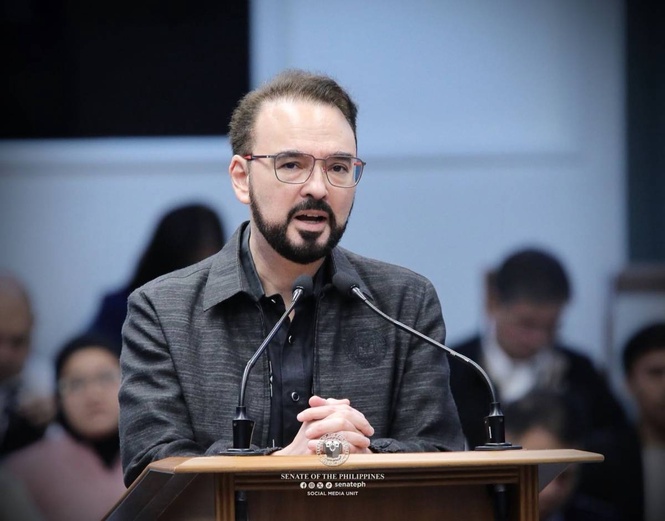
SENATE Minority Leader Alan Peter Cayetano on Friday questioned the government’s ability to fully fund the K–12 program.
”We have to make a radical decision. Do we fully fund K–12? And if we do that, we might have to add maybe another P500 billion — and I don’t know where to get that,” Cayetano said during the Senate’s deliberations on the Department of Education’s (DepEd) proposed 2027 budget on Oct. 16.
Cayetano urged Education Secretary Sonny Angara to initiate a formal debate on whether the country should retain the additional two years of senior high school.
”Or, do we take the hard decision of taking out one year — K to 11 or K to 10 — and focusing where it’s needed to be focused?” he added.
Cayetano said DepEd should first conduct a nationwide inventory of school facilities and resources to identify deficiencies and determine whether the government can afford to address them under the current system.
He proposed assessing schools by region or congressional district against standards covering clinics, guidance offices, covered courts and other essential facilities.
Cayetano argued that shortening the education cycle could free up resources to increase per-student spending, reduce classroom congestion, and improve school hours and learning outcomes.
He cited the Philippine Science High School system, where spending exceeds P224,000 per student, class sizes are capped at 30 and students receive eight hours of schooling daily.
In contrast, he said, DepEd-run public schools spend about P34,960 per student, with some classrooms accommodating 70 to 100 learners. Many also operate on shifting schedules, limiting school hours to five or six.
”We’re looking for a breakthrough,” Cayetano said, stressing that the government must decide whether to fully fund K–12 or concentrate limited resources on fewer years of schooling.
He acknowledged that cutting years would not solve every education problem but said improving spending per student and learning conditions was essential to the country’s future.
”When you look at the education system now, you can tell what kind of Philippines you will have 10 to 15 years from now,” he said.
The K–12 program, established under Republic Act 10533, covers kindergarten, six years of elementary school, four years of junior high school and two years of senior high school. Shortening the cycle would require changes to the law.