
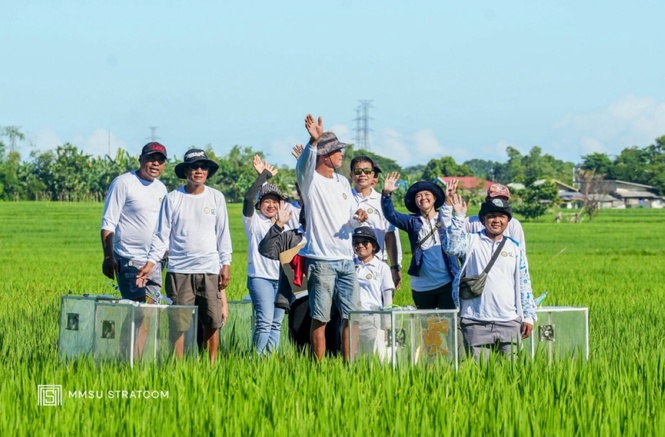
VINTAR, Ilocos Norte — In Barangay Alejo Malasig, the rice field itself has become a classroom.
On Sept. 15, farmers stood beside researchers in muddy paddies, watching as Mariano Marcos State University (MMSU) President Virgilio Julius Manzano Jr. demonstrated how to track water levels and collect gas samples from designated plots.
The activity is part of the 2026 wet-season experiment titled “Methane Emissions from Rice Cultivation Systems Utilizing Alternate Wetting and Drying (AWD) in Ilocos Norte,” a collaboration between MMSU and Verde Carbon Capture Inc., led by President Takato Senoo, the Philippine subsidiary of Japanese climate technology firm Green Carbon Inc.
The study spans 118 hectares in the villages of Alejo Malasig and Parut in Vintar and Barangay Surgui in Paoay.
It aims to test AWD, an irrigation method that introduces controlled drying periods instead of continuous flooding, to improve water efficiency, maintain yields and measure methane emissions under different water management systems.
What sets the project apart is how it places ordinary farmers at the center of the science.
Rather than conducting research inside the university, MMSU has transformed farmers’ fields into learning and demonstration sites where research becomes practical, understandable and relevant.
Farmer-cooperators work alongside project staff led by Janet Villamor, gaining hands-on exposure to data gathering, field monitoring, research methods and evidence-based water management.
Their farms serve as the research plots. Their daily observations feed into the dataset. Their questions shape how results are explained.
The project team said the approach also provides additional livelihood opportunities and income for cooperators, while showing how university research can strengthen farmer capacity and advance climate-smart agriculture and rural livelihoods.
During the sampling, Manzano, an agricultural engineer and Asean Engineer, guided the installation of additional perforated water-monitoring tubes in Vintar to better track subsurface water levels.
Over the season, the team will monitor water levels, assess soil and field conditions, measure crop growth and biomass, evaluate grain yield and collect methane samples from the paddies.
The technical work is deliberate, but the delivery is intentionally simple.
Farmers learn to read the water tubes, record levels, and understand why periodic drying can reduce methane — a potent greenhouse gas produced when flooded fields become anaerobic — without sacrificing productivity.
The collaboration is supported by members of the Rotary Club of Laoag Sunshine, who joined the fieldwork.
MMSU said the wet-season data will provide valuable insights into how AWD performs under local conditions in Ilocos Norte — how much water is saved, how rice responds, and how emissions change.
The AWD research in Ilocos Norte began implementation in November 2025 and continues through the 2026 wet season.
For the farmers in Alejo Malasig, Parut and Surgui, however, the impact is immediate: science is no longer distant. It is measured in their own fields, with their own hands, and explained in terms of water, yield and cost.
By bringing the laboratory to the paddy, the project reframes innovation not as something handed down to farmers, but as something built with them.