
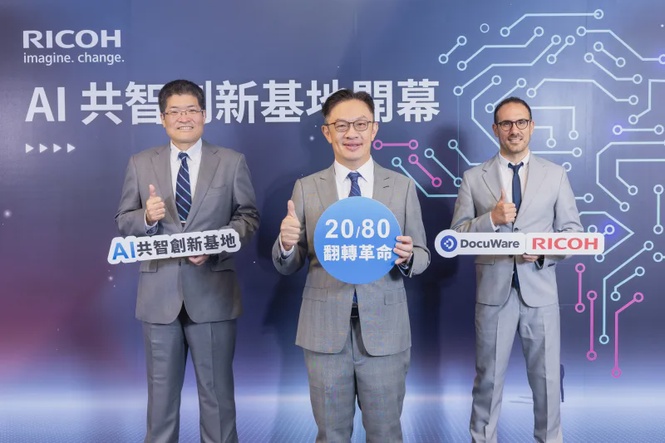
Ricoh Taiwan opened an enterprise AI facility it calls the AI Collaborative Innovation Hub on September 15, 2026, positioning document recognition and contract analysis as the practical entry point to corporate AI. The Japanese group is betting that Taiwanese companies lose more hours to filing and cross-checking paperwork than they stand to gain from adding another AI tool.
The Productivity Gap AI Tools Have Not Closed
The premise behind the hub is a gap that has become awkward for enterprise software vendors. Asana's global survey of more than 10,000 knowledge workers found that roughly 60% of working hours still go to coordination, hunting for information, and administrative process rather than to the work people were hired to do. Generative AI has spread quickly through Taiwanese offices, but few finance or compliance teams can yet point to hours returned.
Ricoh Taiwan's diagnosis is blunter than most vendor language: companies have plenty of data and very little knowledge, and technology that moves far faster than the processes it is dropped into. Documents sit in separate systems in inconsistent formats, so staff retype, reconcile, and search. The cost shows up twice, first in wasted hours and again in recruitment, training, and error correction.
The company packages this as a "20/80 efficiency revolution," arguing that in a conventional office as much as 80% of an employee's time goes to repetitive administration and under 20% to judgment, communication, and anything new. Digitizing and structuring scattered documents first, then handing the repetition to AI, is meant to invert that ratio.
Medical Device Audits Now Take Half The Time
The more persuasive part of Ricoh Taiwan's case is not the framework but two deployments already running in sectors that cannot afford recognition errors.
A global medical device brand selling through distributors had been sending staff into the field every quarter to spot-check sales records against stacks of paper invoices. Manual comparison was slow and left the company exposed on compliance deadlines. After AI document recognition was introduced, the system reads invoices across inconsistent formats, converts them into structured data, cross-references that against the company's own filings, and flags anomalies for a human to open.
Ricoh Taiwan says audit time fell by more than 50% and project coverage settled above 80%, with auditors moving from checking every line by hand to reviewing what the system had already sorted and questioned.
A Bank Runs 700,000 Documents A Year Behind A Closed Network
The second case is a large bank handling more than 700,000 items a year, among them court garnishment orders, corporate tax filings, payment slips, and utility bills. Built on DocuWare, the platform uses AI indexing to identify documents and extract fields, with recognition rates reported at 80% to 90%.
What matters as much as the accuracy figure is where the platform sits. It runs on a closed internal network with permission controls, a complete audit trail, and real-time alerting, a configuration Taiwanese financial institutions increasingly treat as non-negotiable before any AI touches customer records. Contracts, financial statements, and operating documents are precisely the material companies are least willing to send to a public model.
DocuWare AIDP Reads Handwritten Chinese From Two Samples
DocuWare, the enterprise content management company owned by Ricoh, supplies the software behind both cases, and Ricoh Taiwan is leading with two of its AI components.
DocuWare AIDP applies large language models so the system interprets a document by content and context instead of by fixed template. Conventional recognition engines need large volumes of labeled samples before they are usable; AIDP can begin validation and tuning on one or two. Ricoh Taiwan says accuracy on Taiwanese commercial documents tested above 90%, including handwritten Chinese and the mixed text-and-image layouts common in local contracts and ocean bills of lading.
That claim aligns with DocuWare's own product direction. At its EMEA partner gathering in Berlin, the company told 900 partners from 40 countries that its intelligent document processing now offers a Zero Shot Extraction mode built on generative AI and requiring no prior training, alongside OCR in 20 languages.
Aura Answers Contract Questions Without Leaving The Firewall
The second component, DocuWare Aura, targets contract management and financial paperwork. Staff query clauses in plain language, and the assistant returns the relevant passages, surfaces related files, and compares terms across contract versions or across different suppliers.
Because that material is usually confidential, Aura is designed to run inside a controlled corporate environment, paired with permission management and audit mechanisms. DocuWare has described Aura as an AI companion that searches, summarizes, and compares stored documents, and is making it a core feature for cloud customers rather than a paid add-on. "Innovation is at the heart of our long-term strategy. The strategic investments of recent years are now paying off," DocuWare chief executive Michael Berger said of the autumn 2026 release.
Hsu Says AI Should Widen Human Judgment, Not Replace It
Ricoh Taiwan Managing Director Bruce Hsu framed the deployment question as redrawing the boundary between people and systems rather than swapping one for the other.
"The real value of AI lies in amplifying human judgment and creativity, not in replacing people. Through DocuWare deployments, we hope to accompany enterprises starting from small, verifiable use cases, moving at a pace of small steps taken quickly and expanded only once they work, to steadily build the hybrid work and collaboration model best suited to local enterprises."
That caution is doing real work in a market where AI pilots frequently stall at the proof-of-concept stage. Ricoh Taiwan's position is that longevity depends less on the model than on whether a company has settled who is accountable for what, how its data is governed, and how it is secured. The hub is presented as somewhere to test those conditions on live documents before committing budget.
A Hardware Vendor Repositioning For Its Next Decade
The opening also marks a shift in what Ricoh Taiwan sells. A company known here for office equipment is now presenting itself as a digital transformation partner, and its pitch is not a single AI tool but an entry point shaped by a client's workflow, data governance, and information security requirements.
The parent group has reason to move. Ricoh operates in approximately 200 countries and regions and serves more than 1.4 million business customers, with worldwide sales of 2.608 trillion yen, about $16.4 billion, in the financial year ended March 2026. Ninety years after its founding, its growth is expected to come from workplace services rather than hardware volume, and it has been consolidating that business through acquisitions across Asia Pacific, North America, Latin America, and Europe.
Ricoh Taiwan says the hub will serve as a starting point for companies validating document management and process automation, with the longer aim of moving clients from digitized files toward cross-departmental process redesign. Whether the 20/80 ratio actually inverts will be measurable in audit hours and headcount, not in launch events.
Original Article In Chinese