

On a hot afternoon in the village of Felda Tertingkir, Johor, a young boy named Syafiq sat at his mobile phone screen nervously. He has just witnessed the ministry's announcement: a pilot project of local agricultural vending machines will be launched in the district, under the expansion scheme of the Sejati MADANI initiative. In a corner of the village that had previously seemed quiet after the harvest, there was suddenly the possibility that young people like him would no longer have to migrate to the city for a living. Like a small but meaningful light, the government's promise now promises direct returns in their own villages.
Sejati MADANI, short for Sejahtera Community Madani, is one of the flagship programs of the Anwar Ibrahim government, which has been focusing on the socio-economic empowerment of village communities. Now, the movement has expanded to embrace young people through new revenue streams: vending local food machines and modern farming systems such as fertigation (auto-fertilized irrigation). Is this just a political discourse or a real opportunity for change? In this article, we trace the trails, challenges, and hopes behind the new chapter of Sejati MADANI.
Sejati MADANI was first introduced as part of the leap concept of Malaysia MADANI, which emphasizes humane governance and sustainable development. The government has allocated RM1 billion specifically for this program in Budget 2025. (Borneo Post Online)
Each selected community can receive between RM50,000 and RM100,000 for local economic projects ranging from agriculture, handicrafts, to cultural and tourism activities. (BERNAMA) In practice, until the end of 2024, 6,547 applications were approved for community projects under the Sejati MADANI umbrella. (NST Online)
In Sarawak, for example, 1,024 villages or longhouses have received MADANI Sejati funds to support activities such as vegetable farming, fish farming, or local community businesses. (The Vibes) Similarly in Perak: the state government allocated RM60 million to more than 600 communities to realize local projects. (The Star)
However, so far most of the projects have been developed by the village community with the conventional approach of simple vegetable gardens, micro farms, village homestays. While youth involvement is still very limited, and most activities generate relatively low income on a micro scale.
In contrast to older villagers, young people are generally skeptical: they watch their peers migrate to the city, learn technology, and earn a steady salary. For them, traditional farming feels like tiring and unpromising old work. But behind that, the country notes serious demographic challenges.
According to the Ministry of Agriculture and Food Safety (MAFS), most Malaysian farmers are now over 60 years old, they are the ageing generation. Meanwhile, Dato' Arthur Joseph Kurup (Deputy Minister of Agriculture) said that the Ministry encourages the transition from conventional agriculture to technology-based modern agriculture to target young people. (Malay Mail)
At that time, Syafiq and his friends still viewed agriculture as a "less prestigious" job. They want something "more digital" as if there is no room to grow crops in the era of startups and social media. The challenge is not just seeds and land, but perception: farming must be synonymous with tiredness, cheapness, and inevitability.
Incentive programs are also present. For example, in Penang, young people aged 18-45 can apply for a Young Agropreneur Grant (GAM) of up to RM30,000 to start a modern agriculture, agribusiness, fish and processed food business. (BERNAMA) The effort is an answer to the needs of the new generation who are looking for a middle ground between the creative space and the roots of the village.
However, there has not been a concrete connection between schemes such as GAM and community programs such as Sejati MADANI at least has not been explicitly announced. So the idea arose: to combine the spirit of MADANI and young energy through technological projects, such as community vending machines and fertigation.
Imagine a machine like a food ATM in a corner of the village, selling local garden produce: tomatoes, lettuce, hydroponic vegetables, honey, or fresh mustard greens paid for with QR, without direct human interaction. This model has been successful in several major cities, but it has never really been implemented in Malaysian villages as a people's program. Now, the celebration of the expansion of Sejati MADANI states that in the 2026 Budget, the program will be expanded to include "community income projects such as vending machines and agricultural businesses, especially steel irrigation systems (fertigation)". (The Star)
This idea did not come out of the air. The government wants young people to be directly involved in the marketing and logistics of local farmers, not just as farmers. Vending machines provide opportunities for digitally literate people to manage local small chains, from packaging, distribution, to stock management. On the farmer's side, they no longer must sell wholesale at low prices, they can sell directly to consumers in their own villages.
But challenges also arise initial capital of the machine, safety, maintenance, and stable supply of products. Therefore, it needs a dynamic young team, trained in IoT (Internet of Things) systems, temperature sensor monitoring, stock rotation, and digital marketing capabilities. In the context of Sejati MADANI, funds between RM50,000-100,000 can be used to purchase several units of machinery and fund the training of local young staff (including vocational or university students).
While there have been no media reports on a specific pilot of community vending machines in Malaysian villages, the official announcement of the project's expansion in Budget 2026 has hinted that the government is serious about putting it on the "roadmap." (The Star)
Along with vending machines, the government also wants to spur the use of a combined irrigation and automatic fertilization fertigation system as a high-tech agronomic instrument on a village community scale. The strategy: so that the plants do not lack nutrients, water, or land, and the yield increases significantly.
In the 2026 Budget announcement, it was stated that the expansion of Sejati MADANI will "focus on agricultural businesses, especially steel irrigation systems (fertigation)". An) This is not an empty vocabulary: fertigation is already widely applied globally as a water and fertilizer efficiency innovation.
In the Malaysian landscape, agricultural faculties and TVET institutions have introduced this kind of technology in practicum training. UPM Sarawak's AgriSTEM program, for example, includes modules on proper fertilization and nutrition measurement in the learning program of elementary school students. (sarawak.upm.edu.my) This kind of system can accelerate the transformation from a conventional vegetable garden to a smart vegetable garden.
The benefits: faster harvest cycles, higher yields per hectare, much more efficient use of water and fertilizer (reducing input costs), and the risk of crop failure can be minimized. For young people, this is interesting: they do not work with a hoe but with a control panel, a pH sensor and an automatic application system.
However, technology adoption requires specialized training and initial mentoring. The government needs to collaborate with universities, aggrotech startups, or private institutions so that villages are not confused by faulty irrigation gadgets or faulty control systems.
Kampung Selinsing, Perak
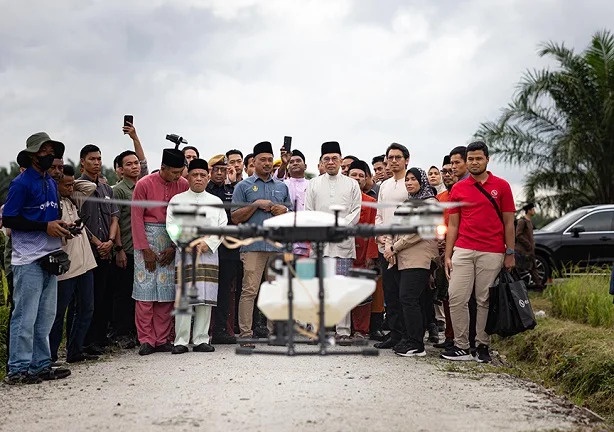
In an official statement, it was mentioned that in Kampung Tebuk Haji Dollah, Selinsing, the Sejati MADANI project has supported the use of three drones for spraying fertilizers and pesticides on 600 acres of rice fields; the application time was shortened from 90 minutes to just 20 minutes. (BERNAMA) This gives the impression that the government is not only funding, but also supporting intensive technology.
However, even though technology has been facilitated, there have been no specific reports that village teenagers run vending machines or fertigation systems. Most activities are still carried out by traditional groups in the village.
Miri, Sarawak
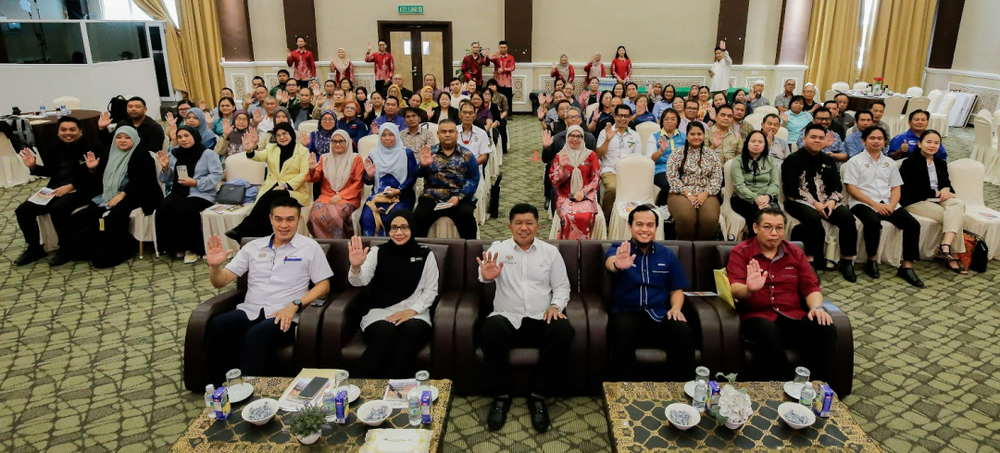
A similar program in Miri brought together 80 JKKK (Village Committee) representatives from 40 communities through leadership capacity training and skills in the use of Sejati MADANI funds. (Borneo Post Online) However, the resulting activities remain traditional community projects: large vegetable gardens, homestays, tourism activities. The challenges of adopting new technologies have not been widely revealed.
Communities are prone to explosions
There was a complaint from youth groups in the local media: "The government needs to provide technical training, not just funds. If the vending machine is damaged, we cannot service it," said a young man in the Free Malaysia Today media. (freemalaysiatoday.com) This reflects that the spirit of innovation can be broken if operational anchors are not available.
For the expansion of Sejati MADANI to successfully embrace young people through vending machines and fertigation, several pillars must be strengthened:
- The central government's technical partnership through the ICU JPM or the Ministry of Agriculture can collaborate with agritech startups, universities, and research institutions to become coaches. Long-term assistance from installation, maintenance, to marketing is crucial for the project to be sustainable.
- TVET training and certification in agricultural TVET programs, it is necessary to add specialized modules on agricultural IoT, sensor control, fertigation systems, and self-service machine maintenance. Moreover, the Malaysian government has provided agricultural education courses and subsidies through 16 free TVET centres (with monthly allowances) for youth aged 18–25 years. (thesun.my)
- The MADANI Sejati Fund flexible financing scheme (RM50,000–100,000) should be viewed as initial capital. The government also needs to provide additional grants, soft loans, or micro credits so that young actors can overcome machine damage, repairs, and business expansion.
- A self-service machine, business model and marketing network will only be successful when it is in a traffic area, a local campus, a bus station, or a rural market. Young people can build digital marketing strategies, such as a weekly fresh vegetable subscription system through an application that uses machines as a pick-up point.
- Monitoring and quality control Because fresh products are perishable, it needs a temperature sensor or a small CCTV camera in the machine, plus regular surveillance. If the machine breaks down and the product is damaged, consumers will be less likely to trust the system.
There is not a little skepticism. Some observers say that programs like this are vulnerable to becoming short-term political projects if they are not supported by sustainable management. As Prime Minister Anwar Ibrahim himself reminds us: village leaders must "take care of Sejati MADANI funds carefully" so that they are not misappropriated. (NST Online)
In addition, although the RM1 billion allocation is relatively large, technical needs such as smart machines and fertigation systems can be very expensive on a local scale. If the funds are only enough to buy basic machines, but not enough for maintenance, the project can die young.
There is also the issue of competency gaps: not all villages have young people who are in high school or have an interest in technology. So, the risk that some villages will continue to rely on the old group remains large. Critics emphasize: "Money is not the only answer without a local companion and a culture of change, this project can only be a symbol." (freemalaysiatoday.com)
Imagine the next five years: in Selinsing Village, two young vocational school alumni manage four local vegetable vending machines. Every morning, the old farmer sends fresh vegetables to the machine. From noon to evening, village customers pay via QR and pick up their own free intermediaries and expensive margins. They earn an additional RM300–500 per week outside of their main venture.
Meanwhile, the fertigation system in the community garden is controlled via mobile phones: humidity sensors, automatic fertilizer scheduling, nutrient control, and data analytics. Yields increase by 25–40 percent in the same season compared to traditional methods. Some of the surplus harvest is sent to local vending machines, some to city markets through regional cooperation.
Young people in the village no longer see agriculture as an ancient job but as a green startup, with digital margins, branding, and even micro export channels to big cities or tourists. For them, villages are the basis of economic creativity, not just a stagnant heritage.
AM World (tameer.work88@gmail.com) is a content creator under the Newswav Creator programme, where you get to express yourself, be a citizen journalist, and at the same time monetize your content & reach millions of users on Newswav. Log in to creator.newswav.com and become a Newswav Creator now!
The User Content (as defined on Newswav Terms of Use) above including the views expressed and media (pictures, videos, citations etc) were submitted & posted by the author. Newswav is solely an aggregation platform that hosts the User Content. If you have any questions about the content, copyright or other issues of the work, please contact creator@newswav.com.