.jpg)
By Mihar Dias June 2026
Every so often, a fish comes along that becomes bigger than politics, more controversial than a budget speech, and more discussed than the latest celebrity scandal.
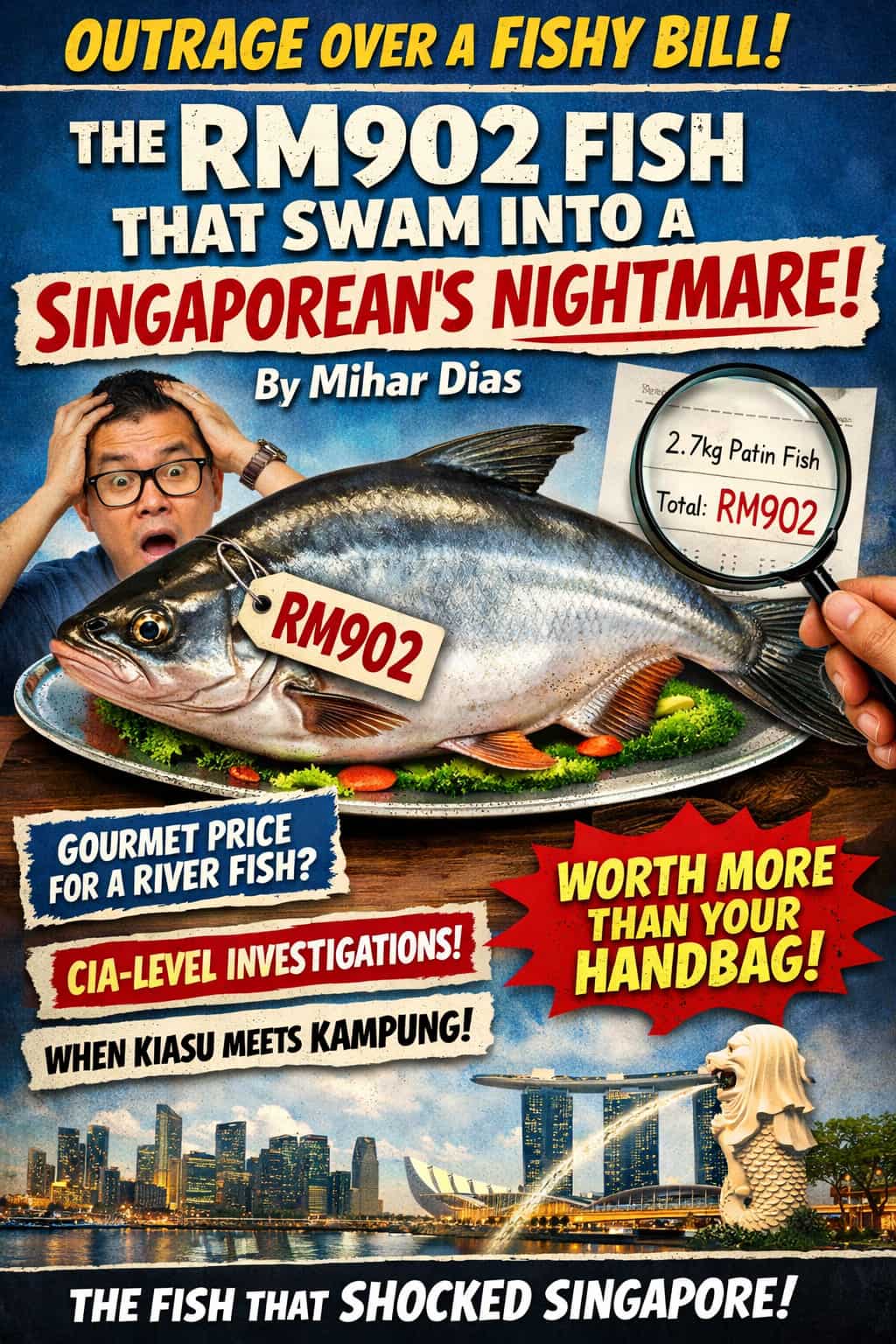
This month, that fish was a humble wild patin from the Pahang River.
Not because it performed miracles. Not because it was endangered. Not because it could predict lottery numbers.
No, it became famous because a Singaporean gentleman nearly choked on the bill.
The fish weighed 2.7kg. The bill came to RM902. https://www.facebook.com/share/p/19Meea8Hg2/
Immediately, social media erupted. Headlines appeared. Public outrage followed. Investigations were launched. One could be forgiven for thinking the restaurant had served a mermaid rather than a river fish.
But after all the excitement, authorities concluded there was no profiteering. The restaurant's profit margins were within acceptable limits. The fish was genuinely rare. Case closed. https://www.facebook.com/share/p/19Meea8Hg2/
Yet the incident reveals something fascinating about the Singaporean psyche.
Singaporeans are among the wealthiest people in Southeast Asia. They routinely spend hundreds of dollars on hotel buffets, premium coffee, luxury handbags, imported wines and concert tickets.
But charge them RM902 for a fish and suddenly they transform into forensic accountants.
A Singaporean can buy a S$12 latte without blinking.
A S$400 dinner at Marina Bay? Perfectly acceptable.
A S$20 cocktail served in a glass decorated with a slice of pineapple and a paper umbrella? No problem.
But a fish from a muddy river in Pahang costing the equivalent of S$280?
That demands an investigation worthy of the CIA.
This is not stinginess.
This is kiasuism elevated into an art form.
The Singaporean national instinct is not simply to save money. It is to ensure nobody else got a better deal.
The issue was never whether the fish tasted good.
The issue was whether the fish knew it was worth RM902.
Imagine the poor patin.
For years it swam freely through the Pahang River, dodging fishermen, surviving floods, escaping predators.
Eventually it gets caught and discovers it has become the most scrutinised fish in Malaysian history.
Government officers examine financial records.
Social media analyses its market value.
Journalists debate its economic significance.
The fish probably received more regulatory attention than some listed companies.
The irony is that rarity has always carried a premium.
People willingly pay thousands for truffles dug out by dogs.
Others pay fortunes for Japanese melons presented in fancy boxes.
Collectors spend absurd sums on aged wine made from fermented grape juice.
Yet when a rare local fish commands a high price, everyone behaves as if civilisation itself is under attack.
Perhaps this reflects a deeper cultural divide.
In Malaysia, dining is often an adventure. You see something unusual, ask the price, wince slightly, then decide whether the experience is worth the money.
In Singapore, efficiency reigns supreme. Every transaction must pass a value-for-money stress test.
The spreadsheet comes before the appetite.
The calculator arrives before the appetite.
And heaven help the vendor whose pricing formula cannot survive cross-examination.
To be fair, transparency matters.
The restaurant appears to have learned its lesson and now reportedly explains the species, weight and total price before customers commit.
That is sensible.
Nobody enjoys discovering halfway through dessert that the fish costs more than the family car's monthly instalment.
But there is also a lesson for consumers.
When ordering something described as "wild", "rare", "river-caught", "seasonal" or "special", it may be wise to ask a simple question beforehand.
“How much?”
This ancient practice has saved humanity from countless financial surprises.
In the end, the wild patin has achieved something remarkable.
It survived the river.
It survived the frying pan.
And after death, it survived a government investigation.
Not many fish can claim such a distinguished legacy.
Perhaps somewhere in the waters of the Pahang River, other patin are now swimming with renewed confidence.
After all, they have just discovered they are apparently worth more per kilogram than some people's investment portfolios.
That, surely, is the ultimate fish tale.
This episode may eventually be forgotten by everyone except the restaurant owner, the stockbroker and the unfortunate patin. But for a few glorious weeks, one fish managed to unite Malaysians and Singaporeans in the region's favourite pastime: arguing about food prices. And if that isn't a uniquely Southeast Asian achievement, nothing is.
Mihar Dias (mihardias@gmail.com) is a content creator under the Newswav Creator programme, where you get to express yourself, be a citizen journalist, and at the same time monetize your content & reach millions of users on Newswav. Log in to creator.newswav.com and become a Newswav Creator now!
The User Content (as defined on Newswav Terms of Use) above including the views expressed and media (pictures, videos, citations etc) were submitted & posted by the author. Newswav is solely an aggregation platform that hosts the User Content. If you have any questions about the content, copyright or other issues of the work, please contact creator@newswav.com.