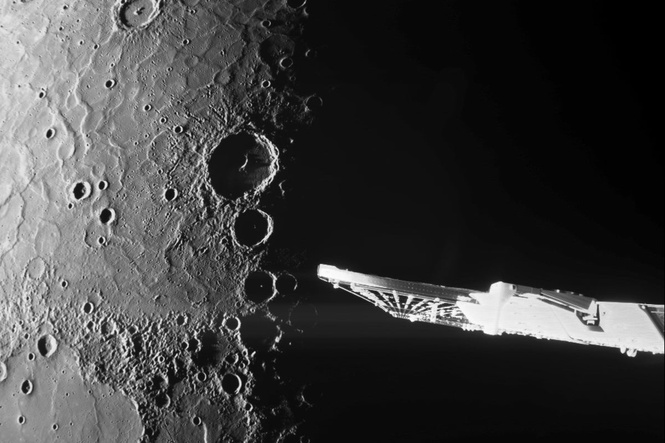
Two spacecraft entered orbit around Mercury on Saturday following an eight-year journey through the inner solar system, though there may be an issue with one of them.
The linked robotic explorers – one European, the other Japanese – will separate next month to embark on a mission to unravel the mysteries of the smallest planet in the solar system.
The $2 billion mission, known collectively as BepiColombo, will map and study the scorching world from differing altitudes, seeking to answer questions such as why ice exists on the closest planet to the Sun.
The European Space Agency announced BepiColombo's arrival on social media. A series of thruster firings slowed the craft enough to be captured by the planet's weak gravity.
It took several anxious hours before flight controllers in Germany, 94 million miles (152 million kilometres) away, confirmed that orbit had been achieved as teams reviewed streaming data.
On Sunday, ESA said a glitch had occurred involving one of the craft’s thrusters.
"The thruster burn was shorter than planned following a software issue,” the space agency said.
"The spacecraft is safe and teams at ESOC (the European Space Operations Centre) are working to understand what happened.”
More updates on the craft’s condition are expected on Monday.
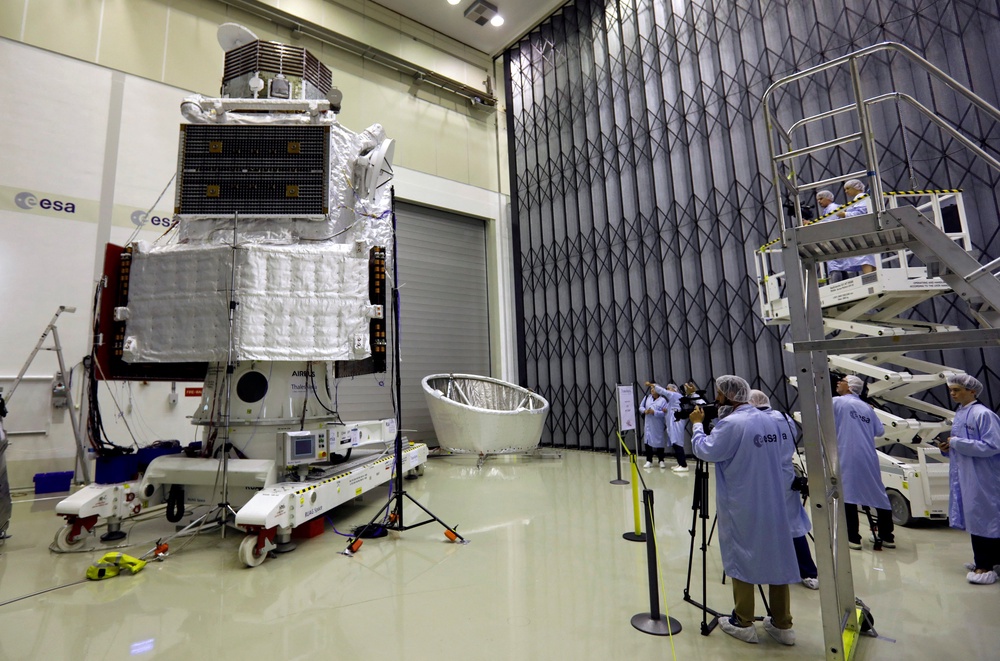
BepiColombo is only the third spacecraft to visit Mercury – the closest planet to the sun and barely bigger than our moon – and the first in over ten years.
NASA's Mariner 10 flew past Mercury three times during the mid-1970s. The team included the late Italian mathematician Giuseppe "Bepi" Colombo, after whom this mission is named.
NASA's Messenger craft entered orbit around Mercury in 2011 and, after running out of fuel, crashed into the planet in 2015.
Launched in 2018, BepiColombo took a slower, circuitous route to reach Mercury, flying once past Earth, twice past Venus and six times past Mercury for gravity assists.
Those manoeuvres added over 6 billion miles to the journey. The combined spacecraft detached from their mother ship in September.
Lead project scientist Geraint Jones said he and colleagues cannot wait for new data in the spring. The mission will allow scientists to compare "unprecedented measurements taken by two spacecraft at the planet at the same time," he noted.
Once orbiting separately, the European Space Agency's satellite and the Japan Aerospace Exploration Agency’s smaller craft will study Mercury’s dense interior, exterior magnetic field, impact craters, volcanic plains, mountain ridges and peaks jutting up to 3 miles high.
Temperatures on Mercury can exceed 427 C, placing strain on electronic and engineering systems. Officials hope to keep the mission going for at least one Earth year – equivalent to four years on Mercury.
"The spacecraft and its instruments need to be kept as cool as possible, which is a huge technical challenge in itself," Jones said.
Despite its proximity to Earth, Mercury remains one of the solar system’s least explored planets. Only outer planets Uranus and Neptune have had fewer visitors – a single Voyager 2 in the 1980s.
Mercury is about 60 per cent closer to the Sun than Earth, with a diameter less than 40 per cent of Earth’s.
Read MoreNASA’s Voyager 1 crosses historic light-day distance from Earth
Star cannibalises its neighbour in never-before-seen cosmic event
NASA’s Voyager 1 reaches ‘astounding’ milestone nearly 50 years after launch
Satellites now outnumber stars in the night sky
Giant dying star seen swallowing its companion in a first-of-its-kind cosmic merger
Elon Musk’s Starship rocket is washing up on a beach in Mexico alongside dead turtles