.jpg)
Role Models: Scarcity Then, Chaos Now
How a Malay Boy, Abu Mansor, Chose a Colonial District Officer as His Inspiration in the 1950s
By Mihar Dias May 2026
Every generation worries about the young men it is raising, but few stop to ask the more uncomfortable question: raised by whom, exactly? Not in the biological sense, but in the quiet, psychological architecture of influence—those figures, real or imagined, who teach a boy how to stand, speak, and decide what sort of man he might become.
Social psychology has a tidy term for this: observational learning, popularised by Albert Bandura. https://pmc.ncbi.nlm.nih.gov/articles/PMC3139552/
The premise is deceptively simple. We become, in part, what we see. Behaviour is modelled, imitated, internalised. The child watches, the adolescent rehearses, the adult performs.
But what happens when there is almost nothing to watch?
This was the quiet dilemma of a young boy named Abu Mansor, growing up an orphan in the long shadow of the World War II. (This is a true account as narrated by Dato' Abu Mansor, former MD of Bank Rakyat).
In the Malay villages of Klang in 1940s, poverty was not just economic—it was aspirational. The horizon of possibility was limited to what one could physically encounter. A clerk behind a desk. A policeman on patrol. A postman threading letters through the day. A fireman, if one was lucky enough to witness urgency in uniform.
Doctors and lawyers existed, certainly, but as distant abstractions. One did not see them, and in the economy of the mind, what is unseen is rarely dreamt.
So when a teacher posed the perennial question—what do you want to be when you grow up?—most boys answered with the vocabulary available to them. Their ambitions were not small because they lacked courage; they were small because they lacked examples.
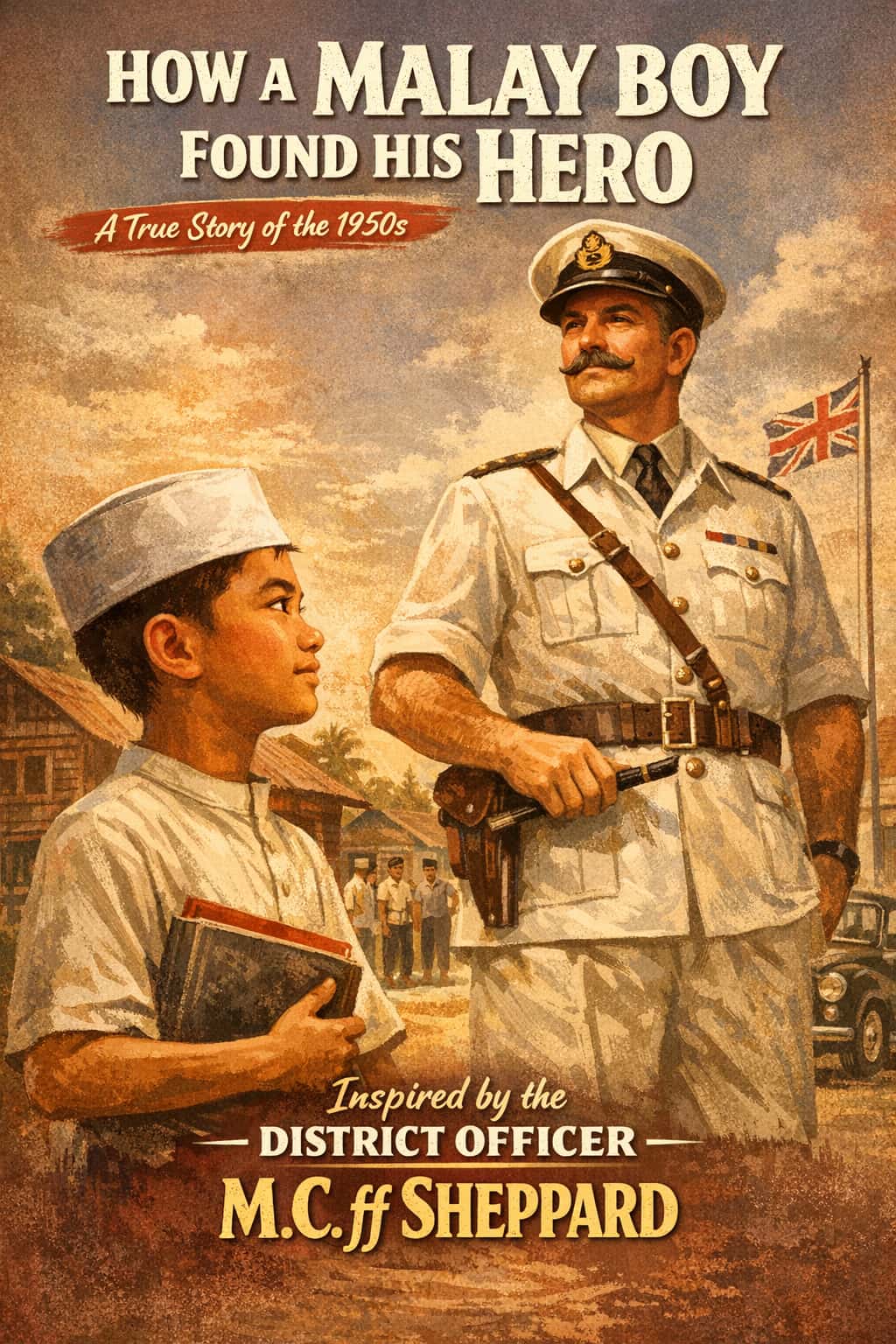
Abu Mansor, however, reached for something else. He named a man he did not know, but had heard about: M. C. ff Sheppard, the District Officer—the king of the district, as he was regarded in the collective imagination of Klang’s Malay community.
It was, in one sense, an improbable choice. The District Officer was not a neighbour, not a relative, not even a familiar face. But he was visible in a different way—spoken of, described, almost mythologised. A man with a handlebar moustache, upright bearing, a certain carriage that suggested authority without apology. In a landscape short on accessible heroes, he became a figure large enough to borrow.
This is where social psychology complicates the story. Role models need not be intimate to be influential. They need only be salient.
The mind, especially a young one, is remarkably efficient at constructing coherence from fragments. A posture here, a reputation there, a story passed down by a grandfather—and suddenly, a boy has assembled a prototype of manhood.
But there is danger in this efficiency.
When role models are scarce, they are not just admired—they are overloaded. They carry more meaning than they were ever meant to bear. The District Officer was not merely a civil servant; he became a symbol of dignity, order, aspiration, even romance. After all, in the social arithmetic of the time, an Assistant District Officer could secure not just status, but the hand of a “fair maiden of Klang.” The model was not just professional—it was personal, moral, aesthetic.
And yet, what Abu Mansor seemed to grasp, even at ten, was something more discerning. It was not the title that captivated him, but the man. The way he carried himself. The sense of uprightness. The intangible quality we might now call presence.
In modern terms, this is the distinction between extrinsic and intrinsic modelling. Young men today are inundated with role models—athletes, influencers, entrepreneurs, all curated by algorithms that understand attention better than any teacher ever could. But abundance has not necessarily improved judgment. If anything, it has made it lazier.
The contemporary boy does not suffer from a lack of examples; he suffers from a lack of filtration.
He can choose a millionaire without asking how the money was made. He can admire confidence without interrogating its source. He can imitate style without understanding substance. In Bandura’s framework, the process remains the same—observe, imitate, internalise—but the inputs have multiplied beyond scrutiny.
Which brings us back, curiously, to the villages of Klang.
There is something almost austere, even admirable, about a childhood with limited models. It forces selectivity. It demands imagination. It encourages the kind of projection that turns a distant District Officer into a personal benchmark of conduct.
And in the case of M. C. ff Sheppard, the story acquired an additional twist. Here was a man who would later convert to Islam and marry into the very community that had once observed him from a distance. The model did not remain static; it evolved, complicated itself, became more human. Perhaps that, too, was instructive.
For young men everywhere, the lesson is neither to reject role models nor to accept them wholesale. It is to recognise that choosing a model is itself a moral act. One is not merely selecting a career template, but a way of being.
Titles will always dazzle. Positions will always tempt. But the more enduring question—the one Abu Mansor seemed to intuit before he could articulate it—is simpler, and far more demanding:
Is this a man worth becoming, even if no one is watching?
Mihar Dias (mihardias@gmail.com) is a content creator under the Newswav Creator programme, where you get to express yourself, be a citizen journalist, and at the same time monetize your content & reach millions of users on Newswav. Log in to creator.newswav.com and become a Newswav Creator now!
The User Content (as defined on Newswav Terms of Use) above including the views expressed and media (pictures, videos, citations etc) were submitted & posted by the author. Newswav is solely an aggregation platform that hosts the User Content. If you have any questions about the content, copyright or other issues of the work, please contact creator@newswav.com.