
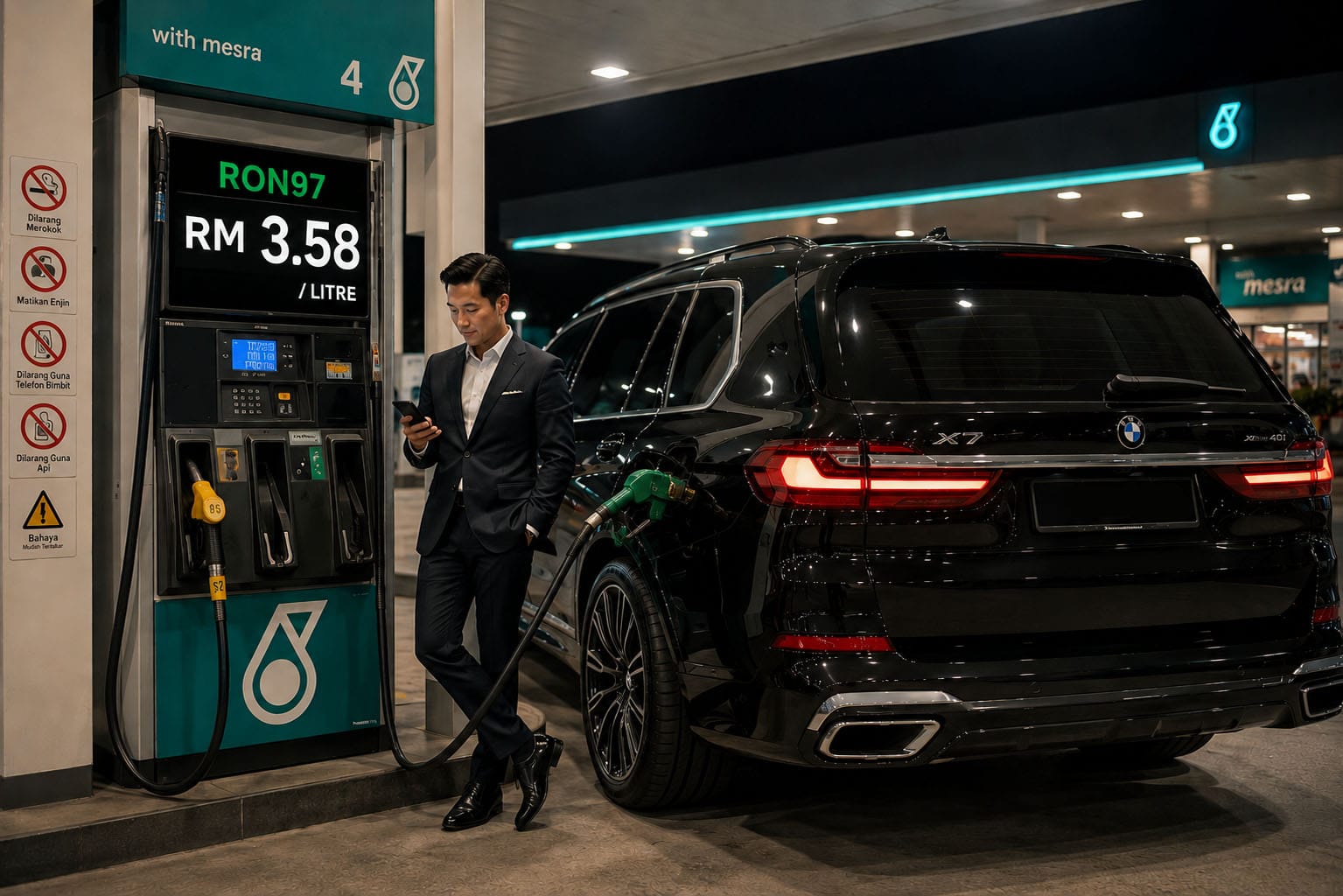
Image generated with ChatGPT by K. Azwan.
The T20 may lose their RON95 subsidy. Here is why most of them will not even notice.
The government has confirmed it is reviewing the RON95 fuel subsidy structure, specifically targeting high income Malaysians who have been quietly enjoying cheap petrol that was never really meant for them. PM Anwar Ibrahim confirmed this week that the National Economic Action Council's crisis management task force, led by corporate figure Hassan Marican, has been studying whether to cut subsidies for the T5, T10, T15, or T20 income groups.
The decision has not been finalised yet. But the direction is clear. Cheaper RON95 for everyone is coming to an end for those at the top of the income ladder. And depending on which bracket you fall into, this either affects you directly or it does not affect you at all.
Let us break down what this actually means.
How Much Is the Government Currently Spending?
Before we talk about who loses what, it helps to understand the scale of what is at stake.
Before the BUDI95 targeted subsidy programme was introduced in September 2025, Malaysia was spending approximately RM20 billion annually on RON95 subsidies. The BUDI95 reform, which capped subsidised purchases at 300 litres per month per citizen and excluded non-citizens, brought that figure down to around RM8 billion a year, saving between RM2.5 billion and RM4 billion annually depending on global crude oil prices.
That sounds like progress. And it is. But economists and international bodies including the World Bank and IMF argue that the reform was not ambitious enough. The World Bank's lead economist for Malaysia pointed out that the claimed savings depend heavily on high income Malaysians exceeding their monthly quota, which in practice most do not. The T20 are still in the system. They are still filling up at RM1.99 per litre. And that is the gap this latest review is trying to close.
How Much Can Malaysia Actually Save?
This is where the numbers get genuinely significant.
Economists estimate that over 30% of RON95 consumption goes to the T20 income group. With the government spending RM8 billion a year on RON95 subsidies, removing the T20 from the programme could save approximately RM1.5 billion per month, or up to RM18 billion annually at full scale. Even a more conservative estimate from economists places potential savings between RM10 billion and RM15 billion per year if the highest earners are fully excluded.
That is not small change. That is enough to fund significant expansions in public healthcare, education infrastructure, and direct cash assistance programmes for the B40 and M40.
The ASEAN Macroeconomic Research Office recommends a phased approach, moving RON95 from RM1.99 to RM2.40 in the first six months and then floating it to market rates of approximately RM2.90 per litre by month twelve, specifically to avoid sudden inflationary shocks. Done gradually, the economic disruption can be managed. Done overnight, it risks the kind of public backlash that derails policy reforms entirely.
Will Removing T20 Subsidies Cause Prices to Rise for Everyone?
This is the question most Malaysians are quietly worried about.
The short answer is: not significantly, if it is done correctly.
Analysts note that fuel costs account for 5.7% of Malaysia's Consumer Price Index basket. Removing the subsidy only for the T20, while leaving it in place for everyone else, means the inflationary pressure is contained to the top income bracket. For the B40 and M40, nothing changes at the pump. Their subsidised price stays. Their monthly fuel costs stay the same.
The risk of broader inflation comes only if the reform is mismanaged, implemented too quickly, or extended beyond the T20 before adequate social protection mechanisms are in place.
The Argument That Nobody Is Making Loudly Enough
Here is something the economic reports and policy papers tend to gloss over but that anyone who has worked in a Malaysian corporation knows to be true.
A significant portion of T20 Malaysians do not actually pay for their own petrol out of pocket. They receive fuel allowances, company cars, or petrol card reimbursements as part of their employment packages. The fuel cost is borne by their employer, not their personal income.
Which means that for a large subset of high income earners, removing the RON95 subsidy does not affect their personal finances at all. Their company absorbs the difference. The subsidy saving goes straight to the government. And the employee feels nothing.
Beyond that, the T20 are also more likely to drive higher capacity vehicles that run on RON97 rather than RON95. Malaysian economists have repeatedly noted that high income households typically drive high-powered vehicles that consume more fuel and are more likely to use premium grade petrol. RON97 is already unsubsidised and priced at market rates. A T20 household that drives a BMW 5 Series or a Mercedes E-Class is already paying full price for fuel. The RON95 subsidy is largely irrelevant to their daily routine.
The people who truly depend on subsidised RON95 to get to work, to send their children to school, to run their small businesses, are the M40 and B40. The mechanic in Shah Alam. The delivery rider in Cheras. The single mother in Kajang doing two jobs and watching every ringgit at the pump.
Those are the people the subsidy was designed for. And those are the people who should keep it.
What Happens to the Savings?
The savings from subsidy rationalisation have already been earmarked for reinvestment into social programmes including Sumbangan Asas Rahmah and Sumbangan Tunai Rahmah, which provide direct cash assistance to low income households. Additional funds are being directed toward clean energy infrastructure, digitalisation, and healthcare expansion.
S&P and Fitch have both affirmed Malaysia's credit ratings in part because of this improved fiscal discipline. A government that spends less on blanket subsidies and more on targeted social protection is a government that international investors and rating agencies view as financially credible. That credibility translates into lower borrowing costs, which ultimately benefits every Malaysian regardless of income bracket.
My Take
I will be transparent. I am in the M40 bracket, and my household does rely on the RON95 subsidy to manage monthly expenses. Fuel is not a luxury for most of us. It is a basic operating cost of being a working Malaysian.
But I genuinely believe this reform is the right call.
If you are in the T20, the probability is high that your company is covering your fuel costs anyway. And if you are personally driving a car that was purchased for hundreds of thousands of ringgit, the difference between RM1.99 and RM2.60 per litre is not going to change your life in any meaningful way.
The subsidy was never meant to help people who can already help themselves. It was meant to protect people who cannot. Every ringgit the government saves from removing the T20 from BUDI95 is a ringgit that can be redirected to someone who needs it far more.
Get the targeting right, phase it in gradually, protect the M40 and B40, and this is a reform worth doing. Malaysia cannot afford to keep subsidising the wealthy indefinitely. And frankly, neither can the rest of us.
Kamarul Azwan (k.azwan@gmail.com) is a content creator under the Newswav Creator programme, where you get to express yourself, be a citizen journalist, and at the same time monetize your content & reach millions of users on Newswav. Log in to creator.newswav.com and become a Newswav Creator now!
The User Content (as defined on Newswav Terms of Use) above including the views expressed and media (pictures, videos, citations etc) were submitted & posted by the author. Newswav is solely an aggregation platform that hosts the User Content. If you have any questions about the content, copyright or other issues of the work, please contact creator@newswav.com.