
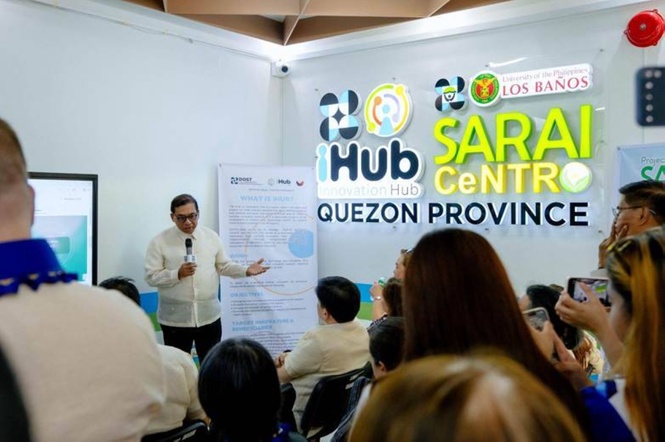
LUCENA CITY, Philippines — Raising glasses of local lambanog in a traditional Quezon "tagay," science officials opened the Regional Science, Technology, and Innovation Week on Oct. 12 to highlight research-driven development across the Calabarzon region.
The opening ceremony, held at the Quezon Convention Center, featured the customary exchange of "naay po" (here is my drink) and "pakinabangan po" (let us make use of this drink), which organizers framed as a symbol of regional cooperation and practical innovation. Science and Technology Secretary Renato U. Solidum Jr. took part in the traditional "sayaw sa tagay" alongside provincial and regional leaders.
"Let us continue building a region where innovation creates livelihoods, where knowledge creates opportunities, where technology strengthens communities, and where science helps us prepare for the challenges ahead," Solidum said in his keynote address.
Department of Science and Technology Calabarzon Regional Director Emelita P. Bagsit presented regional milestones, noting that in 2025 the agency commercialized and transferred 107 DOST-developed technologies to 193 adopters. The region also provided more than 15,000 testing and calibration services through its OneLab network.
"These efforts strengthen the bridge between research and application, allowing knowledge generated in laboratories and institutions to move closer to enterprises, industries, and communities," Solidum said.
The event featured several community-level technology rollouts, led by 3D-printed units of the Project Robust Optical Aerosol Monitor. Developed by the University of the Philippines Diliman and Los Baños, the devices measure particulate matter, gas concentrations, temperature, and relative humidity for volcanic hazard and air quality monitoring. Units were turned over to local government units, including representatives from Cavite and Laguna provinces.
Miguel A. Vasquez, a project technical assistant, said the system is the first Philippine-made air quality monitor and provides a lower-cost alternative to commercial imported devices.
Other provincial initiatives highlighted during the week include:
* San Francisco, Quezon, received food-safety-compliant mobile carts for street vendors.
* Lucena City launched its Digital Business Locator platform.
* The island municipality of Jomalig received a solar-powered water purification system.
* Southern Luzon State University opened an Innovation Hub and a Smarter Approaches to Reinvigorate Agriculture as an Industry (SARAI) Centro to advance agricultural modeling and commercial research.
* Quezon Science High School in Tayabas City opened the province's first 21st Century Learning Environment Model classroom, which includes tools such as the Makeroscope mobile microscope kit.
DOST-Calabarzon also expanded partnerships with higher education institutions, including the Regional Yarn Production and Innovation Center at the University of Rizal System and the Silkworm Innovation Center at Laguna State Polytechnic University.
In Quezon, the municipal governments of San Francisco and Tagkawayan signed agreements with SLSU to implement the Community Empowerment through Science and Technology program. Across the region, the program has assisted 4,110 communities through 576 targeted interventions valued at 8.65 million pesos through 2025.
Bagsit said the department tailors its deployments to provincial strengths: solar-powered bamboo processing and handloom weaving in Cavite; industrial 3D metal printing in Laguna; tsunami early warning systems and mobile solar irrigation in Batangas; creative media hubs in Rizal; and automated smart greenhouses with zero-waste food processing in Quezon.
"This is what innovation looks like when it breaks through," Solidum said. "It helps industries become more productive, helping farmers produce better crops, and helping create greater economic value."