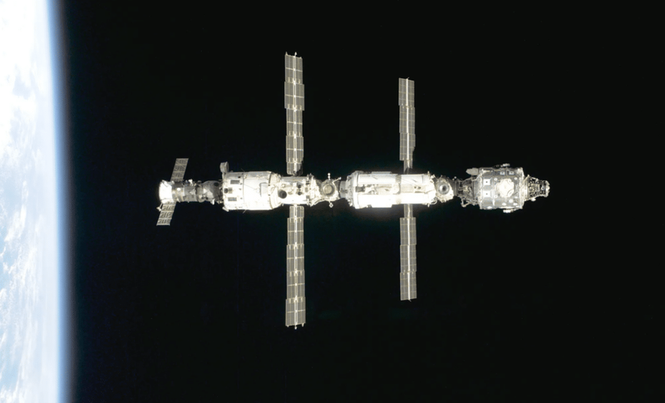
A serious operational dispute aboard the International Space Station has forced NASA and Roscosmos into a rapid reassessment of crew safety protocols, according to reporting from Ars Technica. The incident centered on a long-troubled Russian module that showed structural concerns severe enough to trigger emergency contingency planning and a temporary crew safe haven inside a SpaceX spacecraft. What unfolded in orbit revealed not only technical risk, but also deep coordination tensions between the two space agencies responsible for maintaining the orbiting laboratory.
A Dispute Over A Damaged Orbital Module
The crisis centered on a Russian segment of the station known as the PrK module, which had been under increasing scrutiny due to persistent structural issues. According to Ars Technica, the disagreement escalated when Russian crew members reportedly attempted to proceed with physical modifications despite ongoing safety objections from NASA controllers on the ground. The move prompted urgent internal discussions within NASA, where engineers assessed the possibility of rapid decompression if critical components were altered without coordination.
Communication breakdowns between the agencies added further pressure, as NASA officials expressed frustration over limited responsiveness from their counterparts during the critical window. One NASA official described the intensity of the moment, stating,
“We threatened we would put astronauts in suits, in Dragon, to send a message to world that we disagreed. They didn’t care.”
The remark underscores the level of concern within NASA’s operational command structure as the situation developed in real time.
The standoff also highlighted how maintenance decisions on aging orbital infrastructure can carry cascading risks when multiple national programs share responsibility. Even minor procedural disagreements in such an environment can escalate quickly when structural integrity is in question, particularly in modules already flagged for long-term degradation.
Emergency Safe Haven Measures Aboard The ISS
As the risk assessment intensified, NASA instructed its crew members to move into a protective configuration using SpaceX’s Crew Dragon spacecraft attached to the station. The decision effectively placed astronauts in a ready-to-depart posture, a rare precaution designed for worst-case scenarios involving sudden cabin depressurization or structural failure. Crew members aboard the station included international partners working side by side in tightly coordinated emergency protocols.
A NASA source later explained the reasoning behind the decision, stating,
“We felt there was a very high probability of a bad outcome happening if they sawed that bracket off. NASA’s decision to send its astronauts into a safe haven prompted Roscosmos to finally back off.”
The statement reflects the urgency felt by mission planners who were forced to weigh engineering uncertainty against immediate crew survival risks.
During this period, operations aboard the ISS were partially suspended or rerouted to maintain safety margins. The safe haven posture remained in place until both agencies reassessed the immediate risk and agreed to de-escalate the situation. The episode demonstrated how Crew Dragon has become a critical safety asset, not just for transportation but as a rapid-response refuge in orbital emergencies.
Resolution And Shift In Operational Control
Following the standoff, Russian space officials ultimately agreed to halt intrusive work on the affected module and move toward decommissioning it for crew access purposes. This decision effectively removes the PrK module from active human use while preserving certain limited functions for cargo and fluid transfer operations. The shift marks a significant change in how the segment will be used going forward, reducing the likelihood of further high-risk interventions.
NASA later confirmed the stabilization of normal operations aboard the station, noting: “NASA strongly supported that decision, and as a result, following that decision,Crew-12 and Williams ended their safe haven activities and returned to normal operations aboard the orbiting laboratory.” The return to standard procedures signaled that the immediate threat had been mitigated, although long-term operational adjustments remain in place.
The agreement also reflects a broader pattern in ISS management where aging hardware requires increasingly conservative handling strategies. As modules exceed their original design lifespans, mission controllers must balance scientific utility with structural uncertainty, often requiring rapid decision-making under incomplete information.