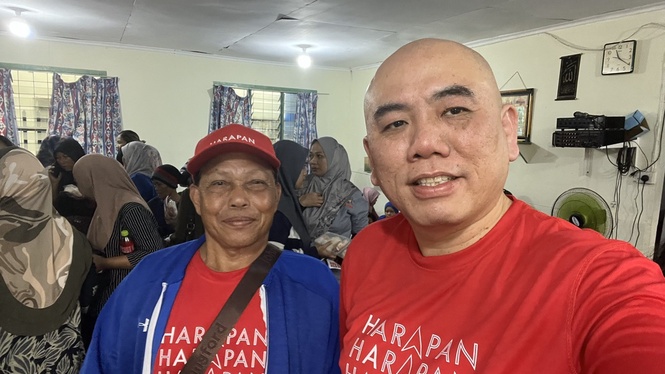
The Democratic Action Party (DAP) Central Executive Committee (CEC) held an emergency meeting that lasted more than five hours on Monday (1st Dec 2025) night following the heavy defeat in the Sabah election. After the meeting, Secretary-General Anthony Loke issued a statement saying that DAP would consolidate all feedback received and work with the Prime Minister to accelerate the reform agenda over the next six months. Sabah DAP also announced that it would not participate in posts in the Sabah state government, including the appointment of assemblymen to government positions.
On 2nd Dec 2025, Sabah Chief Minister Hajiji also announced a reshuffle of the state cabinet. The Chinese community in Sabah had hoped that the only Chinese assemblyman from GRS, the Tanjung Kapor assemblyman Ben Chong Chen Bin, would be appointed as a state minister, but in the end, this did not materialise.
Looking back at history, Sabah is one of the few states in Malaysia, apart from Penang, that has produced three Chinese Chief Ministers: Peter Lo (1965–1967), Yong Teck Lee (1996–1998) and Chan Kong Choy (2001–2003). This is something even neighbouring Sarawak has not achieved. Today, however, Sabah does not have a single Chinese minister, which has surprised the Chinese community.
Although DAP lost all its state seats, this does not mean that the party has disappeared from Sabah’s political landscape. Terms such as “wipe out,” “uprooted,” “zeroed out,” or “lost all deposits” do not objectively describe Sabah DAP’s current situation; instead, they are more mocking than analytical.
As the Taiwanese Hokkien song “Ai Piah Jia Eh Ya” (“Fighting On Will Win”) goes: “Life is like the waves of the sea, sometimes rising, sometimes falling.” Once, a Chinese community leader deliberately altered the lyrics on stage to say, “sometimes rise, never fall,” and I wondered whether such a fairy tale could exist in real life. The DAP’s story is similar: it has had its ups and downs.
Next year, DAP will celebrate its 60th anniversary. Its six-decade journey has not been smooth. In the 1995 general election, under Mahathir’s Barisan Nasional, DAP lost many seats as it could not withstand the onslaught of limited political liberalisation.
In the 1999 general election, because of its cooperation with PAS, DAP lost many of its stronghold seats and votes. At that time, Chinese urban voters across the country were unhappy with DAP’s cooperation with PAS. As a result, Lim Kit Siang and Karpal Singh lost their parliamentary seats in Penang.
In 2004, the “Abdullah Badawi new PM effect” saw almost all opposition parties nearly wiped out. DAP’s parliamentary seats only increased marginally from 10 to 12 seats. Lim Kit Siang and Karpal Singh returned to Parliament, but the party failed to defend the Malacca Town seat. Then-Secretary-General Kerk Kim Hock took responsibility and resigned.
Is today’s Sabah DAP in a worse situation than in 1995, 1999 or 2004? No.
Currently, Sabah DAP still has two Members of Parliament: Deputy Minister of Plantation Industries and Commodities and Kota Kinabalu MP Chan Foong Hin, Sandakan MP Vivian Wong, and one senator, Norita Sual. I believe they will continue serving the west coast, east coast and interior regions of Sabah.
I believe that most of the service centres for the eight state seats contested by DAP will continue to operate, upholding the typical DAP spirit of “paksi bohchau.” After all, there are still many forms of federal government assistance that require cooperation with local leaders to be effectively delivered. The upcoming 40% revenue allocation from the federal government to Sabah must also be monitored to ensure it is spent properly.
As for the federal government’s reform agenda, it is known that legislation for the Parliamentary Services Act has already been enacted. Next, four bills that carry reform agenda are expected to be tabled in the House of Representatives: the Ombudsman Bill, the Freedom of Information Bill, the Political Donations Bill, and amendments to the Federal Constitution to separate the powers of the Attorney General and the Public Prosecutor. Besides economic issues, these are the bills that urban voters care deeply about.
In supporting the Prime Minister to accelerate the speed of reforms, the DAP central leadership must help rebuild the morale of Sabah DAP over the next year. Sabah DAP still has a large number of loyal members and supporters. The party cannot simply walk away from them. Over the next year, DAP must continue to maintain a visible presence at the local level.
As for Parti Warisan, it claims to be a Sabah-based party. If it expands into Peninsular Malaysia and wins one or two seats, can it still truly be considered a Sabah local party? In the eye of its Sabahan voters and supporters, will this weaken its position as a Sabah-based political party?
In 1964, Singapore’s PAP decided to contest seats in Peninsular Malaysia, angering UMNO and MCA, and successfully won the Bangsar parliamentary seat. At that time, PAP expanded its influence under the slogan “Malaysian Malaysia.” In contrast, Warisan now uses the slogan “Save Sabah,” promoting a strong local identity.
Secondly, will Warisan face party-hopping among its elected representatives? Although the Sabah State Assembly has legislated that defecting assemblymen must vacate their seats and trigger by-elections, Warisan cannot prevent its assemblymen from supporting Hajiji without formally leaving the party.
If this happens, how will Warisan respond? Expel them from the party? Has the party amended its constitution like what the DAP did in 2022 to classify those who violate party directives as having automatically resigned, thus triggering anti-hopping provisions? If not, in the future, could Chinese Warisan assemblymen exploit legal loopholes to support Hajiji in hoping to be a state minister? Only time will provide the answer.
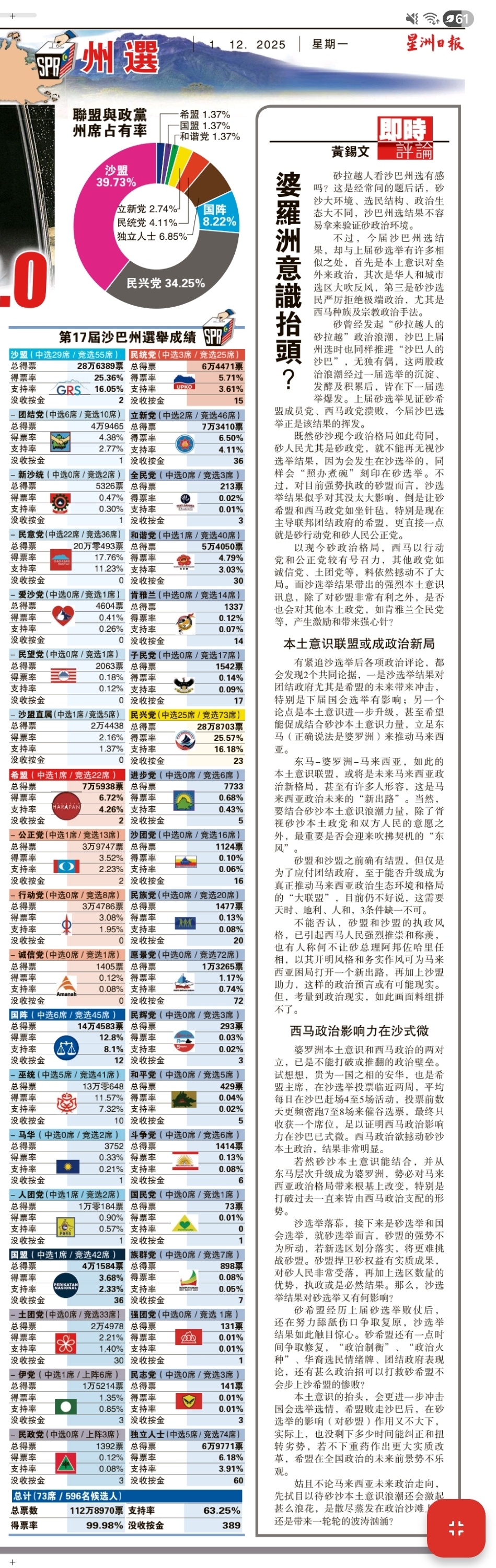
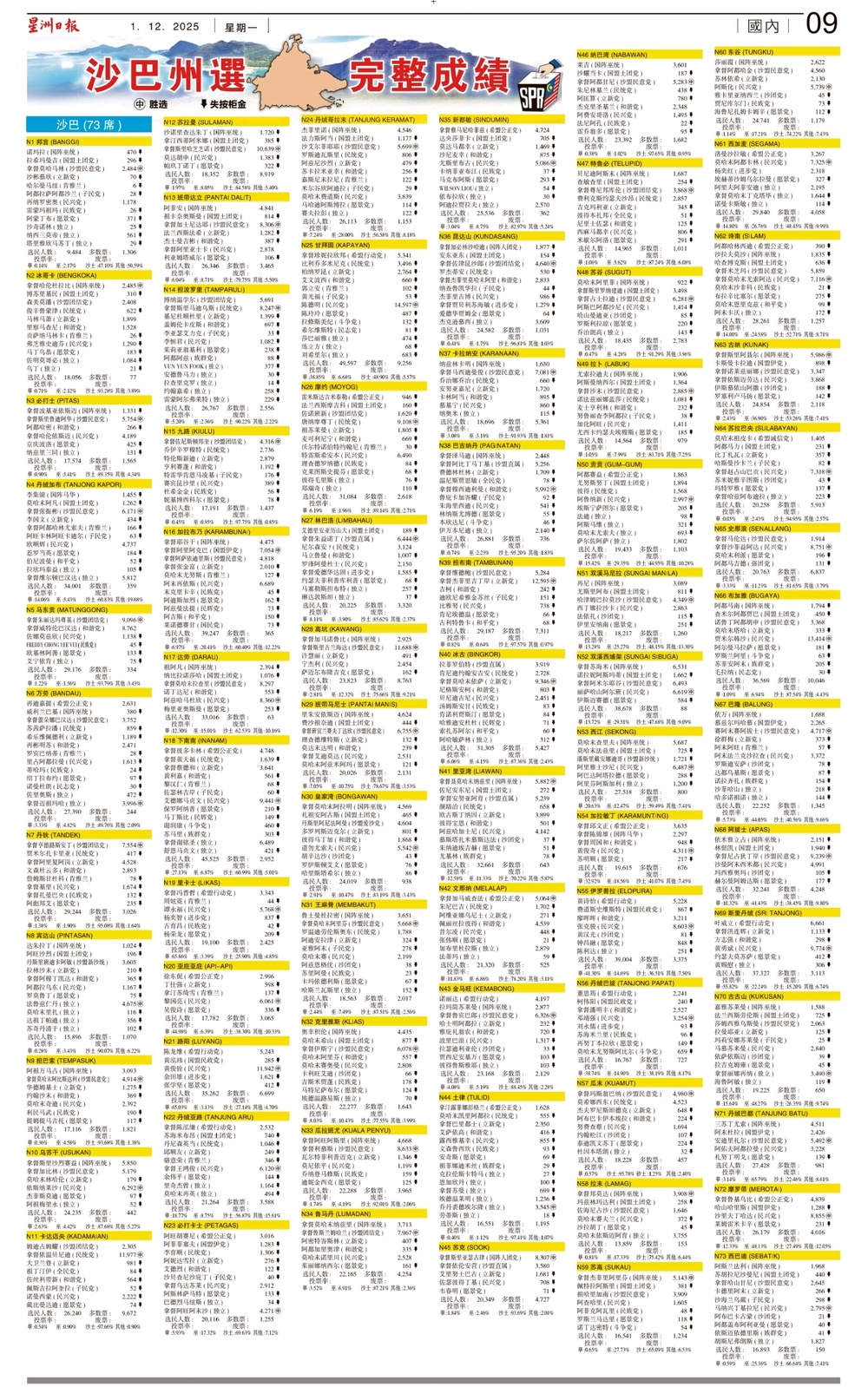
So far, DAP is the only national party that did not lose any deposits. Among all local and national parties that won state seats, almost every one had candidates who lost their deposits. The figures are as follows: Warisan 23 candidates, STAR 36, KDM 30, Bersatu 30, UPKO 15, UMNO 10, PAS 3, MCA 1 out of 2, PBRS 1, PKR 2, SAPP 1, and Gerakan lost all deposits in the three seats it contested. And it is surprising to see almost one-third of Warisan candidates losing deposit in this state election, something which does not match its image as a Sabah-based party.
Among all local parties with state assemblymen, only Hajiji’s Gagasan Rakyat candidates did not lose any deposits. This may at least give Sabah DAP members and supporters a small sense of consolation. Therefore, I would say that Sabah DAP’s foundation still remains solid — the future depends on how its leaders plan and strategise their comeback.
Lau Weng San
Speaker of the Selangor State Legislative Assembly
Weng San Lau (lauwengsan@gmail.com) is a content creator under the Newswav Creator programme, where you get to express yourself, be a citizen journalist, and at the same time monetize your content & reach millions of users on Newswav. Log in to creator.newswav.com and become a Newswav Creator now!
The User Content (as defined on Newswav Terms of Use) above including the views expressed and media (pictures, videos, citations etc) were submitted & posted by the author. Newswav is solely an aggregation platform that hosts the User Content. If you have any questions about the content, copyright or other issues of the work, please contact creator@newswav.com.