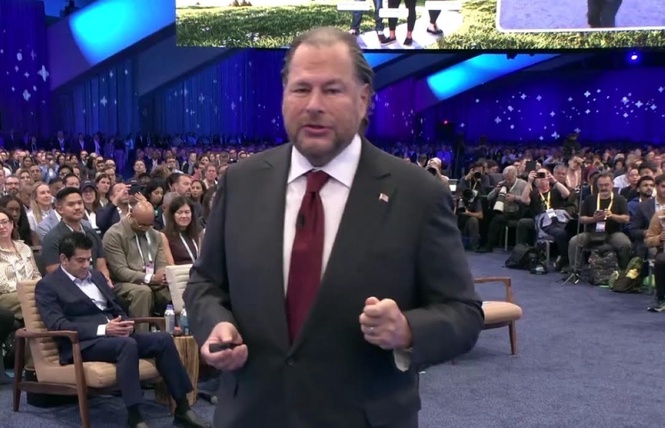
SAN FRANCISCO — Cloud computing firm Salesforce unveiled a new AI interface platform, its first CRM reasoning model, and additional security and management tools as the software company expanded its push to help enterprises deploy AI agents across their operations.
During its Dreamforce 2026 keynote, Salesforce introduced AIforce, which connects AI models with customer information, workflows, permissions, business rules and other data stored in its enterprise applications.
AIforce is intended to let employees ask questions and perform tasks through conversational interfaces instead of navigating conventional software menus and dashboards. It can generate reports, prepare account plans, address service cases, launch campaigns, adjust offers and create workflows using company data and application controls.
Salesforce Chairman and CEO Marc Benioff said the technology brings together four layers: enterprise data, applications and their business semantics, AI agents, and a new interface through which employees can access them.
“Models alone cannot run the enterprise,” Benioff said. “Models also are very probabilistic. They’re probabilistic, like they kind of know what’s going on, but they’re not grounded in a single set of truth like your traditional Salesforce apps.”
Salesforce said AIforce will initially be available through Claudeforce for Anthropic’s Claude Co-Work, Slackforce for Slack and Agentforce Coworker inside Salesforce Lightning. The company also plans to release a software development kit for companies that want to build their own AIforce applications.
Claudeforce uses a Salesforce plugin for Claude that packages the connections, controls and skills needed to access Salesforce information. The integration is available in open beta through Salesforce AppExchange.
During a demonstration, Salesforce showed Claudeforce creating a customized interface that displayed sales, service and marketing information. Users could investigate a delayed sales opportunity and send instructions to a team through Slack without separately opening Salesforce.
Slackforce, meanwhile, will allow employees to access Salesforce data and functions from Slack. Salesforce said developers will also be able to write, review and ship code collaboratively with AI agents inside the messaging platform.
The company also introduced AIforce Max Edition, which bundles the new interface, data, application and agent capabilities in one product.
Salesforce said AIforce would use its existing metadata architecture to generate interfaces based on an organization’s objects, fields, relationships, permissions, security policies and business logic.
“The interface itself now becomes dynamic, intelligent, open, composable, and it’s right where you already work,” Benioff said. “You don’t have to go find the enterprise. The enterprise comes to you.”
Salesforce also announced Koa, its first reasoning model developed specifically for customer relationship management. The model is designed to support long-running agents that perform several tasks to complete complex sales and customer-service processes.
Koa could, for example, determine the next actions needed to pursue a complicated sales opportunity or resolve a customer-support case.
Salesforce President of Platform and Engineering Rohan Kumar said Koa was trained entirely on synthetic data, with no customer information used during its development. The model was built by extending Nvidia’s Nemotron technology.
The company also expanded its portfolio of prebuilt Agentforce agents. These include Hunter for outbound sales, Piper for inbound lead qualification, Casey and Fin for customer service, Page for IT and human-resource requests, and Marshall for supply-chain operations.
Salesforce demonstrated a new capability that allows Marshall to learn processes inside an SAP sandbox and convert the steps into a set of repeatable actions. The company said this would allow the agent to carry out work in back-end systems while reducing the risk of improvising during production tasks.
Other product additions include an automated campaign agent for Marketing Cloud, a shopper agent for Commerce Cloud, a renewals agent for Revenue Cloud, voice-to-text form completion for field-service workers, and a configuration management database that can update itself.
Salesforce said its Contact Center as a Service offering, which combines contact-center functions, telephony and CRM, is scheduled to become available in October.
For enterprise data, Salesforce positioned Informatica as the system for discovering, cleaning and preparing information for AI. Data 360 will then create business context from that information, while Tableau will define business metrics and relationships that agents can use.
Data 360 includes zero-copy technology for accessing information held outside Salesforce without transferring the underlying data into the platform.
To address security risks arising from large deployments of AI agents, Salesforce introduced Salesforce Guardian, an evolution of its Shield and Trusted Services products. Guardian will focus on identifying agents, detecting agents that deviate from approved behavior, classifying data and enforcing data-lifecycle protections.
Salesforce also upgraded MuleSoft into Agent Fabric, which provides a single registry through which IT departments can discover, monitor, govern and control the cost of agents operating across different teams and platforms.
Benioff said Salesforce products would continue to use zero data retention when working with external AI models, meaning customer information would not be retained by or used to train those models.
“Your data is your data,” he said. “You’re not training any other model when you’re using our products.”