
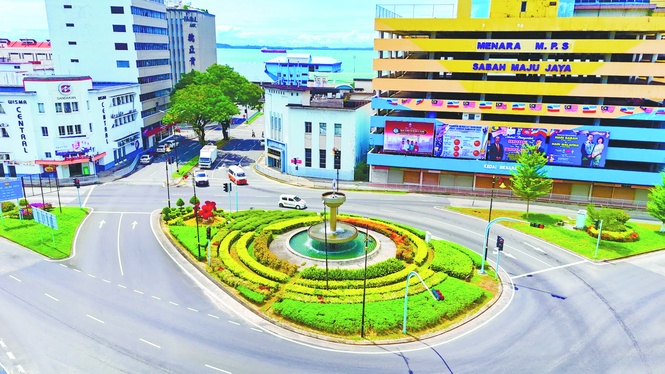
Sandakan is increasingly being treated as a town capable of real renewal, not just one in need of upkeep.
SANDAKAN’S revival is still a work in progress, but for the first time in years, the coastal town feels like it’s moving forward rather than sliding back.
Once known affectionately as “Little Hong Kong” for its ?bustling harbourfront, Sandakan spent decades losing ground through empty shoplots, ageing infrastructure and long-running gripes over drainage, lighting and traffic.
That trajectory now appears to be shifting, not through a single dramatic overhaul, but through a steadier change in municipal priorities.
Much of that shift traces back to Sandakan Municipal Council (MPS) president Datuk Walter Kenson, who has pushed for leaner municipal operations, quicker business licensing, upgraded facilities and closer inter-agency coordination.
What sets his tenure apart isn’t one flagship project but a broader mindset change. Sandakan is increasingly being treated as a town capable of real renewal, not just one in need of upkeep.
Central to that shift has been an unwillingness to let neglect become the default, in which a blocked drain, broken street light or a shuttered store is no longer treated as just part of the scenery.
MPS has stepped up cleanliness efforts, back-lane maintenance and old-town restoration, on the reasoning that a town must show it can manage its basics before investors take it seriously.
Cosmetic improvements alone won’t fill empty shoplots, though. At an MPS public meeting in August, property owners were nudged toward more realistic rents, on the logic that a vacant unit at a high asking price generates less value than an occupied one at a workable rate, a shift already drawing entrepreneurs, jobs and foot traffic back to the old town centre.
Dr Ganesan Kumarasamy, honorary secretary of the Sabah Indian Chamber of Commerce, welcomed the shift, calling the rental-sustainability dialogue and licensing reforms concrete steps that directly affect the ability of members to invest and hire, after years of bureaucratic uncertainty discouraging small enterprises.
He said if MPS sustains this consultative approach, the old town could see a genuine revival in commercial activity.
Making Sandakan simpler to do business in remains a quieter priority. Predictable procedures and shorter turnaround times send their own signal as businesses remember how they are treated, and avoidable ?delays risk pushing investment elsewhere.
Everyday frustrations persist too, notably around parking and a town centre that goes quiet after dark. MPS is developing a new parking management system meant to improve turnover and access rather than simply collect fees, while plans for night markets, longer operating hours and better-lit public spaces aim to build an evening economy.
The “Little Hong Kong” nickname carries emotional weight, but nostalgia won’t rebuild a town on its own. The goal is to recover what once made it vibrant with commerce, movement and entrepreneurship, while adapting to present-day realities.
The town’s Historical Tree Trail sets an example, recognised by the Malaysia Book of Records in June 2025 as the country’s first tree trail of its kind. The project, an effort involving MPS, heritage advocates and the Sabah Forestry Department, shows how heritage assets can double as economic drivers.
Sandakan’s turnaround isn’t down to any one leader. Progress will depend on funding and backing from the Sabah government, alongside elected reps channelling government resources for community needs. As Ganesan put it, reviving a town takes coordinated effort, state support, municipal execution and private-sector risk-taking.
Challenges remain, including public transport, long-term drainage fixes, an underused waterfront and lingering social issues. But something has shifted, perhaps most of all in how people talk about the town’s prospects.
Sandakan has a shot at becoming more than a fond memory, a place the next generation chooses to stay, invest in and build a future.