
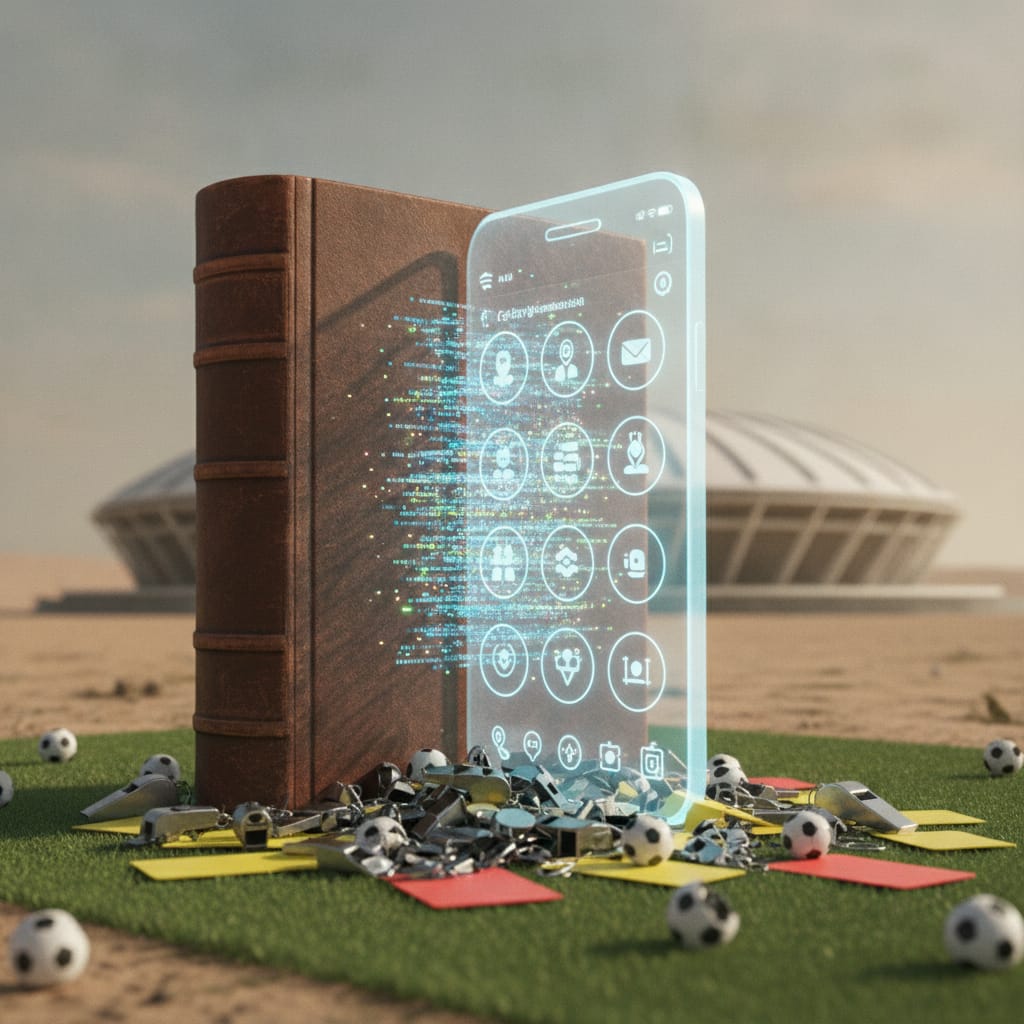
Editorial Note: This content is satirical and opinion-based, reflecting the author’s personal views. It is not intended to defame, insult, or target any individual, group, or institution, and may contain humor or exaggeration for entertainment purposes.
SATIRE: There was a time when football fans believed the Laws of the Game were sacred. Referees made mistakes, disciplinary panels debated evidence, and suspensions were served whether you were a Sunday league striker or the biggest superstar on the planet.
Now, according to the latest rumours circulating through the fictional universe of this article, all that is apparently required is a well-timed phone call, a famous friend, and enough confidence to behave as though the rule book is merely a set of “helpful suggestions.”
Welcome to modern football—where VAR checks your toenail for offside but political influence can allegedly travel faster than a through ball.
To be absolutely clear, this is satire. Unfortunately, satire is increasingly struggling to keep up with reality.
If football’s governing body ever allowed political leaders to influence disciplinary decisions, it would represent one of the greatest betrayals of sporting integrity since someone decided the Nations League was a good idea.
Football works because the rules are supposed to apply equally.
The referee doesn’t ask whether your country’s GDP is larger than the opposition’s before producing a red card.
The disciplinary committee doesn’t usually ask whether the player has a powerful friend.
The World Cup isn’t supposed to become an extension of international diplomacy where suspensions are negotiated like trade agreements.
Imagine explaining this to a ten-year-old.
“Sorry, Timmy. You can’t play in Saturday’s cup final because you were sent off.”
“But what if my dad knows someone important?”
“Then apparently we’re entering advanced constitutional law.”
This fictional version of FIFA resembles less an international sporting organisation and more the customer service department of an airline.
“I’m sorry, sir, your player is suspended.”
“I’d like to speak to your manager.”
“Oh… certainly.”
Five minutes later the suspension has vanished, everyone smiles for photographs and somewhere a football historian quietly faints into his coffee.
Even worse would be the precedent.
If one influential politician can supposedly make a phone call, why stop there?
Perhaps world leaders could start selecting referees.
Maybe billionaire owners could decide added time.
Perhaps yellow cards could be available as downloadable content.
“We’re pleased to announce our new FIFA Premium Membership. Platinum subscribers receive one overturned suspension every tournament.”
At this point EA Sports would reject the idea for being unrealistic.
The saddest part isn’t even the hypothetical decision itself.
It’s what it would tell every supporter watching.
Football has spent decades telling us that fair play matters.
Grassroots volunteers spend every weekend teaching children to respect referees, accept punishment and play by the rules.
Then imagine discovering the actual lesson is:
“The rules are important… unless someone important doesn’t like them.”
That isn’t football.
That’s theatre.
And not even good theatre.
More like a pantomime where the villain keeps rewriting Act Three because he doesn’t like the ending.
Any FIFA president, fictional or otherwise, has one responsibility above almost everything else:
Protect the integrity of competition.
Not television ratings.
Not political relationships.
Not VIP photo opportunities.
Not personal friendships.
The competition.
Once supporters begin believing results and disciplinary decisions are influenced by politics rather than independent processes, every decision becomes suspect.
Every red card becomes controversial.
Every appeal becomes conspiracy.
Every tournament becomes less about football and more about who has the strongest address book.
Trust, once lost, is almost impossible to rebuild.
Football’s greatest asset isn’t television money.
It isn’t sponsorship.
It isn’t billion-pound broadcasting contracts.
It’s credibility.
Fans must believe that when twenty-two players walk onto a pitch, everyone is playing under exactly the same rules.
Destroy that belief and you don’t simply damage a tournament.
You damage the sport itself.
That is why governing bodies must not merely be independent.
They must also be seen to be independent.
Justice doesn’t simply have to be done.
It has to be visible.
Otherwise every future disciplinary decision comes with an invisible asterisk.
Did the evidence matter?
Or did someone make a phone call?
This fictional crisis also raises another question.
Why do football administrators keep acting surprised when supporters lose faith?
Fans aren’t asking for perfection.
VAR proves perfection is impossible.
They’re asking for consistency.
They’re asking for transparency.
They’re asking for administrators who remember they are custodians of the game, not celebrities orbiting political power.
Football belongs to supporters.
It belongs to children kicking a ball in the park.
It belongs to volunteers marking muddy pitches at seven in the morning.
It belongs to grandparents who have followed the same club for sixty years.
It does not belong to presidents, politicians, billionaires or executives who mistake themselves for the main attraction.
Administrators are supposed to protect football.
Not become the story.
If they ever fail that test, they shouldn’t need public campaigns demanding accountability.
They should recognise the damage done and step aside.
Because no individual is bigger than the World Cup.
No politician is bigger than the game.
And certainly no football administrator should ever become more important than the principles they were elected to defend.
Until then, supporters can only hope that the next edition of the FIFA Laws of the Game doesn’t include Rule 37:
“All suspensions remain subject to availability, executive discretion and whether anyone famous has your number.”
Now that would deserve a straight red.
The Daily Durian (zaynp100@yahoo.com) is a content creator under the Newswav Creator programme, where you get to express yourself, be a citizen journalist, and at the same time monetize your content & reach millions of users on Newswav. Log in to creator.newswav.com and become a Newswav Creator now!
The User Content (as defined on Newswav Terms of Use) above including the views expressed and media (pictures, videos, citations etc) were submitted & posted by the author. Newswav is solely an aggregation platform that hosts the User Content. If you have any questions about the content, copyright or other issues of the work, please contact creator@newswav.com.