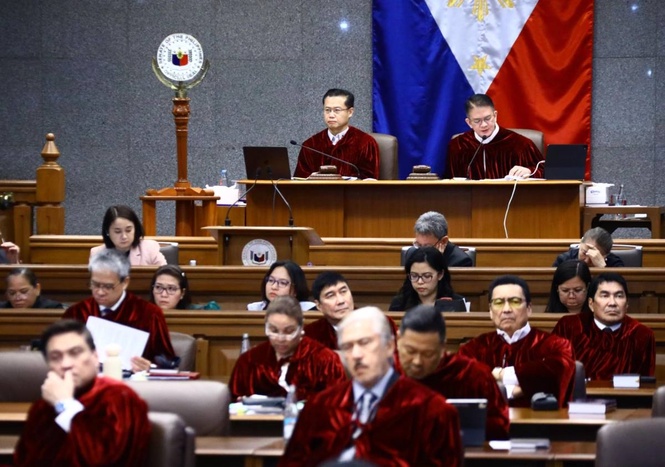
THE Supreme Court on Wednesday dismissed three separate petitions challenging the Senate impeachment court’s interpretation of the constitutional requirement for a two-thirds vote to convict in an impeachment case.
The petitions were filed by Victor Rodriguez, Berteni Cataluña Causing and Ernesto Francisco Jr., who separately questioned the Senate tribunal’s Sept. 23 ruling on how the required two-thirds vote should be counted.
The Senate impeachment court had ruled that the phrase “all the members of the Senate” under Article XI, Section 3(6) of the Constitution refers only to senators who are legally and actually able to participate in the impeachment proceedings at the time of the vote.
Rodriguez argued that the Senate tribunal effectively amended the Constitution by adding a qualification not found in the constitutional text. He asked the Supreme Court to nullify the ruling and temporarily restrain its implementation.
Causing, meanwhile, argued that senators who remain in office should still be counted even if they are in hiding, detained or medically unable to attend the proceedings. He also sought orders stopping any final vote on Vice President Sara Duterte’s conviction while his case was pending.
Francisco similarly maintained that because the Constitution provides for a 24-member Senate, conviction requires the concurrence of at least 16 senator-judges. He argued that senators who are detained, on medical leave or temporarily absent remain members of the Senate and should therefore be included in the count.
The Supreme Court, however, dismissed all three petitions on procedural grounds, including lack of standing and prematurity.
A spokesman for the impeachment court said the Supreme Court’s dismissal of the petitions removed a legal challenge that could have disrupted the impeachment trial of Duterte.
In a statement, impeachment court spokesman Reginald Tongol said the Supreme Court en banc’s dismissal of the separate petitions affirmed the authority of the senator-judges to interpret and apply their rules in carrying out its constitutional mandate.
He said the dismissal also reinforces the independence of the Senate when sitting as an impeachment court and prevents the trial from being stalled by what he characterized as premature judicial challenges.
“By junking these challenges, the Highest Court has drawn a definitive firewall around the independence of the Senate as an impeachment court, confirming that its proceedings cannot be held hostage by premature judicial meddling or collateral litigation,” he said.
Tongol said the tribunal would proceed with its constitutional duty to try and decide the impeachment case “without unnecessary stalling or external distractions.”
Deep dive into VP’s finances
The Senate impeachment court is expected to delve deeper into Duterte’s financial records on Thursday as it resumes proceedings on the unexplained wealth charge.
Two Davao land officials and an Anti-Money Laundering Council (AMLC) executive are set to testify on property and financial records at the Senate impeachment trial of Vice President Duterte, as prosecutors build their case on allegations of unexplained wealth.
The court canceled Wednesday’s scheduled hearing to give the prosecution and defense a “strategic procedural pause” before a series of whole-day sessions. The trial resumes today, Oct. 1, under a calendar that provides for extended proceedings through Oct. 2 and again from Oct. 5 to 9 and Oct. 12 to 15.
Davao City register of deeds Kathy Florence Baldonado and Samal deputy register of deeds Marco Pineda have been subpoenaed to testify on land records involving properties registered to Duterte’s husband, lawyer Manases Carpio.
AMLC Secretariat Executive Director Ronel Buenaventura is also in the prosecution’s witness lineup and is expected to testify on financial records relevant to Article II of the impeachment complaint, which covers allegations of unexplained wealth.
House lead prosecutor Gerville Luistro earlier said the prosecution is preparing voluminous bank records submitted by about 10 banks in compliance with subpoenas issued by the impeachment court.
Bank representatives may be called to identify and authenticate the records unless the defense agrees to stipulate to their authenticity, Luistro said.
The financial inquiry comes after the impeachment court last week made available to the prosecution bank and tax records involving Duterte, her husband Manases Carpio and their companies. The prosecution had described the records as a major component of its evidence for Article II. More than 1,800 bank, insurance and other financial documents had been marked in preparation for the wealth-related proceedings.
Also potentially in Thursday’s proceedings are Davao City register of deeds IV Kathy Florence Baldonado and Samal deputy register of deeds III Marco Pineda, who were subpoenaed to testify and produce property records involving Carpio. Their subpoenas cover Sept. 30 to Oct. 2, although the cancellation of Wednesday’s session could affect the precise order of their appearance.
The court’s handling of the financial evidence will also determine when former senator Antonio Trillanes IV can take the witness stand.
The prosecution had sought to present Trillanes in connection with Article II, but Presiding Officer Francis Escudero said the court would first require the presentation of the AMLC witness, bank officials or relevant bank records before deciding on his subpoena. Trillanes may still testify voluntarily, with the court retaining the option to revisit the subpoena issue later.
The sequencing is significant because the court has been trying to establish the documentary and institutional basis for the allegations before moving to testimony that could interpret or connect the financial transactions to Duterte and her family.
Tuesday’s proceedings already provided a preview of the next phase. Davao City Mayor Sebastian Duterte testified as a hostile witness over government contracts involving GenCorp Industries Inc., a company Duterte identified as a business interest in her 2024 and 2025 statements of assets, liabilities and net worth. The prosecution questioned him about contracts awarded by the Davao City government to the firm.
The court, however, rejected the prosecution’s request seeking to have Duterte admit ownership of bank accounts covered by subpoenaed records, ruling that compelling such admissions would implicate her constitutional right against self-incrimination. The ruling leaves the prosecution to establish the evidentiary significance and provenance of the financial records through other witnesses and documents.
The expected financial testimony also comes after the court’s Sept. 23 ruling that the two-thirds conviction requirement would be calculated based on the senator-judges participating in the proceedings. With four of the 24 senators unable to participate, the threshold is currently 14 votes rather than 16.
For Thursday, therefore, the central questions are likely to be less about the presentation of another high-profile personality and more about what the AMLC, bank records and property documents can establish independently — and how those records will be connected to the allegations under Article II.
The court has tentatively allotted whole-day sessions for the coming two weeks, with the impeachment proceedings expected to give way to the Senate’s 2027 budget deliberations afterward. The tentative schedule calls for the trial to resume Nov. 9 and 16, before regular proceedings return on Nov. 23.
The House prosecution panel is ready to resume presenting witnesses and financial records after a one-day procedural pause, prosecutor and Bicol Saro Party-list Rep. Terry Ridon said on Wednesday.
The Senate impeachment court canceled its Sept. 30 hearing ahead of whole-day hearings beginning Thursday.
Ridon said the pause did not delay the prosecution’s preparations.