
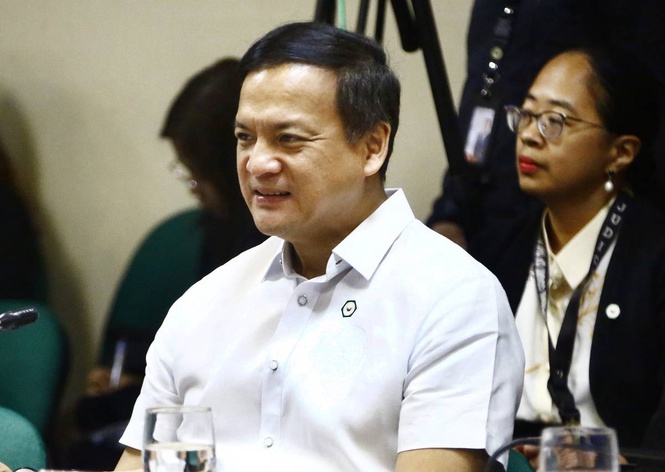
SUPREME Court Associate Justice Jose Midas Marquez has vowed to eliminate overburdened courts by 2032 by sustaining judicial reforms, accelerating digitalization and speeding up case resolution if appointed the country’s next chief justice.
Presenting his vision before the Judicial and Bar Council (JBC), Marquez proposed a five-year reform program, the Strategic Plan for Judicial Innovations 2.0 (SPJI 2.0), covering 2028 to 2032 and building on reforms initiated under Chief Justice Alexander Gesmundo.
“My goal is not to begin anew, but to sustain and strengthen transformative reforms already underway,” Marquez said, stressing the need to institutionalize successful initiatives while addressing persistent weaknesses in the judicial system.
Marquez cited his more than three decades of experience at the Supreme Court, where he started as an executive assistant in 1991 while studying law at Ateneo de Manila University.
He later served as chief of staff to former Chief Justice Reynato Puno, Supreme Court spokesman and Court Administrator for nearly 12 years before becoming an associate justice in November 2021.
Having worked under at least nine chief justices and alongside justices, judges and court personnel nationwide, Marquez said his experience has given him a deep understanding of the judiciary’s operations and challenges.
He entered the race after accepting endorsements from the Association of Retired Regional Trial Court Judges of the Philippines and retired Supreme Court Associate Justice Arturo Brion, who cited his work ethic, integrity and extensive judicial administration experience.
Marquez, however, cautioned against treating seniority as an automatic qualification for the top post.
“Length of service is not by itself the qualification,” he told the JBC, adding that what mattered was what his years in the institution had taught him and how he would use that experience.
At the heart of his proposed reform agenda is the development of judicial personnel, whom he described as the judiciary’s most important asset.
He pledged stronger training and leadership programs, employee wellness initiatives, and the development of ethical, competent future judicial leaders.
To address mounting caseloads, Marquez proposed nationwide docket studies to identify the causes of delays, determine which cases take the longest to resolve, and pinpoint courts suffering from severe congestion.
He also called for specialized judicial training and the establishment of additional courts where caseloads justify them.
“By 2032, we should no longer have overburdened courts,” he said.
Marquez also vowed to advance digitalization by sustaining the eCourt PH system and digitizing court records.
He proposed artificial intelligence-assisted information portals and helpdesk chatbots to provide litigants and other court users with faster assistance, alongside the prompt online publication of decisions and resolutions after promulgation.
He suggested allowing persons deprived of liberty to help digitize non-sensitive court records in exchange for a stipend, providing opportunities for rehabilitation and reintegration into society while supporting the Judiciary’s modernization efforts.
He also pushed for stronger fiscal autonomy under Republic Act 12233, or the Judiciary Fiscal Autonomy Act, including a review of court staffing patterns and personnel benefits.
His agenda further covers revisions to the Rules of Court scheduled to take effect in June 2027, stronger integrity investigations, enhanced judicial security, and improvements to the JBC.
To expand professional development, Marquez proposed establishing judicial training centers in Visayas and Mindanao and amending the Philippine Judicial Academy’s charter to allow it to confer degrees and certificates in judicial leadership, law and public administration.
He acknowledged that his proposals were initial ideas that could be refined through stakeholder consultation.
Marquez also expressed confidence in the other four Supreme Court aspirants, saying he hoped all five justices seeking the post would make the JBC shortlist.
The other candidates are Senior Associate Justice Marvic M.V.F. Leonen and Associate Justices Alfredo Benjamin Caguioa, Rodil Zalameda and Japar Dimaampao.
The council is screening candidates to succeed Gesmundo, who will retire upon reaching the mandatory retirement age of 70 on Nov. 6.
The JBC will submit a shortlist to President Ferdinand Marcos Jr., who will appoint the next chief justice.