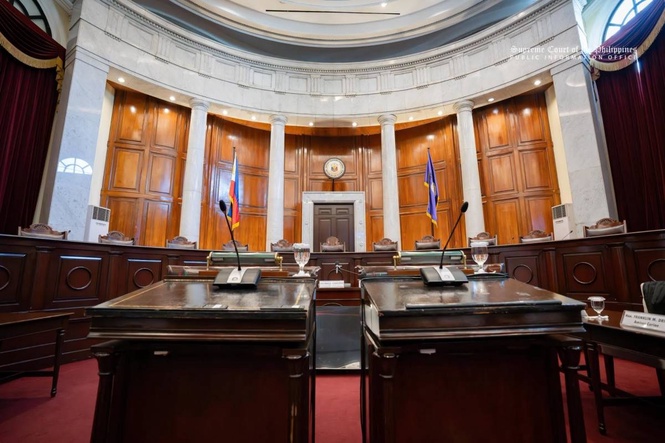
THE Supreme Court has clarified that unprogrammed appropriations are not illegal as long as they comply with specific conditions.
The high court said that unprogrammed appropriations “are not unconstitutional per se as long as they comply with specific conditions.”
In its ruling in the case Lagman v Congress, the tribunal said it provided “guardrails to ensure these do not become a means of bypassing constitutional limits on public spending.” It stressed that Congress cannot increase the total appropriations proposed by the president, whether programmed or unprogrammed, reinforcing constitutional restrictions on the legislature’s power over the national budget.
“In this case, Congress violated the Constitution when it increased the total appropriations submitted by the President,” it said in a statement.
However, the court said the doctrine of operative fact applies on good-faith projects already implemented and can no longer be reversed.
“Applying this doctrine, irreversible programs under the 2024 and 2025 GAAs.whose beneficiaries acted in good faith, are valid,” the tribunal said.
The Court also upheld the president’s certification of urgency for House Bill 8980, which became the 2024 national budget. It said that the President has the prerogative to determine whether a public calamity or emergency warrants such certification, while Congress retains discretion on how to act on it.
Unprogrammed appropriations have been included in national budgets since 1987. They serve as standby funds that may be released when specified conditions are met, including when government revenues exceed projections or financing becomes available for foreign-assisted projects.
But the court stressed that these funds must remain subject to strict safeguards and cannot be used to bypass constitutional restrictions on government spending.
The decision sets clearer limits on Congress’ authority to alter the President’s proposed budget while defining the conditions under which standby appropriations may be released.
Camille Sue Mae Ting, the court’s spokesman, said that the government 15 days to appeal the ruling.
The Office of the Solicitor General (OSG) said it will seek clarification on the limits and “guardrails” set by the Supreme Court amid concerns over the execution of projects under the 2026 national budget.
Solicitor General Darlene Marie Berberabe said the OSG will appeal for a review of certain parts of the court’s decision.
“Now, there is something that the president, in particular, wants to clarify because the execution of the budget will be affected,” Berberabe said in a press briefing.
She said the OSG agrees that guardrails are important to ensure transparency, accountability, and the prudent use of public funds.
“Nevertheless, the challenge lies in determining which of these guardrails are mandated by the Constitution and which should be left to Congress and the Executive branch in accordance with the powers granted by the Constitution itself,” Berberabe said.
“The OSG will respectfully request clarification to ensure that the limits and standards set in the decision conform to the separation of these powers under the Constitution,” she said in Filipino.
Berberabe said the budget phases or processes vary. “The responsibility of the executive branch is to propose and execute; Congress, on the other hand, passes the GAA (General Appropriations Act) or passes the law.” “Right now, we are in the execution stage, so the responsibility lies with the executive. So, we just want to comply with their decision, but it needs to be clear,” she added.
Berberabe said she has advised the Department of Budget and Management and the executive branch to hold off temporarily the release of the budget, “since it is expected that a decision will be made on this [matter] immediately.” She noted that the 12 separate opinions attached to the decision showed “how complex the constitutional issues presented to the Court are, as well as the varying views of the justices in resolving them.” The OSG is carefully studying these opinions in deciding its next steps, Berberabe said.