

Researchers have found a new kind of deep-sea “spaghetti worms” with suction cups on their bodies in the Indian Ocean, shedding more light on undiscovered marine species.
The genus has been named Terebellosuctoria for the unusual sucker-like structures on the underside of the body.
They are the latest addition to the polychaetes, a class of marine worms with segmented bodies and appendages with multiple bristles resembling centipedes.
While finding new deep-sea species isn’t uncommon, establishing an entirely new genus, a biological classification of multiple related species, is rare.
“The sucker-like structure is what makes this genus so interesting and unique,” said Elena Kupriyanova, author of a study detailing the new discovery in Records of the Australian Museum.
The worms were first discovered during voyages led by Museums Victoria onboard the research vessel Investigator in 2021 and 2022.
Researchers collected over 850 worms during expeditions to the seamounts of Christmas Island and the Cocos Islands in the Indian Ocean and found 13 species new to science.
“An expedition may collect hundreds or thousands of specimens but discovering what they actually are can take years,” Dr Kupriyanova said.
The new study details seven species of marine worms from three families, two of them from the new genus Terebellosuctoria.
One of the species was collected from a seamount about 670m underwater near the Cocos Islands.
It stood out with its numerous branching brown “tentacles” when specimens were brought up by a beam trawl.
“Spaghetti worms”, so called because of their numerous long tentacles, build tubes in soft sediments to collect fine food particles.
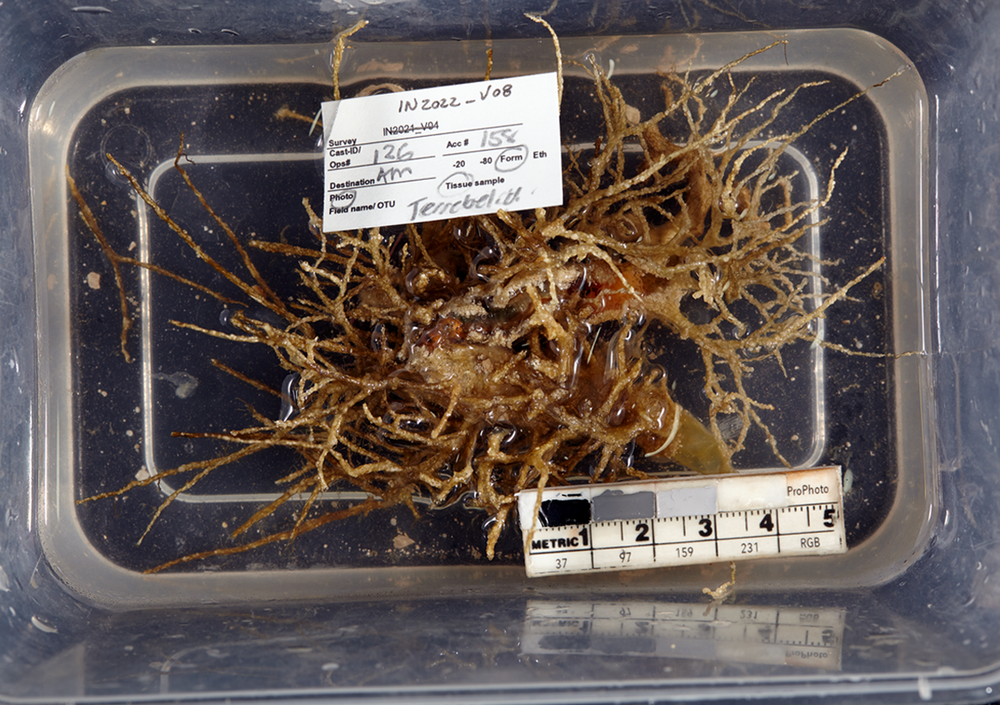
Researchers found bright orange marine worms, some up to 75mm long, emerging from these tubes.
They named one of the species Terebellosuctoria jimii, in honour of Naoto Jimi, a scientist who had earlier described similar sucker-like structures on another marine worm species.
Marine worms are among the most diverse creatures on the planet, with the largest species growing up to 3m long.
Their sucker-like structures could be an adaptation among sediment-dependent taxa to live attached in sediment-scarce environments, such as seamount slopes, scientists say.
“But marine worms, like many marine invertebrates, are unseen and underappreciated. Only a tiny fraction has been officially named and described,” said marine worm expert Pat Hutchings, a senior fellow at the Australian Museum, said.
Read MoreNow it's Typhoon Nolo after Pacific hurricane crosses the international dateline
A 1960 study predicted the world will end next month. Here’s why