
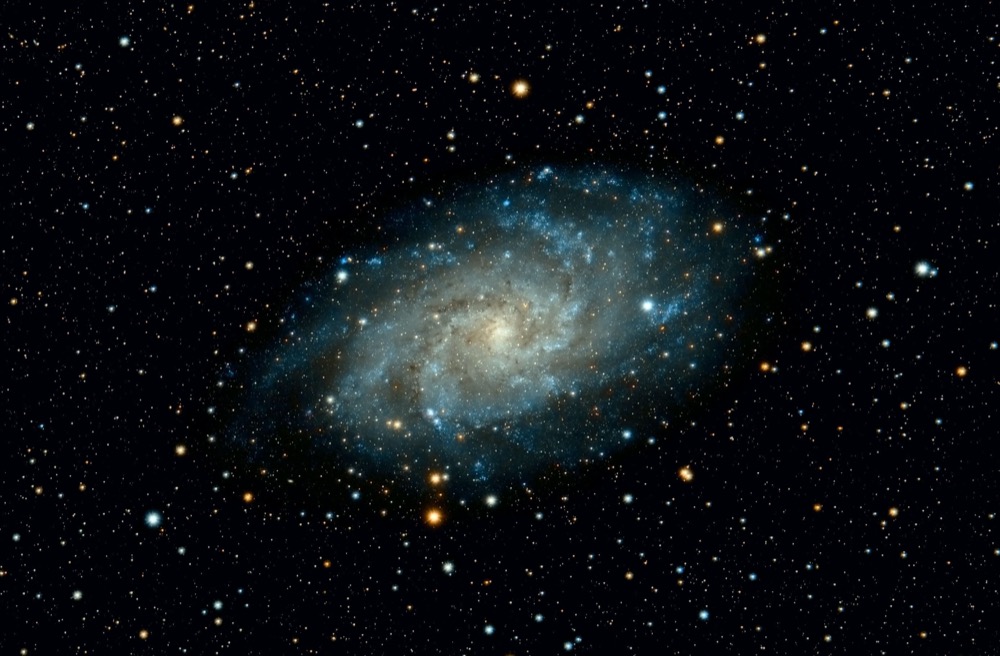
A team of astronomers has identified 77 previously unknown heavily reddened quasars, objects hidden behind dense dust despite being among the brightest sources in the universe. Quasars are powered by supermassive black holes located at the centers of galaxies.
As matter falls inward, enormous amounts of energy are released, making these objects visible across vast cosmic distances. Dust, though, can obscure part of that radiation and leave entire populations difficult to detect.
The newly identified objects belong to a category known as heavily reddened quasars (HRQs), whose light is strongly altered by intervening dust. Studying them allows astronomers to examine stages of black hole activity that are not easily visible in more familiar quasar populations.
Dozens of Hidden Objects Found
Using infrared measurements and spectrophotometric observations from NASA’s SPHEREx, researchers led by Matthew Stepney of the Center of Excellence in Astrophysics and Related Technologies in Chile expanded the known population of heavily reddened quasars.
According to the study, avaliable on arXiv, the team discovered 77 new dust-obscured quasars, more than doubling the number previously identified.
These objects existed when the universe was between 1.6 billion and 4.3 billion years old. Among them were seven HRQs detected at redshifts above 3, marking the first examples of this class identified within the universe’s first 2.1 billion years. The result extends observations of black hole growth into earlier periods of cosmic history while focusing on systems that had remained largely hidden.
Unexpected Pattern Found Among Quasars
To interpret the characteristics of the new sample, the researchers compared heavily reddened quasars with two well-known categories. The first was Hot Dust-Obscured Galaxies (Hot DOGs), some of the most hidden objects ever observed, where most of the light comes from extremely hot dust.
The second group included blue quasars, more exposed systems whose surrounding dust still glows brightly in infrared light. As reported in the paper, heavily reddened quasars seem to sit somewhere between these two groups when it comes to how much dust hides them.
But one result surprised the researchers: even though HRQs are still dust-covered, they showed less hot dust than the blue one, which are supposed to be more exposed. That was not what the team expected based on how bright and dusty these objects appear.
Data Point to Dust Dispersal
After correcting for the effects of dust blocking the light, the researchers found that these newly identified quasars were actually among the brightest ever observed.
At the same time, they noticed something unusual: the quasars produced weaker infrared signals than expected from the dusty material surrounding their central black holes.
The team explained that this combination may reveal a short but dramatic stage known as the “blow-out” phase, a moment when the black hole becomes so active that it begins pushing gas and dust away from the galaxy’s core.
“This combination of depleted torus-scale dust reservoirs and higher luminosities compared to Hot DOGs and blue quasars supports a scenario in which HRQs represent a blow-out phase when strong feedback has begun to clear the central regions of obscuring material,” as the authors explained.
The researchers also spotted another interesting observation: around three-quarters of the quasars showed extra ultraviolet light. They suggest this glow could come from quasar radiation escaping around the edges of the dusty cocoon, although ongoing star formation inside the host galaxy may also play an important role, and in some cases could even be the main source.
Enjoyed this article? Subscribe to our free newsletter for engaging stories, exclusive content, and the latest news.